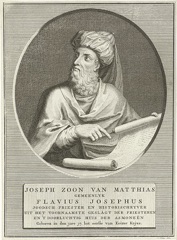
Flavius Josephus
c. 37–c. 100 · Jewish priest, general and historian whose Jewish War and Jewish Antiquities are major sources for Judea in the first century.
Josephus was born Yosef ben Mattityahu in Jerusalem around AD 37, to a father of priestly descent and a mother who claimed royal Hasmonean ancestry. He received a thorough education and visited Rome as a young man. When the Jewish revolt against Rome broke out in 66, he became a commander of Jewish forces in Galilee. In 67 the town of Yodfat (Jotapata), which he defended, fell to the Roman army of Vespasian after a siege of about six weeks, and Josephus surrendered. He claimed that he had predicted that Vespasian would become emperor, and when this came true in 69 he was freed. He took the family name Flavius from his patron and accompanied Titus, Vespasian's son, at the siege and destruction of Jerusalem in 70. He then lived in Rome on an imperial pension and wrote in Greek: The Jewish War, an account of the revolt, and the Jewish Antiquities, a history of the Jewish people from the creation onward, as well as an autobiography and Against Apion. He died around 100.
Flavius Josephus is also an author in the library: author page and works.
Faith: A Jew who went to Rome in 64 to seek the release of imprisoned Jewish priests who were his friends. Source: Catholic Encyclopedia (1913)

Key dates
- c. 37 Born in Jerusalem
- 66 Jewish revolt begins; commands in Galilee
- 67 Surrenders to Vespasian after the siege of Yodfat
- 70 Witnesses the destruction of Jerusalem
- c. 75 The Jewish War completed
- c. 94 Jewish Antiquities completed
- c. 100 Dies in Rome
Read about them
Grades 9–12
- Jewish Antiquities · In the library
- The Jewish War · In the library
More lives
Aeschylus · Aesop · Apollodorus · Apollonius of Rhodes · Apuleius · Aristophanes
Notes: His dates are approximate.