George Berkeley
1685–1753 · Irish philosopher and Anglican bishop, known for the idea that to be is to be perceived.
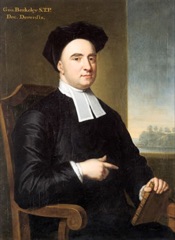
George Berkeley was born in 1685 near Kilkenny, Ireland, and studied at Trinity College Dublin, where he became a fellow and teacher. While still in his twenties he published An Essay towards a New Theory of Vision (1709) and A Treatise Concerning the Principles of Human Knowledge (1710), in which he argued that material objects exist only as they are perceived by minds, summed up in the phrase esse est percipi, 'to be is to be perceived'. Things continue to exist when no human sees them, he argued, because they are always perceived by God. His Three Dialogues between Hylas and Philonous (1713) presented these ideas in conversation. Berkeley traveled in Europe and hoped to found a college in Bermuda to educate colonists and Native Americans; he lived for three years in Rhode Island while waiting for promised funds that never came. In 1734 he became Anglican bishop of Cloyne in Ireland. He also wrote on mathematics and promoted tar-water as a medicine. He died in Oxford in 1753. The city of Berkeley, California, is named after him.
George Berkeley is also an author in the library: author page and works.
Faith: Anglican Bishop of Cloyne who wrote Alciphron, a work of Christian apologetics against the free-thinkers. Source: Stanford Encyclopedia of Philosophy
Key dates
- 1685 Born near Kilkenny, Ireland
- 1709 New Theory of Vision
- 1710 Principles of Human Knowledge
- 1729–1731 Lives in Rhode Island
- 1734 Becomes bishop of Cloyne
- 1753 Dies in Oxford
Watch


Videos load from YouTube in privacy-enhanced mode only when you press play.
Read about them
Grades 9–12
- A Treatise Concerning the Principles of Human Knowledge · In the library
More lives
Richard Allen · Cesare Beccaria · Edmund Burke · Denis Diderot · Jonathan Edwards · David Hume