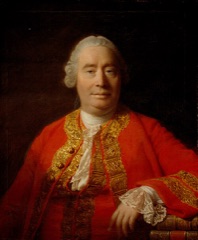
David Hume
1711–1776 · Scottish philosopher and historian, a leading skeptic of the Enlightenment.
David Hume was born in Edinburgh and grew up at his family's estate in the Scottish Borders. He entered the University of Edinburgh at about ten or twelve, tried law and business, and then devoted himself to philosophy. His Treatise of Human Nature, written in France and published in 1739 and 1740, fell, he said, dead-born from the press, so he recast its ideas in shorter, clearer books. Hume argued that all our ideas come from experience, that we never observe causes directly but only one event regularly following another, and that our belief that the future will resemble the past rests on habit, not proof. He argued that reason alone cannot move us to act; feelings and desires do. His skeptical writing on miracles and religion led to his being refused professorships at Edinburgh and Glasgow, and he was widely considered an unbeliever. He became famous for his six-volume History of England and his essays on politics and economics. He served as a diplomat in Paris. Cheerful and sociable, he was a close friend of Adam Smith. He died in Edinburgh in 1776.
David Hume is also an author in the library: author page and works.
Faith: Known in his own century as a sceptical and atheistic thinker, though these labels are disputed. Source: Stanford Encyclopedia of Philosophy
Further reading
- Hume: A Very Short Introduction by James A. Harris (Oxford University Press, 2021), ISBN 9780198849780
Key dates
- 1711 Born in Edinburgh
- 1739–40 A Treatise of Human Nature
- 1748 An Enquiry Concerning Human Understanding
- 1754–1762 History of England
- 1776 Dies in Edinburgh
Watch


Videos load from YouTube in privacy-enhanced mode only when you press play.
In their words
“A wise man, therefore, proportions his belief to the evidence”
“Custom, then, is the great guide of human life”
Read about them
Grades 9–12
- An Enquiry Concerning Human Understanding · In the library
- Essays, Moral and Political (selection) · In the library
- Dialogues Concerning Natural Religion · In the library
- A Treatise of Human Nature · In the library
More lives
Cesare Beccaria · George Berkeley · Edmund Burke · Denis Diderot · Jonathan Edwards · Immanuel Kant