Homer
c. 8th century BC (traditional) · Ancient Greek poet to whom tradition credits the Iliad and the Odyssey.
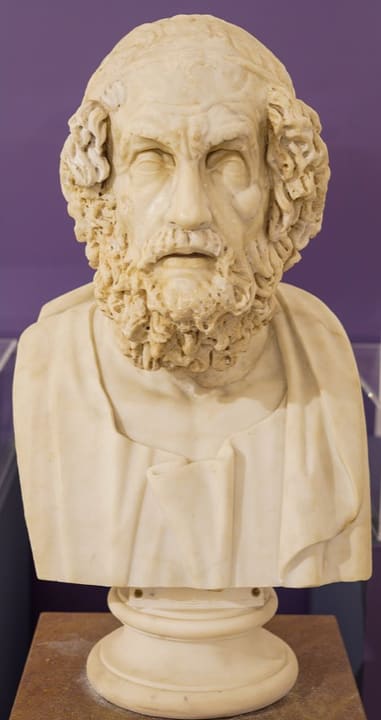
Homer is the name the ancient Greeks gave to the poet of the Iliad and the Odyssey, the two great epic poems at the start of Western literature. Almost nothing is known about him for certain. Ancient traditions describe him as a blind singer and offer several possible birthplaces, including Smyrna and the island of Chios in Ionia, on the coast of Asia Minor. Most modern scholars think the poems took their present form around the eighth or seventh century BC, growing out of a long tradition of oral poetry composed and performed by singers who used repeated phrases and episodes to build long stories. Whether one poet, two or many shaped the poems has long been debated, a puzzle known as the Homeric Question. The Iliad tells of the anger of Achilles during the Trojan War, and the Odyssey follows Odysseus on his ten-year journey home from Troy. The poems were recited at Greek festivals, studied in schools, and influenced later writers, including Virgil, Dante and James Joyce.
Homer is also an author in the library: author page and works.
Faith: Faith not well documented; almost nothing certain is known of his life. Source: Wikipedia
Further reading
- Homer: A Very Short Introduction by Barbara Graziosi (Oxford University Press, 2019)
Key dates
- c. 8th–7th century BC The Iliad and the Odyssey take shape
- 6th century BC Poems recited at the Panathenaic festival in Athens
- 3rd–2nd century BC Scholars in Alexandria edit the texts
Watch


Videos load from YouTube in privacy-enhanced mode only when you press play.
Read about them
Grades 9–12
- The Odyssey · In the library
- The Iliad · In the library
More lives
Aeschylus · Aesop · Apollodorus · Apollonius of Rhodes · Apuleius · Aristophanes
Notes: Homer's existence and dates are uncertain; scholars debate whether the poems had a single author.