John Maynard Keynes
1883–1946 · English economist whose General Theory changed how governments respond to recessions.
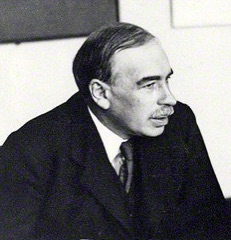
John Maynard Keynes was born in Cambridge, England, in 1883, the son of an economist and a mother who later became the city's mayor. He studied mathematics at King's College, Cambridge, where he became a fellow, and he worked at the India Office and later the Treasury. As a Treasury official at the Paris Peace Conference in 1919, he opposed the heavy reparations demanded of Germany and resigned; his book The Economic Consequences of the Peace made him famous. He was part of the Bloomsbury Group of writers and artists, married the Russian ballerina Lydia Lopokova, and was a successful investor. In The General Theory of Employment, Interest and Money (1936), written during the Great Depression, he argued that economies can remain stuck with high unemployment and that government spending can raise demand. His ideas, called Keynesian economics, shaped the policies of many governments for decades. During the Second World War he advised the British Treasury and helped design the Bretton Woods system of international finance. He died in Sussex in 1946.
John Maynard Keynes is also an author in the library: author page and works.
Faith: An agnostic all his life, according to Cambridge University. Source: Wikipedia
Further reading
- Keynes: A Very Short Introduction by Robert Skidelsky (Oxford University Press, 2010), ISBN 9780199591640

Key dates
- 1883 Born in Cambridge
- 1919 The Economic Consequences of the Peace
- 1925 Marries Lydia Lopokova
- 1936 The General Theory published
- 1944 Bretton Woods conference
- 1946 Dies in Sussex
Major works
- Indian Currency and Finance (1913) · His first book, drawn from his work at the India Office
- The Economic Consequences of the Peace (1919) · In the library
- A Treatise on Probability (1921) · His work on the logic of probability
- A Tract on Monetary Reform (1923) · Argues for stable prices over the prewar gold standard
- The End of Laissez-Faire (1926) · Essay on the limits of the free market
- A Treatise on Money (1930) · Two-volume study of money and the trade cycle
- The General Theory of Employment, Interest and Money (1936) · In the library
- How to Pay for the War (1940) · Proposed compulsory saving to finance the Second World War
In their words
“The power to become habituated to his surroundings is a marked characteristic of mankind.”
“There is no subtler, no surer means of overturning the existing basis of society than to debauch the currency.”
Read about them
Grades 9–12
- The Economic Consequences of the Peace · In the library
- The General Theory of Employment, Interest and Money · In the library
More lives
Hannah Arendt · Henri Bergson · W. E. B. Du Bois · John Buchan · Winston Churchill · Ariel Durant