John Wycliffe
c. 1328–1384 · Oxford theologian whose followers made the first complete English Bible.
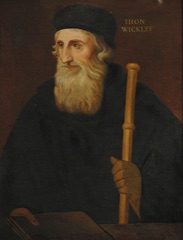
John Wycliffe was born in Yorkshire and spent most of his career at Oxford University, where he became a leading philosopher and theologian. He was also a parish priest at Lutterworth. In the 1370s he served the English government, arguing that the king had the right to limit the Church's wealth and that clergy who lived in sin forfeited their authority. He taught that the Bible was the supreme authority for Christians and that everyone should be able to read it, criticized the wealth of the clergy and the papacy, and rejected the doctrine of transubstantiation. Pope Gregory XI condemned some of his teachings in 1377, but he was protected by powerful friends. His followers began translating the whole Bible from Latin into English, completing the first full English Bible in the 1380s, copied by hand. He sent out poor preachers, later called Lollards. After the Peasants' Revolt of 1381 he lost support, but he was allowed to retire to Lutterworth, where he died after a stroke in 1384. In 1428 his bones were dug up and burned by order of the Church.
Faith: English priest and Oxford Doctor of Theology whose dissent made him a forerunner of the Protestant Reformation. Source: Catholic Encyclopedia (1913)

Key dates
- 1372 Doctor of theology at Oxford
- 1377 Teachings condemned by Gregory XI
- 1380s First complete English Bible by his followers
- 1384 Dies at Lutterworth
- 1415 Condemned at the Council of Constance
- 1428 His remains exhumed and burned
More lives
Anselm of Canterbury · Thomas Aquinas · Thomas Becket · Bede · Benedict of Nursia · Bernard of Clairvaux