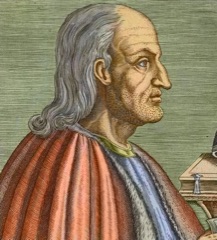
Anselm of Canterbury
c. 1033–1109 · Monk, archbishop and philosopher of faith seeking understanding.
Anselm was born in Aosta, in northern Italy. After quarreling with his father, he crossed the Alps and came to the abbey of Bec in Normandy to study with the famous teacher Lanfranc, and became a monk there in 1060. He was later prior and then abbot of Bec. Anselm described his work as faith seeking understanding: starting from belief, he tried to understand it by reason. In the Proslogion he set out what is now called the ontological argument, that God is that than which nothing greater can be conceived, and that such a being must exist in reality, not only in the mind. In Why God Became Man he explained the atonement as Christ making satisfaction for human sin. In 1093 he was made archbishop of Canterbury, reluctantly, by King William II. He quarreled with William and later Henry I over the rights of the Church, especially over who should invest bishops, and was twice exiled. He also opposed the slave trade in England at a council in 1102. He died in 1109.
Anselm of Canterbury is also an author in the library: author page and works.
Faith: Christian philosopher and theologian, Archbishop of Canterbury; venerated as Saint Anselm. Source: Stanford Encyclopedia of Philosophy
Further reading
- Anselm: A Very Short Introduction by Thomas Williams (Oxford University Press, 2022), ISBN 9780192897817

Key dates
- 1060 Becomes a monk at Bec
- 1078 Abbot of Bec; Proslogion
- 1093 Archbishop of Canterbury
- 1098 Why God Became Man
- 1109 Dies at Canterbury
Read about them
Grades 9–12
- Proslogion · In the library
More lives
Thomas Aquinas · Avicenna (Ibn Sina) · Bede · Bernard of Clairvaux · Boethius · Bonaventure