Thomas Aquinas
1225–1274 · Dominican friar and theologian who joined Aristotle's philosophy with Christian theology.
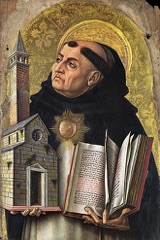
Thomas Aquinas was born into a noble family at Roccasecca, near Naples. His family sent him to the great Benedictine abbey of Monte Cassino, hoping he would become its abbot, but as a young man he chose instead to join the Dominicans, a new order of preaching friars. His brothers were so opposed that they held him captive at the family castle for about a year. Released, he studied in Paris and Cologne under Albert the Great. Quiet and heavily built, he was nicknamed the Dumb Ox by fellow students; Albert is said to have replied that this ox would one day bellow so loudly the world would hear. He taught at the University of Paris and in Italy, writing commentaries on Aristotle and on Scripture, the Summa contra Gentiles, and the vast Summa Theologica, which argues that faith and reason do not contradict each other. Late in 1273, after an experience during Mass, he stopped writing, saying all he had written seemed like straw. He died in 1274 and was declared a saint in 1323.
Thomas Aquinas is also an author in the library: author page and works.
Faith: Dominican priest and theologian who held the Dominican chair of theology in Paris. Source: Stanford Encyclopedia of Philosophy
Further reading
- Thomas Aquinas: A Very Short Introduction by Fergus Kerr (Oxford University Press, 2009), ISBN 9780199556649
Key dates
- 1225 Born at Roccasecca
- 1244 Joins the Dominicans
- 1256 Becomes master of theology in Paris
- 1265–1273 Writes the Summa Theologica
- 1274 Dies at Fossanova
- 1323 Canonized
Watch


Videos load from YouTube in privacy-enhanced mode only when you press play.
In their words
“grace does not destroy nature but perfects it”
Read about them
Grades 9–12
- Summa Theologica · In the library
- De Regno · In the library
More lives
Anselm of Canterbury · Avicenna (Ibn Sina) · Bede · Bernard of Clairvaux · Boethius · Bonaventure