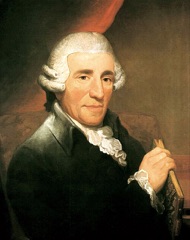
Joseph Haydn
1732–1809 · Austrian composer called the father of the symphony and the string quartet.
Franz Joseph Haydn was born in the village of Rohrau, Austria, the son of a wheelwright. At eight he became a choirboy at St. Stephen's Cathedral in Vienna, and when his voice broke he was dismissed and earned a meager living teaching and playing, while teaching himself composition. In 1761 he entered the service of the Esterházy princes, a wealthy Hungarian noble family, and worked for them for nearly thirty years, mostly at their remote palace of Eszterháza. With his own orchestra to write for, he experimented freely, and he composed more than a hundred symphonies and dozens of string quartets, giving both forms their classic shape. He became a friend of Mozart, whom he called the greatest composer he knew, and later taught the young Beethoven. After Prince Nikolaus died in 1790, Haydn traveled twice to London, where his twelve London Symphonies, including the Surprise Symphony, were enormously popular. Back in Vienna, he wrote the oratorios The Creation and The Seasons and the Emperor's Hymn, whose melody later became the German national anthem. He died in Vienna in 1809 while the city was occupied by Napoleon's army.
Faith: A Catholic composer who was deeply religious by temperament. Source: Catholic Encyclopedia (1913)

Key dates
- 1740 Choirboy at St. Stephen's, Vienna
- 1761 Enters the service of the Esterházy family
- 1791–1795 Two visits to London
- 1798 The Creation first performed
- 1809 Dies in Vienna
Fun facts
- Neither of his parents could read music, but his father had taught himself to play the harp. (Source: Joseph Haydn (Wikipedia))
More lives
Johann Sebastian Bach · William Blake · George Frideric Handel · Francis Hopkinson · Wolfgang Amadeus Mozart · Horace Walpole