William Blake
1757–1827 · English poet, painter and printmaker, author of Songs of Innocence and of Experience.
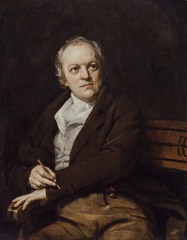
William Blake was born in London in 1757, the son of a hosier. He left school at ten, having learned to read and write, and as a child he described visions such as angels among the haystacks. At fourteen he was apprenticed to an engraver, and he later studied at the Royal Academy. He earned his living mainly as an engraver of book illustrations. In 1782 he married Catherine Boucher, who helped him with his work. Blake invented a method he called relief etching, which let him print his poems and pictures together on the same copper plate; he and Catherine then coloured the pages by hand. In this way he produced Songs of Innocence and of Experience, which include 'The Lamb' and 'The Tyger'. He also wrote long prophetic books, such as Jerusalem, and made paintings and engravings, including illustrations for the Book of Job and Dante's Divine Comedy. He was largely unrecognised in his lifetime, and many contemporaries thought him mad. He died in London in 1827. Today he is seen as one of the great figures of English poetry and art.
William Blake is also an author in the library: author page and works.
Faith: A Christian visionary hostile to the Church of England and to almost all organised religion. Source: Wikipedia
See also: William Wordsworth · Samuel Taylor Coleridge
Key dates
- 1757 Born in London
- 1772 Apprenticed to an engraver
- 1782 Marries Catherine Boucher
- 1788 Invents relief etching
- 1827 Dies in London
Watch


Videos load from YouTube in privacy-enhanced mode only when you press play.
Read about them
Grades 3–5
- The Lamb · In the library
Grades 6–8
- The Tyger · In the library
- Songs of Innocence and of Experience · In the library
More lives
Johann Sebastian Bach · James Boswell · Robert Burns · William Cowper · John Dickinson · Denis Diderot