Julius Caesar
100–44 BC · Roman general and dictator whose rise and murder ended the Roman Republic.
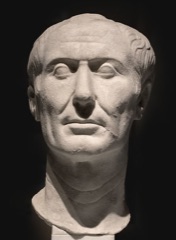
Gaius Julius Caesar came from an old but not wealthy Roman family. A gifted speaker and politician, he formed an alliance with Pompey and Crassus and was elected consul in 59 BC. As governor in Gaul, modern France and Belgium, he fought a series of wars from 58 to 50 BC that added the whole region to Rome's territory and twice took him across the Channel to Britain. He wrote his own account of these wars in clear, plain Latin. When the Senate ordered him to give up his army, he crossed the Rubicon River into Italy in 49 BC, starting a civil war against Pompey, whom he defeated. As dictator he reformed the calendar, creating the Julian calendar, and pardoned many former enemies. Many senators feared he meant to make himself king, and on the Ides of March, 15 March 44 BC, a group led by Brutus and Cassius stabbed him to death in a meeting of the Senate. His adopted heir Octavian later became Rome's first emperor.
Julius Caesar is also an author in the library: author page and works.
Faith: Practiced Roman state religion; as a young man he was appointed priest of Jupiter (flamen Dialis). Source: Encyclopaedia Britannica (1911) (via Wikisource)
See also: Plutarch's Life of Caesar

Key dates
- 59 BC Consul of Rome
- 58–50 BC Conquers Gaul
- 49 BC Crosses the Rubicon; civil war begins
- 44 BC Assassinated on the Ides of March
In their words
“in most cases men willingly believe what they wish”
Read about them
As an Amazon Associate I earn from qualifying purchases. As a Bookshop.org affiliate I earn from qualifying purchases, which also support independent bookstores.
Grades 3–5
- Who Was Julius Caesar? by Nico Medina (2014; ISBN 9780448480831)
Bookshop.org · Amazon
Grades 9–12
- The Conquest of Gaul · In the library
- The Fall of the Roman Republic: Six Lives · In the library
- The Twelve Caesars · In the library
- The Civil War · In the library
- Caesar: Life of a Colossus by Adrian Goldsworthy (Yale University Press, 2008; ISBN 9780300126891)
Bookshop.org · Amazon
More lives
Alexander the Great · Augustus · Cicero · Hannibal · Kautilya (Chanakya) · Leonidas I