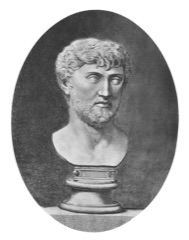
Lucretius
c. 99–55 BC · Roman poet and philosopher, author of On the Nature of Things, a poem explaining Epicurean philosophy.
Titus Lucretius Carus was a Roman poet and philosopher who lived in the first century BC, probably from about 99 to 55 BC. Almost nothing is known about his life; the only certainty is that he was a friend or client of Gaius Memmius, a Roman politician to whom his poem is addressed. His only known work, De rerum natura, usually translated On the Nature of Things or On the Nature of the Universe, is a long poem in six books that sets out the teachings of the Greek philosopher Epicurus. It explains that everything is made of tiny atoms moving through empty space, that the soul dies with the body, and that people should therefore not fear death or the gods, and it describes the origins of the world, of life and of human society. The poem influenced the poets Virgil and Horace. It was almost lost during the Middle Ages, but a manuscript was rediscovered in a German monastery in 1417 by the Italian scholar Poggio Bracciolini, and it later influenced early modern thinkers about atoms.
Lucretius is also an author in the library: author page and works.
Faith: An Epicurean philosopher who taught that the gods do not intervene in the world. Source: Wikipedia

Key dates
- c. 99 BC Probable birth
- 1st century BC Writes De rerum natura, addressed to Gaius Memmius
- c. 55 BC Probable death
- 1417 Manuscript rediscovered by Poggio Bracciolini
Record-breaker
Firsts and records, worded as the sources give them ("first known", "at the time").
- He is believed to be the first to describe the ages of tools: first wood and stone, then copper and bronze, and finally iron. (Source: Lucretius (Wikipedia))
Read about them
Grades 9–12
- On the Nature of the Universe · In the library
More lives
Aeschylus · Aesop · Apollodorus · Apollonius of Rhodes · Apuleius · Aristophanes
Notes: Lucretius's dates are uncertain; c. 99–55 BC is the conventional estimate.