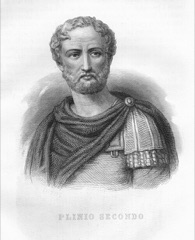
Pliny the Elder
AD 23/24–79 · Roman naturalist, commander and author of the Natural History, who died during the eruption of Vesuvius.
Gaius Plinius Secundus, known as Pliny the Elder, was born in AD 23 or 24 at Novum Comum, now Como, in northern Italy, into a wealthy family of the equestrian class. As a young man he served as a cavalry officer on the German frontier, and he wrote a history of Rome's wars with the Germans. Under the emperor Vespasian, a personal friend, he held high posts as a provincial administrator. He was famous for his industry: according to his nephew, Pliny the Younger, one servant would read aloud to him while another wrote down the extracts he dictated, even while he was bathing. His only surviving work, the Natural History, in 37 books, dedicated to the future emperor Titus in AD 77, gathers knowledge from hundreds of earlier writers on astronomy, geography, people, animals, plants, medicine, metals and art. It became a standard reference for many centuries. In AD 79, while commanding the Roman fleet at Misenum, near Naples, he saw the eruption of Mount Vesuvius and sailed to study it and to rescue people; he died on the shore at Stabiae.
Pliny the Elder is also an author in the library: author page and works.
Faith: Faith not well documented. Source: Wikipedia
Key dates
- AD 23/24 Born at Novum Comum
- AD 47 Cavalry officer in Germany
- AD 77 Natural History dedicated to Titus
- AD 79 Dies at Stabiae during the eruption of Vesuvius
Watch


Videos load from YouTube in privacy-enhanced mode only when you press play.
Read about them
Grades 9–12
- Natural History: A Selection · In the library
More lives
Aeschylus · Aesop · Alexander the Great · Apollodorus · Apollonius of Rhodes · Apuleius