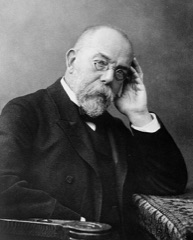
Robert Koch
1843–1910 · German doctor who identified the germs that cause anthrax, tuberculosis and cholera.
Robert Koch was born in Clausthal, Germany, the son of a mining official, one of thirteen children. He studied medicine at Göttingen and became a country doctor in Wollstein. His wife gave him a microscope for his birthday, and in a small laboratory in his home he studied anthrax, a disease that killed cattle and sheep. In 1876 he showed that a particular bacterium causes anthrax and traced its full life cycle, the first time a specific germ was proved to cause a specific disease. He developed ways to grow bacteria on solid gelatin and agar plates, to stain them, and to photograph them. In 1882 he announced that he had found the bacterium that causes tuberculosis, then one of the leading causes of death. In 1883, in Egypt and India, he identified the bacterium that causes cholera, and showed that it spreads through contaminated water. He set out rules, called Koch's postulates, for proving that a germ causes a disease. A remedy he announced for tuberculosis failed. He received the Nobel Prize in 1905 and died in 1910.
Faith: Faith not well documented. Source: Wikipedia

Key dates
- 1876 Proves the cause of anthrax
- 1882 Discovers the tuberculosis bacterium
- 1883 Identifies the cholera bacterium
- 1891 Heads the Institute for Infectious Diseases in Berlin
- 1905 Nobel Prize
- 1910 Dies in Baden-Baden
Fun facts
- He taught himself to read and write before he started school. (Source: Robert Koch (Wikipedia))
Record-breaker
Firsts and records, worded as the sources give them ("first known", "at the time").
- His method of growing bacteria on agar and glass plates, later developed into the Petri dish by his assistant Julius Petri, made him the first to grow bacteria in the laboratory. (Source: Robert Koch (Wikipedia))
More lives
Edwin A. Abbott · Charles Babbage · Clara Barton · Claude Bernard · Elizabeth Blackwell · Eugen Bleuler