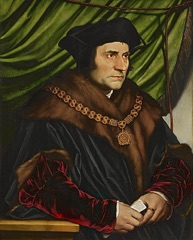
Thomas More
1478–1535 · English lawyer, author of Utopia and Lord Chancellor, executed for refusing to accept Henry VIII as head of the Church.
Thomas More was the son of a London judge. He studied at Oxford and trained as a lawyer, and for a while lived with Carthusian monks, considering the religious life, before deciding to marry. A close friend of the scholar Erasmus, he wrote Utopia in 1516, a book in Latin describing an imaginary island society, which gave its name to all ideal commonwealths. He gave his daughters the same classical education as a son, which was unusual at the time. He became a trusted servant of King Henry VIII and in 1529 Lord Chancellor, the highest office in the law. As chancellor he pursued Protestants as heretics, and several were burned. When Henry broke with Rome to end his marriage, More resigned. He refused to swear the oath accepting the king as head of the Church, was imprisoned in the Tower of London, convicted of treason on false testimony, and beheaded in 1535. He is reported to have said he died the king's good servant, but God's first. He was declared a saint in 1935.
Thomas More is also an author in the library: author page and works.
Faith: A Catholic who studied the Church Fathers to find the consensus of the Catholic Church on disputed questions. Source: Stanford Encyclopedia of Philosophy
Further reading
- Thomas More: A Very Short Introduction by Peter Marshall (Oxford University Press, 2026)

Key dates
- 1478 Born in London
- 1516 Publishes Utopia
- 1529 Becomes Lord Chancellor
- 1532 Resigns
- 1535 Executed on Tower Hill
- 1935 Canonized
Fun facts
- He could joke and chat in Latin as easily as in English. (Source: Thomas More (Wikipedia))
In their words
“there are many things in the commonwealth of Utopia that I rather wish, than hope, to see followed in our governments.”
Read about them
Grades 9–12
- Utopia · In the library
More lives
Fra Angelico · Francis Bacon · William Bradford · Thieleman J. van Braght · John Calvin · Thomas Cranmer