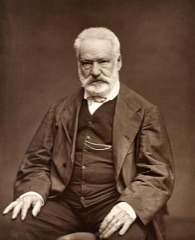
Victor Hugo
1802–1885 · French poet, novelist and playwright, author of Les Misérables and The Hunchback of Notre-Dame.
Victor Hugo was born in 1802 in Besançon, France, the youngest son of a general in Napoleon's army. He began writing poetry as a teenager, and his first collection appeared in 1822, the year he married his childhood friend Adèle Foucher. His plays Cromwell and Hernani (1830) made him a leader of the Romantic movement in French literature. His novel Notre-Dame de Paris (1831), known in English as The Hunchback of Notre-Dame, is set around the great cathedral of Paris in the Middle Ages. In 1843 his daughter Léopoldine drowned in the Seine, aged 19. He entered politics, campaigned against the death penalty, and after Napoleon III seized complete power in 1851 he went into exile, living for fifteen years on the Channel Island of Guernsey. There he finished Les Misérables (1862), the story of the former convict Jean Valjean and of the poor of Paris. He returned to France in 1870. When he died in Paris in 1885, he was given a state funeral and buried in the Panthéon.
Victor Hugo is also an author in the library: author page and works.
Faith: Grew up a royalist and a Catholic; his views changed later in life. Source: Encyclopaedia Britannica (1911) (via Wikisource)

Key dates
- 1802 Born in Besançon, France
- 1830 Hernani performed
- 1831 Notre-Dame de Paris published
- 1851 Goes into exile
- 1862 Les Misérables published
- 1870 Returns to France
- 1885 Dies in Paris
Fun facts
- Most large French towns and cities have a street or square named after him. (Source: Victor Hugo (Wikipedia))
Read about them
Grades 9–12
- Les Misérables · In the library
- The Hunchback of Notre-Dame (Notre-Dame de Paris) · In the library
More lives
Edwin A. Abbott · Jane Addams · Louisa May Alcott · Hans Christian Andersen · Jane Austen · Honoré de Balzac