Key ideas · Grades 9–12
Apology
The PDF is one letter-size page (8.5 × 11 in).
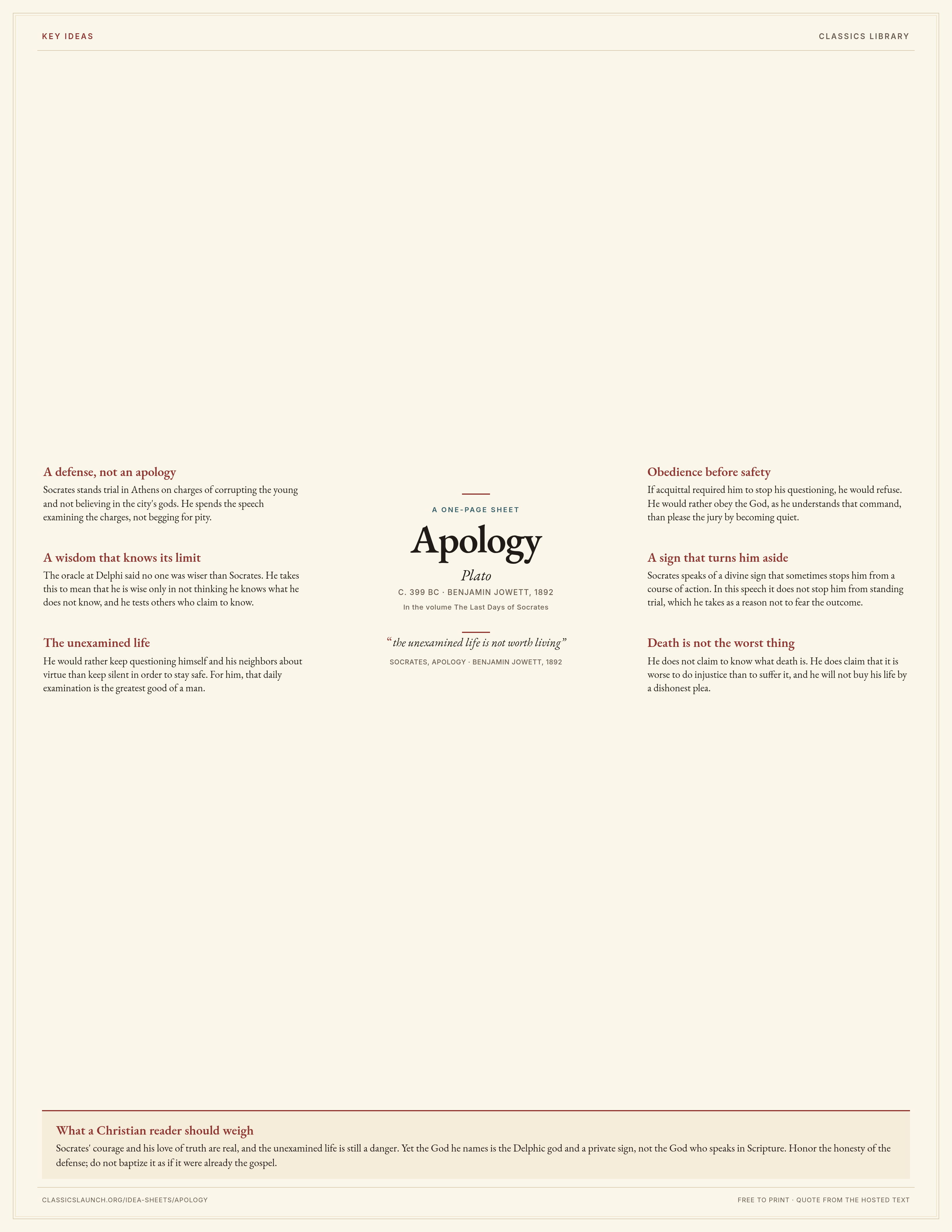
The ideas on the sheet
A defense, not an apology
Socrates stands trial in Athens on charges of corrupting the young and not believing in the city's gods. He spends the speech examining the charges, not begging for pity.
A wisdom that knows its limit
The oracle at Delphi said no one was wiser than Socrates. He takes this to mean that he is wise only in not thinking he knows what he does not know, and he tests others who claim to know.
The unexamined life
He would rather keep questioning himself and his neighbors about virtue than keep silent in order to stay safe. For him, that daily examination is the greatest good of a man.
Obedience before safety
If acquittal required him to stop his questioning, he would refuse. He would rather obey the God, as he understands that command, than please the jury by becoming quiet.
A sign that turns him aside
Socrates speaks of a divine sign that sometimes stops him from a course of action. In this speech it does not stop him from standing trial, which he takes as a reason not to fear the outcome.
Death is not the worst thing
He does not claim to know what death is. He does claim that it is worse to do injustice than to suffer it, and he will not buy his life by a dishonest plea.
What a Christian reader should weigh
Socrates' courage and his love of truth are real, and the unexamined life is still a danger. Yet the God he names is the Delphic god and a private sign, not the God who speaks in Scripture. Honor the honesty of the defense; do not baptize it as if it were already the gospel.
“the unexamined life is not worth living”
The quotation is word for word from the Benjamin Jowett, 1892 text hosted in this library and is checked against that text each time the site is built.