Key ideas · Grades 11–12
On Liberty
The PDF is one letter-size page (8.5 × 11 in).
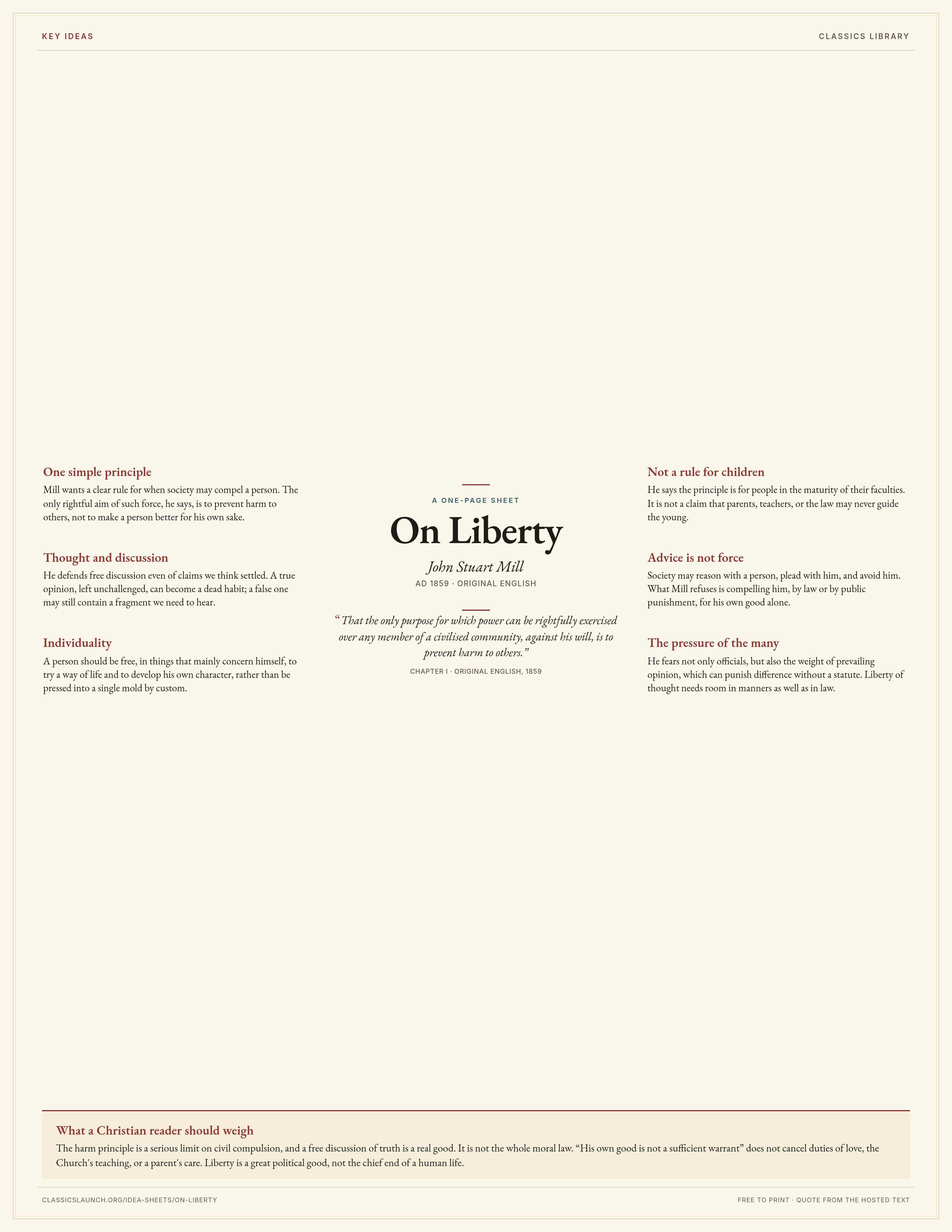
The ideas on the sheet
One simple principle
Mill wants a clear rule for when society may compel a person. The only rightful aim of such force, he says, is to prevent harm to others, not to make a person better for his own sake.
Thought and discussion
He defends free discussion even of claims we think settled. A true opinion, left unchallenged, can become a dead habit; a false one may still contain a fragment we need to hear.
Individuality
A person should be free, in things that mainly concern himself, to try a way of life and to develop his own character, rather than be pressed into a single mold by custom.
Not a rule for children
He says the principle is for people in the maturity of their faculties. It is not a claim that parents, teachers, or the law may never guide the young.
Advice is not force
Society may reason with a person, plead with him, and avoid him. What Mill refuses is compelling him, by law or by public punishment, for his own good alone.
The pressure of the many
He fears not only officials, but also the weight of prevailing opinion, which can punish difference without a statute. Liberty of thought needs room in manners as well as in law.
What a Christian reader should weigh
The harm principle is a serious limit on civil compulsion, and a free discussion of truth is a real good. It is not the whole moral law. “His own good is not a sufficient warrant” does not cancel duties of love, the Church's teaching, or a parent's care. Liberty is a great political good, not the chief end of a human life.
“That the only purpose for which power can be rightfully exercised over any member of a civilised community, against his will, is to prevent harm to others.”
The quotation is word for word from the original English text hosted in this library and is checked against that text each time the site is built.