Key ideas · Grades 11–12
Pensées
The PDF is one letter-size page (8.5 × 11 in).
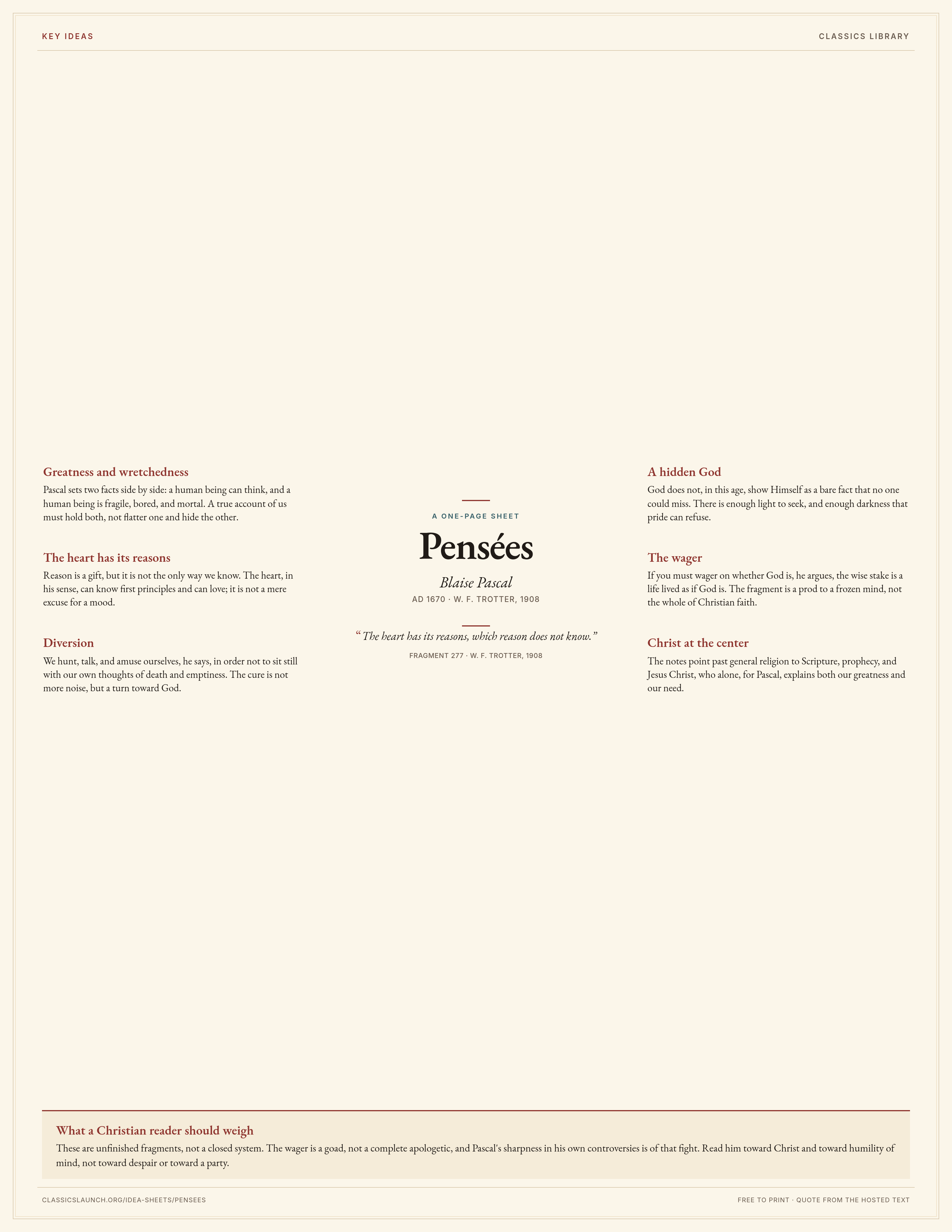
The ideas on the sheet
Greatness and wretchedness
Pascal sets two facts side by side: a human being can think, and a human being is fragile, bored, and mortal. A true account of us must hold both, not flatter one and hide the other.
The heart has its reasons
Reason is a gift, but it is not the only way we know. The heart, in his sense, can know first principles and can love; it is not a mere excuse for a mood.
Diversion
We hunt, talk, and amuse ourselves, he says, in order not to sit still with our own thoughts of death and emptiness. The cure is not more noise, but a turn toward God.
A hidden God
God does not, in this age, show Himself as a bare fact that no one could miss. There is enough light to seek, and enough darkness that pride can refuse.
The wager
If you must wager on whether God is, he argues, the wise stake is a life lived as if God is. The fragment is a prod to a frozen mind, not the whole of Christian faith.
Christ at the center
The notes point past general religion to Scripture, prophecy, and Jesus Christ, who alone, for Pascal, explains both our greatness and our need.
What a Christian reader should weigh
These are unfinished fragments, not a closed system. The wager is a goad, not a complete apologetic, and Pascal's sharpness in his own controversies is of that fight. Read him toward Christ and toward humility of mind, not toward despair or toward a party.
“The heart has its reasons, which reason does not know.”
The quotation is word for word from the W. F. Trotter, 1908 text hosted in this library and is checked against that text each time the site is built.