Key ideas · Grades 11–12
Second Treatise of Government
The PDF is one letter-size page (8.5 × 11 in).
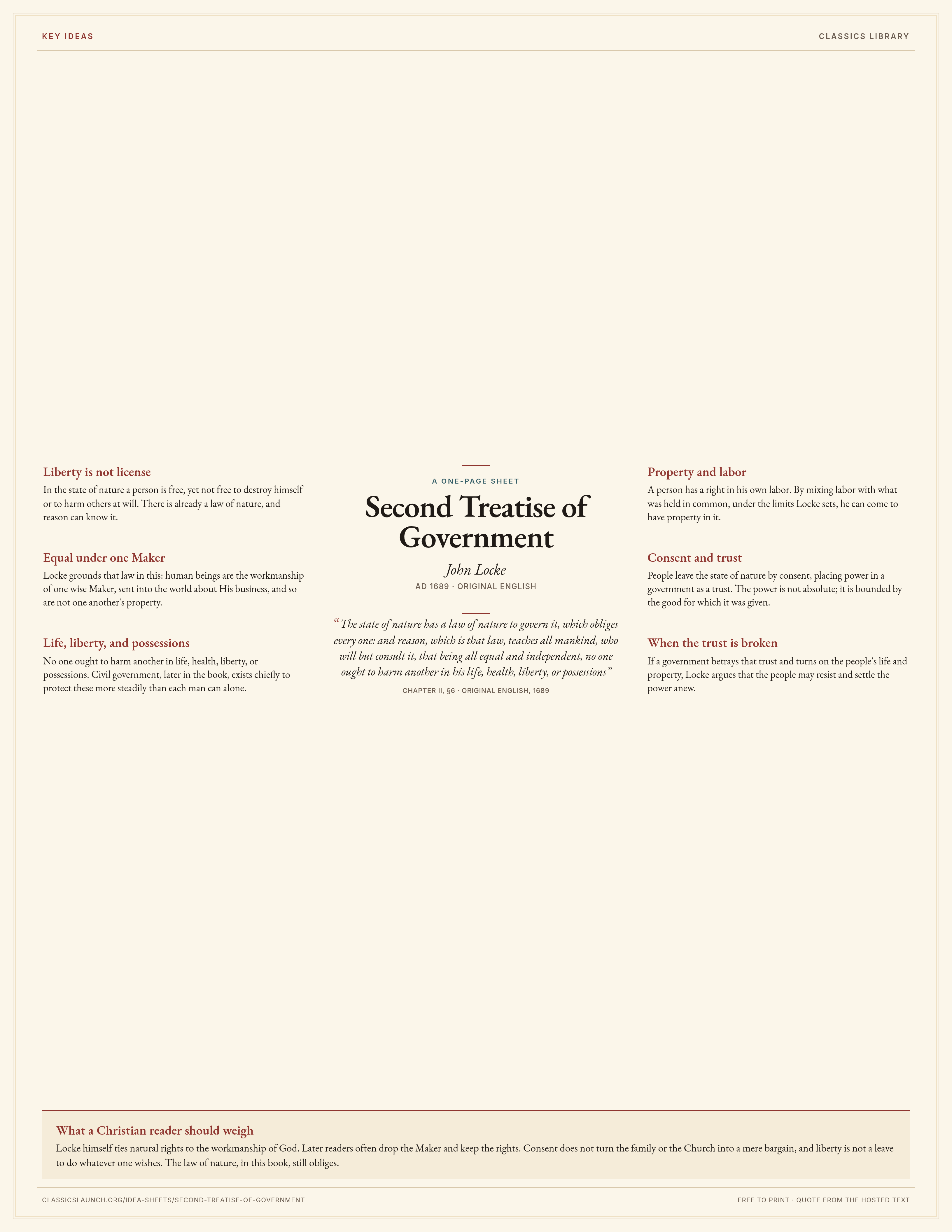
The ideas on the sheet
Liberty is not license
In the state of nature a person is free, yet not free to destroy himself or to harm others at will. There is already a law of nature, and reason can know it.
Equal under one Maker
Locke grounds that law in this: human beings are the workmanship of one wise Maker, sent into the world about His business, and so are not one another's property.
Life, liberty, and possessions
No one ought to harm another in life, health, liberty, or possessions. Civil government, later in the book, exists chiefly to protect these more steadily than each man can alone.
Property and labor
A person has a right in his own labor. By mixing labor with what was held in common, under the limits Locke sets, he can come to have property in it.
Consent and trust
People leave the state of nature by consent, placing power in a government as a trust. The power is not absolute; it is bounded by the good for which it was given.
When the trust is broken
If a government betrays that trust and turns on the people's life and property, Locke argues that the people may resist and settle the power anew.
What a Christian reader should weigh
Locke himself ties natural rights to the workmanship of God. Later readers often drop the Maker and keep the rights. Consent does not turn the family or the Church into a mere bargain, and liberty is not a leave to do whatever one wishes. The law of nature, in this book, still obliges.
“The state of nature has a law of nature to govern it, which obliges every one: and reason, which is that law, teaches all mankind, who will but consult it, that being all equal and independent, no one ought to harm another in his life, health, liberty, or possessions”
The quotation is word for word from the original English text hosted in this library and is checked against that text each time the site is built.