Key ideas · Grades 11–12
Summa Theologica
The PDF is one letter-size page (8.5 × 11 in).
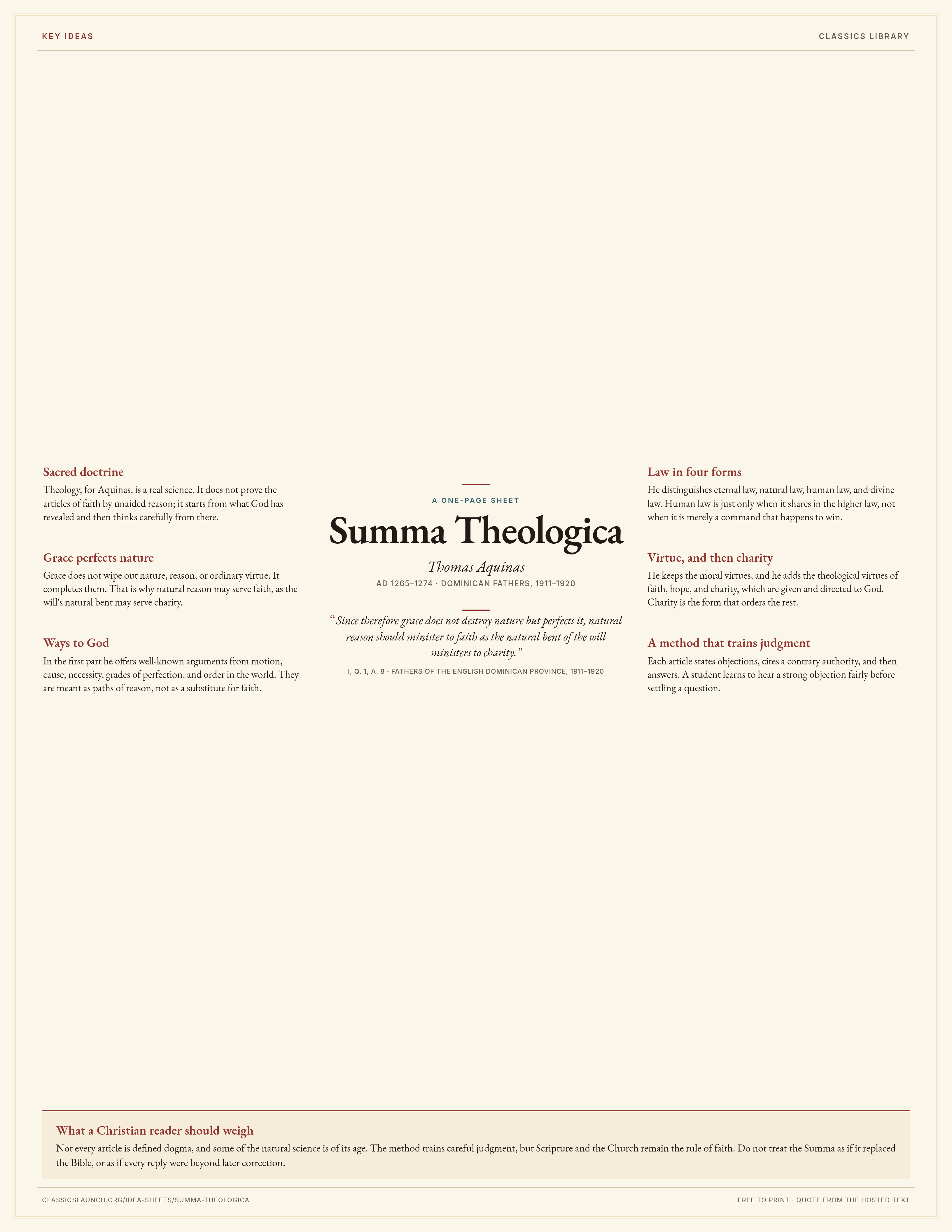
The ideas on the sheet
Sacred doctrine
Theology, for Aquinas, is a real science. It does not prove the articles of faith by unaided reason; it starts from what God has revealed and then thinks carefully from there.
Grace perfects nature
Grace does not wipe out nature, reason, or ordinary virtue. It completes them. That is why natural reason may serve faith, as the will's natural bent may serve charity.
Ways to God
In the first part he offers well-known arguments from motion, cause, necessity, grades of perfection, and order in the world. They are meant as paths of reason, not as a substitute for faith.
Law in four forms
He distinguishes eternal law, natural law, human law, and divine law. Human law is just only when it shares in the higher law, not when it is merely a command that happens to win.
Virtue, and then charity
He keeps the moral virtues, and he adds the theological virtues of faith, hope, and charity, which are given and directed to God. Charity is the form that orders the rest.
A method that trains judgment
Each article states objections, cites a contrary authority, and then answers. A student learns to hear a strong objection fairly before settling a question.
What a Christian reader should weigh
Not every article is defined dogma, and some of the natural science is of its age. The method trains careful judgment, but Scripture and the Church remain the rule of faith. Do not treat the Summa as if it replaced the Bible, or as if every reply were beyond later correction.
“Since therefore grace does not destroy nature but perfects it, natural reason should minister to faith as the natural bent of the will ministers to charity.”
The quotation is word for word from the Dominican Fathers, 1911–1920 text hosted in this library and is checked against that text each time the site is built.