Key ideas · Grades 10–12
The Consolation of Philosophy
The PDF is one letter-size page (8.5 × 11 in).
The ideas on the sheet
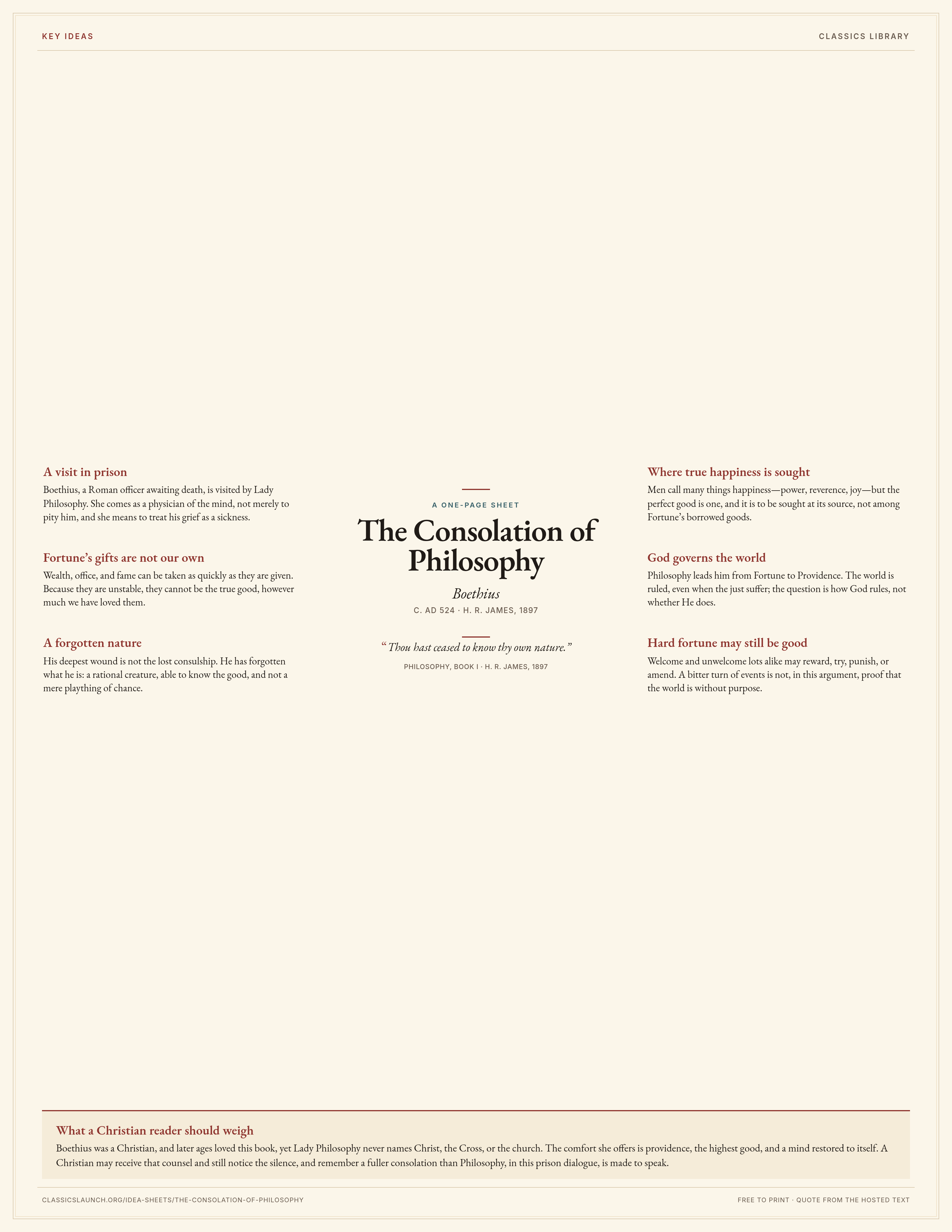
A visit in prison
Boethius, a Roman officer awaiting death, is visited by Lady Philosophy. She comes as a physician of the mind, not merely to pity him, and she means to treat his grief as a sickness.
Fortune’s gifts are not our own
Wealth, office, and fame can be taken as quickly as they are given. Because they are unstable, they cannot be the true good, however much we have loved them.
A forgotten nature
His deepest wound is not the lost consulship. He has forgotten what he is: a rational creature, able to know the good, and not a mere plaything of chance.
Where true happiness is sought
Men call many things happiness—power, reverence, joy—but the perfect good is one, and it is to be sought at its source, not among Fortune’s borrowed goods.
God governs the world
Philosophy leads him from Fortune to Providence. The world is ruled, even when the just suffer; the question is how God rules, not whether He does.
Hard fortune may still be good
Welcome and unwelcome lots alike may reward, try, punish, or amend. A bitter turn of events is not, in this argument, proof that the world is without purpose.
What a Christian reader should weigh
Boethius was a Christian, and later ages loved this book, yet Lady Philosophy never names Christ, the Cross, or the church. The comfort she offers is providence, the highest good, and a mind restored to itself. A Christian may receive that counsel and still notice the silence, and remember a fuller consolation than Philosophy, in this prison dialogue, is made to speak.
“Thou hast ceased to know thy own nature.”
The quotation is word for word from the H. R. James, 1897 text hosted in this library and is checked against that text each time the site is built.