Key ideas · Grades 11–12
The Nicomachean Ethics
The PDF is one letter-size page (8.5 × 11 in).
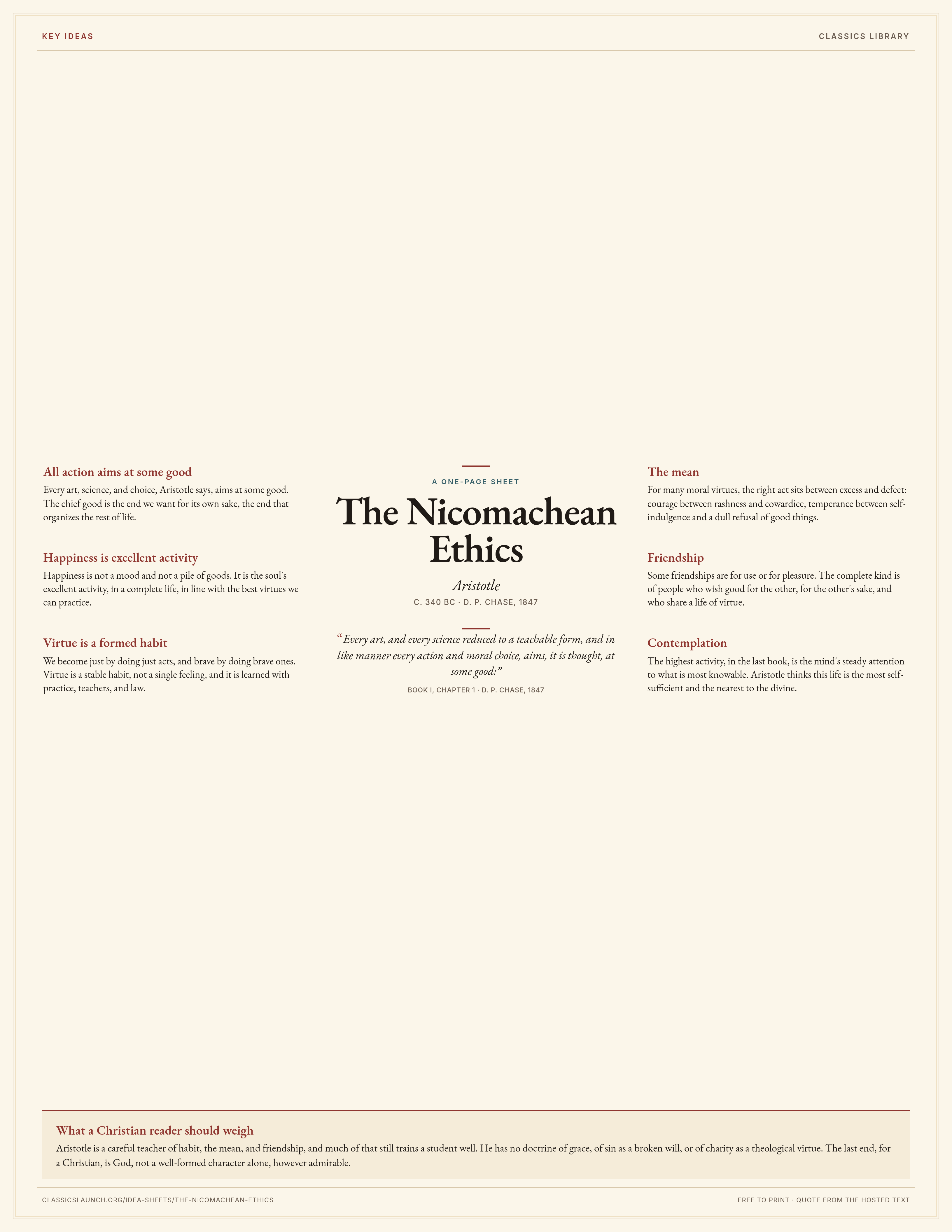
The ideas on the sheet
All action aims at some good
Every art, science, and choice, Aristotle says, aims at some good. The chief good is the end we want for its own sake, the end that organizes the rest of life.
Happiness is excellent activity
Happiness is not a mood and not a pile of goods. It is the soul's excellent activity, in a complete life, in line with the best virtues we can practice.
Virtue is a formed habit
We become just by doing just acts, and brave by doing brave ones. Virtue is a stable habit, not a single feeling, and it is learned with practice, teachers, and law.
The mean
For many moral virtues, the right act sits between excess and defect: courage between rashness and cowardice, temperance between self-indulgence and a dull refusal of good things.
Friendship
Some friendships are for use or for pleasure. The complete kind is of people who wish good for the other, for the other's sake, and who share a life of virtue.
Contemplation
The highest activity, in the last book, is the mind's steady attention to what is most knowable. Aristotle thinks this life is the most self-sufficient and the nearest to the divine.
What a Christian reader should weigh
Aristotle is a careful teacher of habit, the mean, and friendship, and much of that still trains a student well. He has no doctrine of grace, of sin as a broken will, or of charity as a theological virtue. The last end, for a Christian, is God, not a well-formed character alone, however admirable.
“Every art, and every science reduced to a teachable form, and in like manner every action and moral choice, aims, it is thought, at some good:”
The quotation is word for word from the D. P. Chase, 1847 text hosted in this library and is checked against that text each time the site is built.