Key ideas · Grades 11–12
The Prince
The PDF is one letter-size page (8.5 × 11 in).
The ideas on the sheet
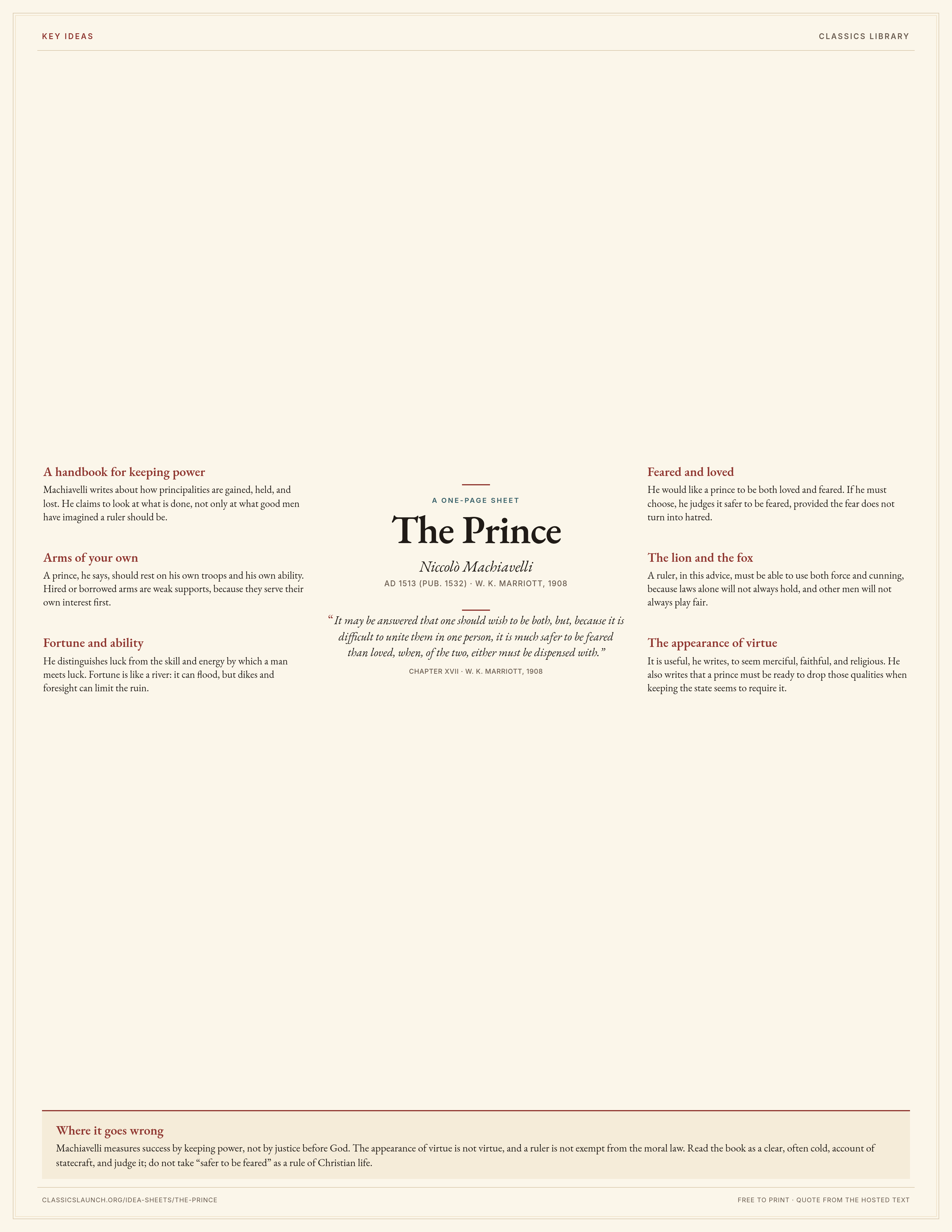
A handbook for keeping power
Machiavelli writes about how principalities are gained, held, and lost. He claims to look at what is done, not only at what good men have imagined a ruler should be.
Arms of your own
A prince, he says, should rest on his own troops and his own ability. Hired or borrowed arms are weak supports, because they serve their own interest first.
Fortune and ability
He distinguishes luck from the skill and energy by which a man meets luck. Fortune is like a river: it can flood, but dikes and foresight can limit the ruin.
Feared and loved
He would like a prince to be both loved and feared. If he must choose, he judges it safer to be feared, provided the fear does not turn into hatred.
The lion and the fox
A ruler, in this advice, must be able to use both force and cunning, because laws alone will not always hold, and other men will not always play fair.
The appearance of virtue
It is useful, he writes, to seem merciful, faithful, and religious. He also writes that a prince must be ready to drop those qualities when keeping the state seems to require it.
Where it goes wrong
Machiavelli measures success by keeping power, not by justice before God. The appearance of virtue is not virtue, and a ruler is not exempt from the moral law. Read the book as a clear, often cold, account of statecraft, and judge it; do not take “safer to be feared” as a rule of Christian life.
“It may be answered that one should wish to be both, but, because it is difficult to unite them in one person, it is much safer to be feared than loved, when, of the two, either must be dispensed with.”
The quotation is word for word from the W. K. Marriott, 1908 text hosted in this library and is checked against that text each time the site is built.