Story maps · Grades 6–10
A Midsummer Night’s Dream: A Story Map
The PDF is one tabloid page (11 × 17 in). On letter paper, choose “Fit to page.”
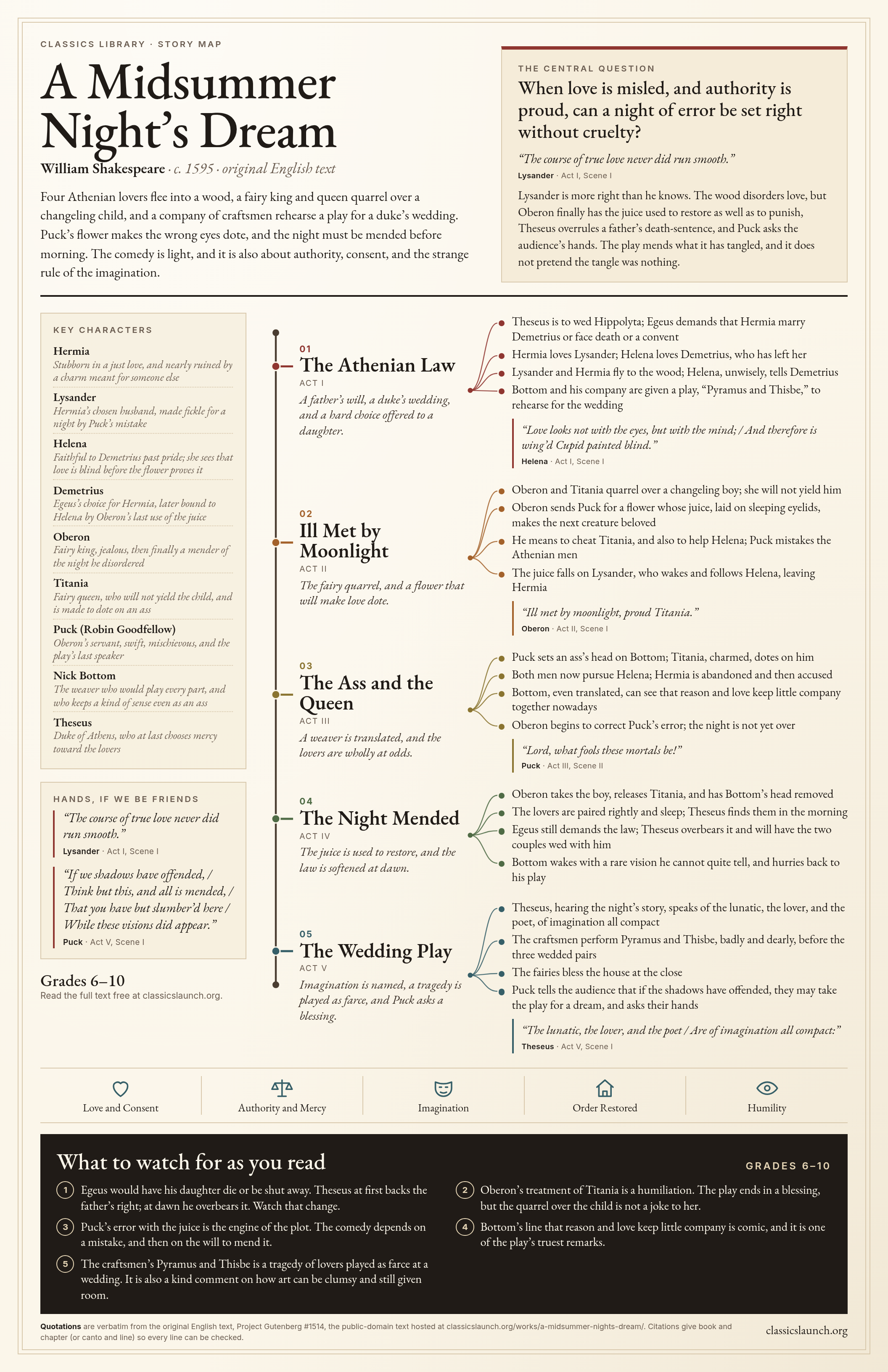
Four Athenian lovers flee into a wood, a fairy king and queen quarrel over a changeling child, and a company of craftsmen rehearse a play for a duke’s wedding. Puck’s flower makes the wrong eyes dote, and the night must be mended before morning. The comedy is light, and it is also about authority, consent, and the strange rule of the imagination.
The central question
When love is misled, and authority is proud, can a night of error be set right without cruelty?
“The course of true love never did run smooth.”
Lysander is more right than he knows. The wood disorders love, but Oberon finally has the juice used to restore as well as to punish, Theseus overrules a father’s death-sentence, and Puck asks the audience’s hands. The play mends what it has tangled, and it does not pretend the tangle was nothing.
- 01
The Athenian Law
Act I
A father’s will, a duke’s wedding, and a hard choice offered to a daughter.
- Theseus is to wed Hippolyta; Egeus demands that Hermia marry Demetrius or face death or a convent
- Hermia loves Lysander; Helena loves Demetrius, who has left her
- Lysander and Hermia fly to the wood; Helena, unwisely, tells Demetrius
- Bottom and his company are given a play, “Pyramus and Thisbe,” to rehearse for the wedding
“Love looks not with the eyes, but with the mind; / And therefore is wing’d Cupid painted blind.”
- 02
Ill Met by Moonlight
Act II
The fairy quarrel, and a flower that will make love dote.
- Oberon and Titania quarrel over a changeling boy; she will not yield him
- Oberon sends Puck for a flower whose juice, laid on sleeping eyelids, makes the next creature beloved
- He means to cheat Titania, and also to help Helena; Puck mistakes the Athenian men
- The juice falls on Lysander, who wakes and follows Helena, leaving Hermia
“Ill met by moonlight, proud Titania.”
- 03
The Ass and the Queen
Act III
A weaver is translated, and the lovers are wholly at odds.
- Puck sets an ass’s head on Bottom; Titania, charmed, dotes on him
- Both men now pursue Helena; Hermia is abandoned and then accused
- Bottom, even translated, can see that reason and love keep little company together nowadays
- Oberon begins to correct Puck’s error; the night is not yet over
“Lord, what fools these mortals be!”
- 04
The Night Mended
Act IV
The juice is used to restore, and the law is softened at dawn.
- Oberon takes the boy, releases Titania, and has Bottom’s head removed
- The lovers are paired rightly and sleep; Theseus finds them in the morning
- Egeus still demands the law; Theseus overbears it and will have the two couples wed with him
- Bottom wakes with a rare vision he cannot quite tell, and hurries back to his play
- 05
The Wedding Play
Act V
Imagination is named, a tragedy is played as farce, and Puck asks a blessing.
- Theseus, hearing the night’s story, speaks of the lunatic, the lover, and the poet, of imagination all compact
- The craftsmen perform Pyramus and Thisbe, badly and dearly, before the three wedded pairs
- The fairies bless the house at the close
- Puck tells the audience that if the shadows have offended, they may take the play for a dream, and asks their hands
“The lunatic, the lover, and the poet / Are of imagination all compact:”
- Love and Consent
- Authority and Mercy
- Imagination
- Order Restored
- Humility
What to watch for as you read
Grades 6–10- Egeus would have his daughter die or be shut away. Theseus at first backs the father’s right; at dawn he overbears it. Watch that change.
- Oberon’s treatment of Titania is a humiliation. The play ends in a blessing, but the quarrel over the child is not a joke to her.
- Puck’s error with the juice is the engine of the plot. The comedy depends on a mistake, and then on the will to mend it.
- Bottom’s line that reason and love keep little company is comic, and it is one of the play’s truest remarks.
- The craftsmen’s Pyramus and Thisbe is a tragedy of lovers played as farce at a wedding. It is also a kind comment on how art can be clumsy and still given room.
Every quotation is word for word from the original English text hosted in this library and is checked against that text each time the site is built. Citations give book and chapter (or canto and line).