Story maps · Grades 10–12
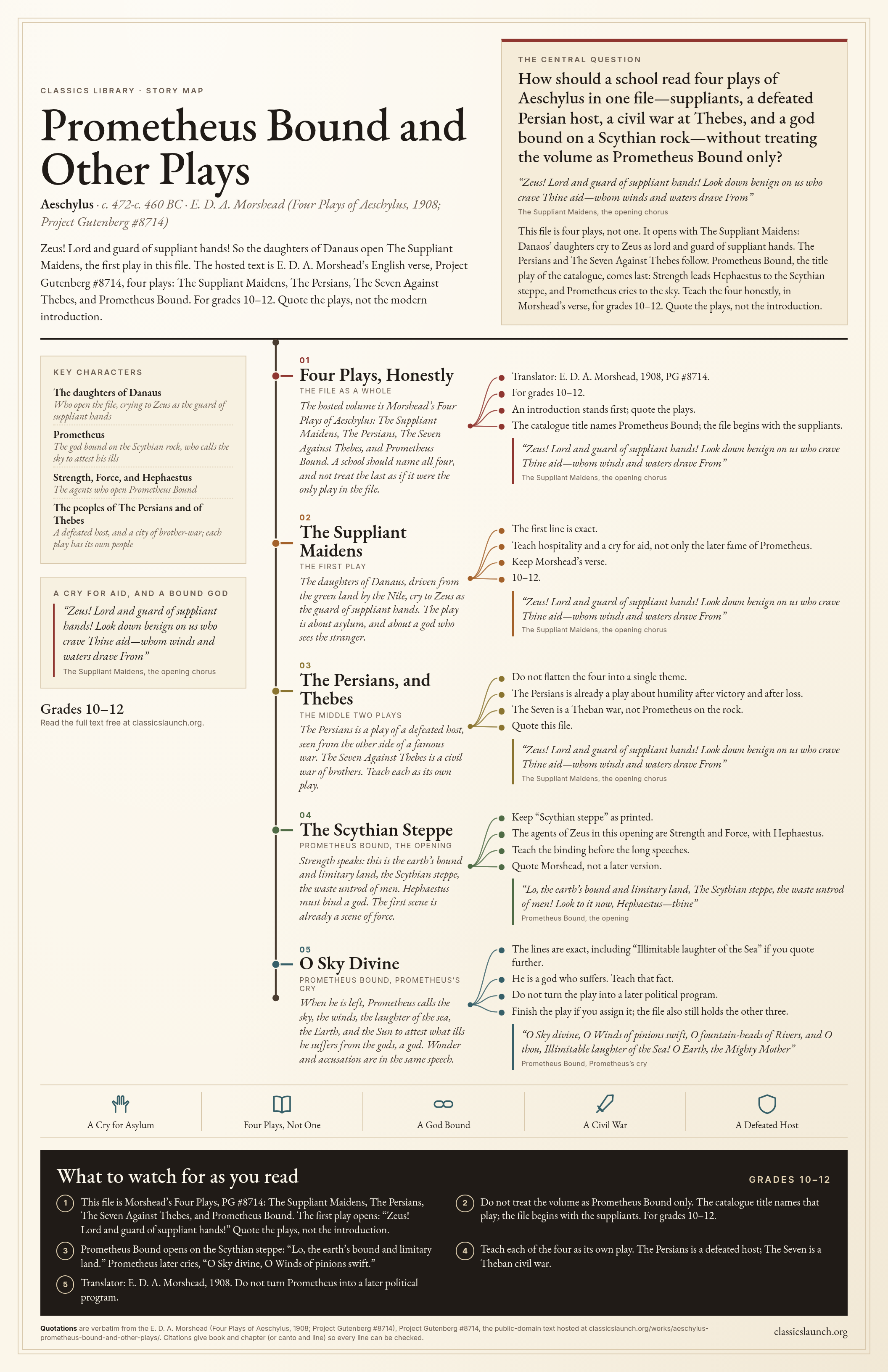
Prometheus Bound and Other Plays: A Story Map
The PDF is one tabloid page (11 × 17 in). On letter paper, choose “Fit to page.”
Zeus! Lord and guard of suppliant hands! So the daughters of Danaus open The Suppliant Maidens, the first play in this file. The hosted text is E. D. A. Morshead’s English verse, Project Gutenberg #8714, four plays: The Suppliant Maidens, The Persians, The Seven Against Thebes, and Prometheus Bound. For grades 10–12. Quote the plays, not the modern introduction.
The central question
How should a school read four plays of Aeschylus in one file—suppliants, a defeated Persian host, a civil war at Thebes, and a god bound on a Scythian rock—without treating the volume as Prometheus Bound only?
“Zeus! Lord and guard of suppliant hands! Look down benign on us who crave Thine aid—whom winds and waters drave From”
This file is four plays, not one. It opens with The Suppliant Maidens: Danaos’ daughters cry to Zeus as lord and guard of suppliant hands. The Persians and The Seven Against Thebes follow. Prometheus Bound, the title play of the catalogue, comes last: Strength leads Hephaestus to the Scythian steppe, and Prometheus cries to the sky. Teach the four honestly, in Morshead’s verse, for grades 10–12. Quote the plays, not the introduction.
- 01
Four Plays, Honestly
The file as a whole
The hosted volume is Morshead’s Four Plays of Aeschylus: The Suppliant Maidens, The Persians, The Seven Against Thebes, and Prometheus Bound. A school should name all four, and not treat the last as if it were the only play in the file.
- Translator: E. D. A. Morshead, 1908, PG #8714.
- For grades 10–12.
- An introduction stands first; quote the plays.
- The catalogue title names Prometheus Bound; the file begins with the suppliants.
“Zeus! Lord and guard of suppliant hands! Look down benign on us who crave Thine aid—whom winds and waters drave From”
- 02
The Suppliant Maidens
The first play
The daughters of Danaus, driven from the green land by the Nile, cry to Zeus as the guard of suppliant hands. The play is about asylum, and about a god who sees the stranger.
- The first line is exact.
- Teach hospitality and a cry for aid, not only the later fame of Prometheus.
- Keep Morshead’s verse.
- 10–12.
“Zeus! Lord and guard of suppliant hands! Look down benign on us who crave Thine aid—whom winds and waters drave From”
- 03
The Persians, and Thebes
The middle two plays
The Persians is a play of a defeated host, seen from the other side of a famous war. The Seven Against Thebes is a civil war of brothers. Teach each as its own play.
- Do not flatten the four into a single theme.
- The Persians is already a play about humility after victory and after loss.
- The Seven is a Theban war, not Prometheus on the rock.
- Quote this file.
“Zeus! Lord and guard of suppliant hands! Look down benign on us who crave Thine aid—whom winds and waters drave From”
- 04
The Scythian Steppe
Prometheus Bound, the opening
Strength speaks: this is the earth’s bound and limitary land, the Scythian steppe, the waste untrod of men. Hephaestus must bind a god. The first scene is already a scene of force.
- Keep “Scythian steppe” as printed.
- The agents of Zeus in this opening are Strength and Force, with Hephaestus.
- Teach the binding before the long speeches.
- Quote Morshead, not a later version.
“Lo, the earth’s bound and limitary land, The Scythian steppe, the waste untrod of men! Look to it now, Hephaestus—thine”
- 05
O Sky Divine
Prometheus Bound, Prometheus’s cry
When he is left, Prometheus calls the sky, the winds, the laughter of the sea, the Earth, and the Sun to attest what ills he suffers from the gods, a god. Wonder and accusation are in the same speech.
- The lines are exact, including “Illimitable laughter of the Sea” if you quote further.
- He is a god who suffers. Teach that fact.
- Do not turn the play into a later political program.
- Finish the play if you assign it; the file also still holds the other three.
“O Sky divine, O Winds of pinions swift, O fountain-heads of Rivers, and O thou, Illimitable laughter of the Sea! O Earth, the Mighty Mother”
- A Cry for Asylum
- Four Plays, Not One
- A God Bound
- A Civil War
- A Defeated Host
What to watch for as you read
Grades 10–12- This file is Morshead’s Four Plays, PG #8714: The Suppliant Maidens, The Persians, The Seven Against Thebes, and Prometheus Bound. The first play opens: “Zeus! Lord and guard of suppliant hands!” Quote the plays, not the introduction.
- Do not treat the volume as Prometheus Bound only. The catalogue title names that play; the file begins with the suppliants. For grades 10–12.
- Prometheus Bound opens on the Scythian steppe: “Lo, the earth’s bound and limitary land.” Prometheus later cries, “O Sky divine, O Winds of pinions swift.”
- Teach each of the four as its own play. The Persians is a defeated host; The Seven is a Theban civil war.
- Translator: E. D. A. Morshead, 1908. Do not turn Prometheus into a later political program.
Every quotation is word for word from the E. D. A. Morshead (Four Plays of Aeschylus, 1908; Project Gutenberg #8714) hosted in this library and is checked against that text each time the site is built. Citations give book and chapter (or canto and line).