Story maps · Grades 11–12
All's Well That Ends Well: A Story Map
The PDF is one tabloid page (11 × 17 in). On letter paper, choose “Fit to page.”
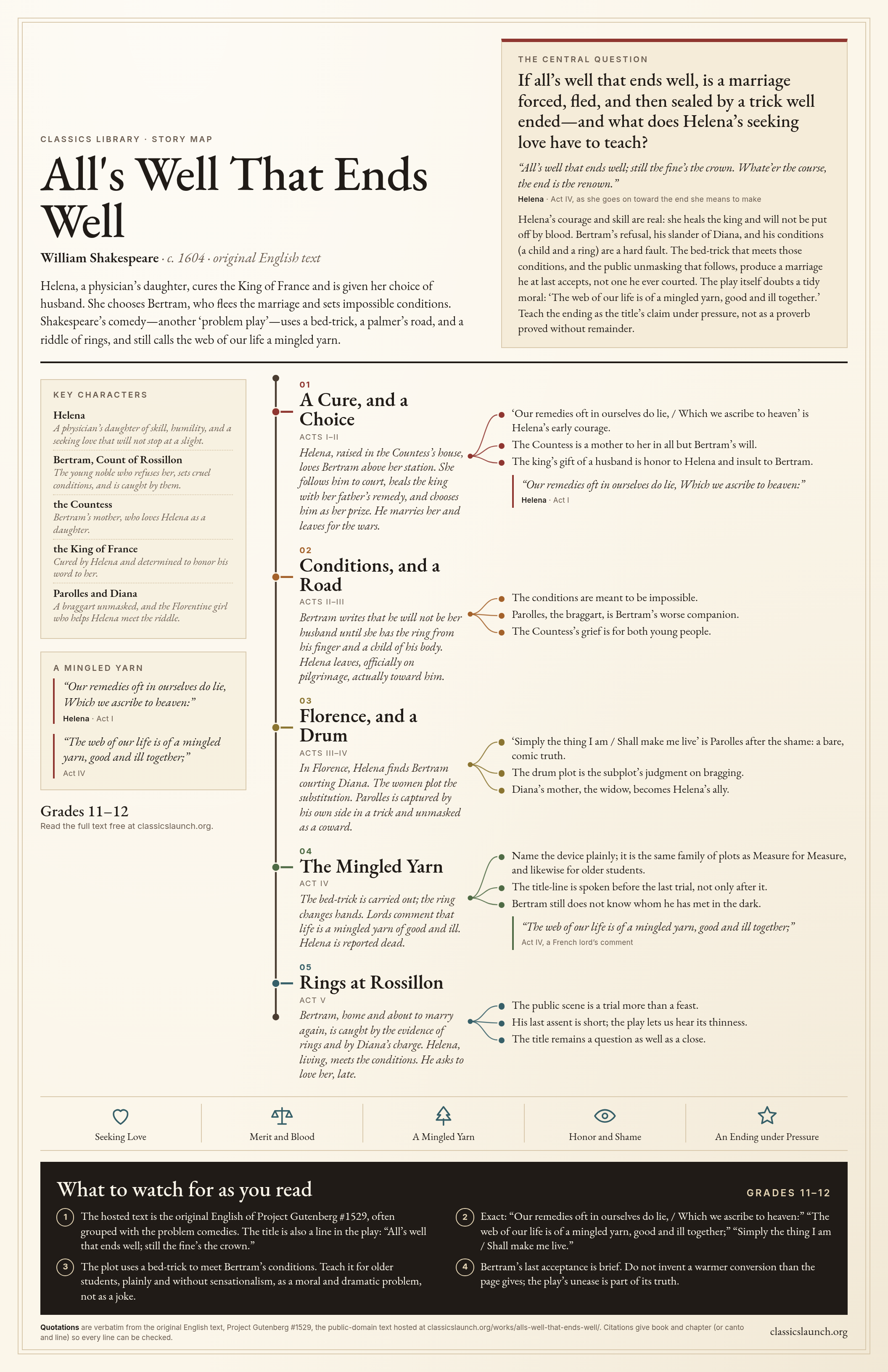
Helena, a physician’s daughter, cures the King of France and is given her choice of husband. She chooses Bertram, who flees the marriage and sets impossible conditions. Shakespeare’s comedy—another ‘problem play’—uses a bed-trick, a palmer’s road, and a riddle of rings, and still calls the web of our life a mingled yarn.
The central question
If all’s well that ends well, is a marriage forced, fled, and then sealed by a trick well ended—and what does Helena’s seeking love have to teach?
“All’s well that ends well; still the fine’s the crown. Whate’er the course, the end is the renown.”
Helena’s courage and skill are real: she heals the king and will not be put off by blood. Bertram’s refusal, his slander of Diana, and his conditions (a child and a ring) are a hard fault. The bed-trick that meets those conditions, and the public unmasking that follows, produce a marriage he at last accepts, not one he ever courted. The play itself doubts a tidy moral: ‘The web of our life is of a mingled yarn, good and ill together.’ Teach the ending as the title’s claim under pressure, not as a proverb proved without remainder.
- 01
A Cure, and a Choice
Acts I–II
Helena, raised in the Countess’s house, loves Bertram above her station. She follows him to court, heals the king with her father’s remedy, and chooses him as her prize. He marries her and leaves for the wars.
- ‘Our remedies oft in ourselves do lie, / Which we ascribe to heaven’ is Helena’s early courage.
- The Countess is a mother to her in all but Bertram’s will.
- The king’s gift of a husband is honor to Helena and insult to Bertram.
“Our remedies oft in ourselves do lie, Which we ascribe to heaven:”
- 02
Conditions, and a Road
Acts II–III
Bertram writes that he will not be her husband until she has the ring from his finger and a child of his body. Helena leaves, officially on pilgrimage, actually toward him.
- The conditions are meant to be impossible.
- Parolles, the braggart, is Bertram’s worse companion.
- The Countess’s grief is for both young people.
- 03
Florence, and a Drum
Acts III–IV
In Florence, Helena finds Bertram courting Diana. The women plot the substitution. Parolles is captured by his own side in a trick and unmasked as a coward.
- ‘Simply the thing I am / Shall make me live’ is Parolles after the shame: a bare, comic truth.
- The drum plot is the subplot’s judgment on bragging.
- Diana’s mother, the widow, becomes Helena’s ally.
- 04
The Mingled Yarn
Act IV
The bed-trick is carried out; the ring changes hands. Lords comment that life is a mingled yarn of good and ill. Helena is reported dead.
- Name the device plainly; it is the same family of plots as Measure for Measure, and likewise for older students.
- The title-line is spoken before the last trial, not only after it.
- Bertram still does not know whom he has met in the dark.
“The web of our life is of a mingled yarn, good and ill together;”
- 05
Rings at Rossillon
Act V
Bertram, home and about to marry again, is caught by the evidence of rings and by Diana’s charge. Helena, living, meets the conditions. He asks to love her, late.
- The public scene is a trial more than a feast.
- His last assent is short; the play lets us hear its thinness.
- The title remains a question as well as a close.
- Seeking Love
- Merit and Blood
- A Mingled Yarn
- Honor and Shame
- An Ending under Pressure
What to watch for as you read
Grades 11–12- The hosted text is the original English of Project Gutenberg #1529, often grouped with the problem comedies. The title is also a line in the play: “All’s well that ends well; still the fine’s the crown.”
- Exact: “Our remedies oft in ourselves do lie, / Which we ascribe to heaven:” “The web of our life is of a mingled yarn, good and ill together;” “Simply the thing I am / Shall make me live.”
- The plot uses a bed-trick to meet Bertram’s conditions. Teach it for older students, plainly and without sensationalism, as a moral and dramatic problem, not as a joke.
- Bertram’s last acceptance is brief. Do not invent a warmer conversion than the page gives; the play’s unease is part of its truth.
Every quotation is word for word from the original English text hosted in this library and is checked against that text each time the site is built. Citations give book and chapter (or canto and line).