Story maps · Grades 11–12
Antony and Cleopatra: A Story Map
The PDF is one tabloid page (11 × 17 in). On letter paper, choose “Fit to page.”
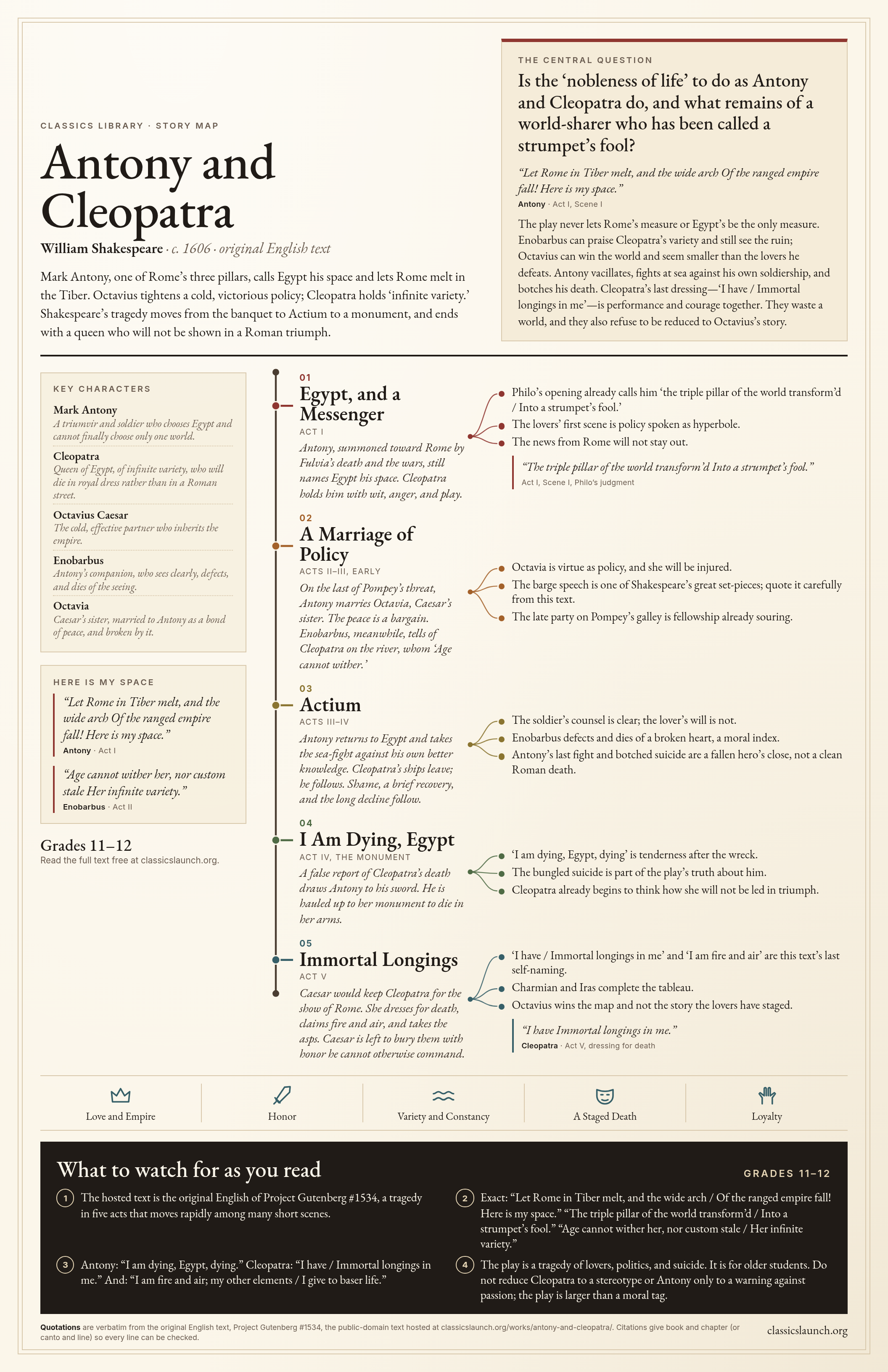
Mark Antony, one of Rome’s three pillars, calls Egypt his space and lets Rome melt in the Tiber. Octavius tightens a cold, victorious policy; Cleopatra holds ‘infinite variety.’ Shakespeare’s tragedy moves from the banquet to Actium to a monument, and ends with a queen who will not be shown in a Roman triumph.
The central question
Is the ‘nobleness of life’ to do as Antony and Cleopatra do, and what remains of a world-sharer who has been called a strumpet’s fool?
“Let Rome in Tiber melt, and the wide arch Of the ranged empire fall! Here is my space.”
The play never lets Rome’s measure or Egypt’s be the only measure. Enobarbus can praise Cleopatra’s variety and still see the ruin; Octavius can win the world and seem smaller than the lovers he defeats. Antony vacillates, fights at sea against his own soldiership, and botches his death. Cleopatra’s last dressing—‘I have / Immortal longings in me’—is performance and courage together. They waste a world, and they also refuse to be reduced to Octavius’s story.
- 01
Egypt, and a Messenger
Act I
Antony, summoned toward Rome by Fulvia’s death and the wars, still names Egypt his space. Cleopatra holds him with wit, anger, and play.
- Philo’s opening already calls him ‘the triple pillar of the world transform’d / Into a strumpet’s fool.’
- The lovers’ first scene is policy spoken as hyperbole.
- The news from Rome will not stay out.
“The triple pillar of the world transform’d Into a strumpet’s fool.”
- 02
A Marriage of Policy
Acts II–III, early
On the last of Pompey’s threat, Antony marries Octavia, Caesar’s sister. The peace is a bargain. Enobarbus, meanwhile, tells of Cleopatra on the river, whom ‘Age cannot wither.’
- Octavia is virtue as policy, and she will be injured.
- The barge speech is one of Shakespeare’s great set-pieces; quote it carefully from this text.
- The late party on Pompey’s galley is fellowship already souring.
- 03
Actium
Acts III–IV
Antony returns to Egypt and takes the sea-fight against his own better knowledge. Cleopatra’s ships leave; he follows. Shame, a brief recovery, and the long decline follow.
- The soldier’s counsel is clear; the lover’s will is not.
- Enobarbus defects and dies of a broken heart, a moral index.
- Antony’s last fight and botched suicide are a fallen hero’s close, not a clean Roman death.
- 04
I Am Dying, Egypt
Act IV, the monument
A false report of Cleopatra’s death draws Antony to his sword. He is hauled up to her monument to die in her arms.
- ‘I am dying, Egypt, dying’ is tenderness after the wreck.
- The bungled suicide is part of the play’s truth about him.
- Cleopatra already begins to think how she will not be led in triumph.
- 05
Immortal Longings
Act V
Caesar would keep Cleopatra for the show of Rome. She dresses for death, claims fire and air, and takes the asps. Caesar is left to bury them with honor he cannot otherwise command.
- ‘I have / Immortal longings in me’ and ‘I am fire and air’ are this text’s last self-naming.
- Charmian and Iras complete the tableau.
- Octavius wins the map and not the story the lovers have staged.
“I have Immortal longings in me.”
- Love and Empire
- Honor
- Variety and Constancy
- A Staged Death
- Loyalty
What to watch for as you read
Grades 11–12- The hosted text is the original English of Project Gutenberg #1534, a tragedy in five acts that moves rapidly among many short scenes.
- Exact: “Let Rome in Tiber melt, and the wide arch / Of the ranged empire fall! Here is my space.” “The triple pillar of the world transform’d / Into a strumpet’s fool.” “Age cannot wither her, nor custom stale / Her infinite variety.”
- Antony: “I am dying, Egypt, dying.” Cleopatra: “I have / Immortal longings in me.” And: “I am fire and air; my other elements / I give to baser life.”
- The play is a tragedy of lovers, politics, and suicide. It is for older students. Do not reduce Cleopatra to a stereotype or Antony only to a warning against passion; the play is larger than a moral tag.
Every quotation is word for word from the original English text hosted in this library and is checked against that text each time the site is built. Citations give book and chapter (or canto and line).