Story maps · Grades 11–12
The Eleven Comedies: A Story Map
The PDF is one tabloid page (11 × 17 in). On letter paper, choose “Fit to page.”
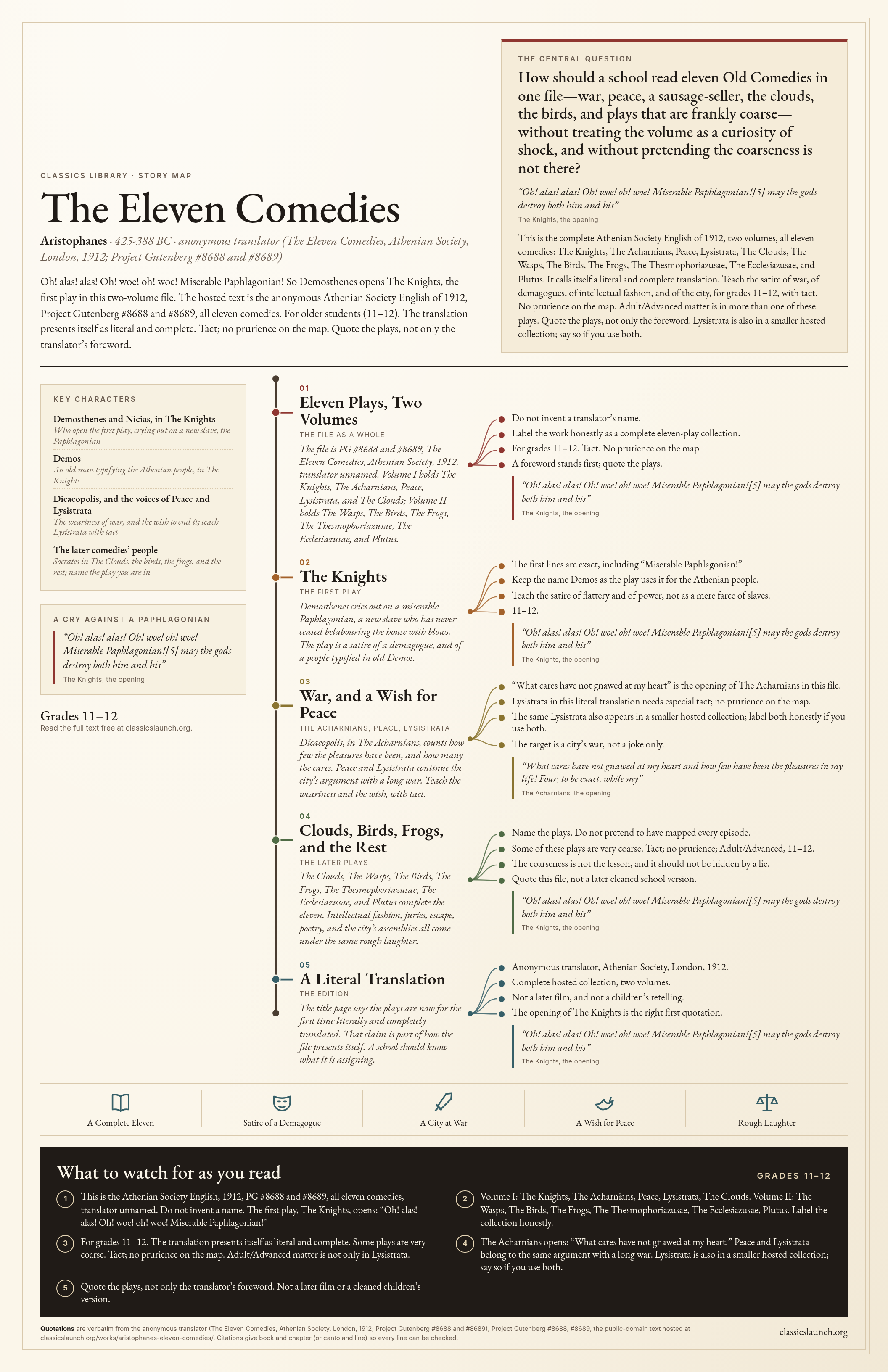
Oh! alas! alas! Oh! woe! oh! woe! Miserable Paphlagonian! So Demosthenes opens The Knights, the first play in this two-volume file. The hosted text is the anonymous Athenian Society English of 1912, Project Gutenberg #8688 and #8689, all eleven comedies. For older students (11–12). The translation presents itself as literal and complete. Tact; no prurience on the map. Quote the plays, not only the translator’s foreword.
The central question
How should a school read eleven Old Comedies in one file—war, peace, a sausage-seller, the clouds, the birds, and plays that are frankly coarse—without treating the volume as a curiosity of shock, and without pretending the coarseness is not there?
“Oh! alas! alas! Oh! woe! oh! woe! Miserable Paphlagonian![5] may the gods destroy both him and his”
This is the complete Athenian Society English of 1912, two volumes, all eleven comedies: The Knights, The Acharnians, Peace, Lysistrata, The Clouds, The Wasps, The Birds, The Frogs, The Thesmophoriazusae, The Ecclesiazusae, and Plutus. It calls itself a literal and complete translation. Teach the satire of war, of demagogues, of intellectual fashion, and of the city, for grades 11–12, with tact. No prurience on the map. Adult/Advanced matter is in more than one of these plays. Quote the plays, not only the foreword. Lysistrata is also in a smaller hosted collection; say so if you use both.
- 01
Eleven Plays, Two Volumes
The file as a whole
The file is PG #8688 and #8689, The Eleven Comedies, Athenian Society, 1912, translator unnamed. Volume I holds The Knights, The Acharnians, Peace, Lysistrata, and The Clouds; Volume II holds The Wasps, The Birds, The Frogs, The Thesmophoriazusae, The Ecclesiazusae, and Plutus.
- Do not invent a translator’s name.
- Label the work honestly as a complete eleven-play collection.
- For grades 11–12. Tact. No prurience on the map.
- A foreword stands first; quote the plays.
“Oh! alas! alas! Oh! woe! oh! woe! Miserable Paphlagonian![5] may the gods destroy both him and his”
- 02
The Knights
The first play
Demosthenes cries out on a miserable Paphlagonian, a new slave who has never ceased belabouring the house with blows. The play is a satire of a demagogue, and of a people typified in old Demos.
- The first lines are exact, including “Miserable Paphlagonian!”
- Keep the name Demos as the play uses it for the Athenian people.
- Teach the satire of flattery and of power, not as a mere farce of slaves.
- 11–12.
“Oh! alas! alas! Oh! woe! oh! woe! Miserable Paphlagonian![5] may the gods destroy both him and his”
- 03
War, and a Wish for Peace
The Acharnians, Peace, Lysistrata
Dicaeopolis, in The Acharnians, counts how few the pleasures have been, and how many the cares. Peace and Lysistrata continue the city’s argument with a long war. Teach the weariness and the wish, with tact.
- “What cares have not gnawed at my heart” is the opening of The Acharnians in this file.
- Lysistrata in this literal translation needs especial tact; no prurience on the map.
- The same Lysistrata also appears in a smaller hosted collection; label both honestly if you use both.
- The target is a city’s war, not a joke only.
“What cares have not gnawed at my heart and how few have been the pleasures in my life! Four, to be exact, while my”
- 04
Clouds, Birds, Frogs, and the Rest
The later plays
The Clouds, The Wasps, The Birds, The Frogs, The Thesmophoriazusae, The Ecclesiazusae, and Plutus complete the eleven. Intellectual fashion, juries, escape, poetry, and the city’s assemblies all come under the same rough laughter.
- Name the plays. Do not pretend to have mapped every episode.
- Some of these plays are very coarse. Tact; no prurience; Adult/Advanced, 11–12.
- The coarseness is not the lesson, and it should not be hidden by a lie.
- Quote this file, not a later cleaned school version.
“Oh! alas! alas! Oh! woe! oh! woe! Miserable Paphlagonian![5] may the gods destroy both him and his”
- 05
A Literal Translation
The edition
The title page says the plays are now for the first time literally and completely translated. That claim is part of how the file presents itself. A school should know what it is assigning.
- Anonymous translator, Athenian Society, London, 1912.
- Complete hosted collection, two volumes.
- Not a later film, and not a children’s retelling.
- The opening of The Knights is the right first quotation.
“Oh! alas! alas! Oh! woe! oh! woe! Miserable Paphlagonian![5] may the gods destroy both him and his”
- A Complete Eleven
- Satire of a Demagogue
- A City at War
- A Wish for Peace
- Rough Laughter
What to watch for as you read
Grades 11–12- This is the Athenian Society English, 1912, PG #8688 and #8689, all eleven comedies, translator unnamed. Do not invent a name. The first play, The Knights, opens: “Oh! alas! alas! Oh! woe! oh! woe! Miserable Paphlagonian!”
- Volume I: The Knights, The Acharnians, Peace, Lysistrata, The Clouds. Volume II: The Wasps, The Birds, The Frogs, The Thesmophoriazusae, The Ecclesiazusae, Plutus. Label the collection honestly.
- For grades 11–12. The translation presents itself as literal and complete. Some plays are very coarse. Tact; no prurience on the map. Adult/Advanced matter is not only in Lysistrata.
- The Acharnians opens: “What cares have not gnawed at my heart.” Peace and Lysistrata belong to the same argument with a long war. Lysistrata is also in a smaller hosted collection; say so if you use both.
- Quote the plays, not only the translator’s foreword. Not a later film or a cleaned children’s version.
Every quotation is word for word from the anonymous translator (The Eleven Comedies, Athenian Society, London, 1912; Project Gutenberg #8688 and #8689) hosted in this library and is checked against that text each time the site is built. Citations give book and chapter (or canto and line).