Story maps · Grades 11–12
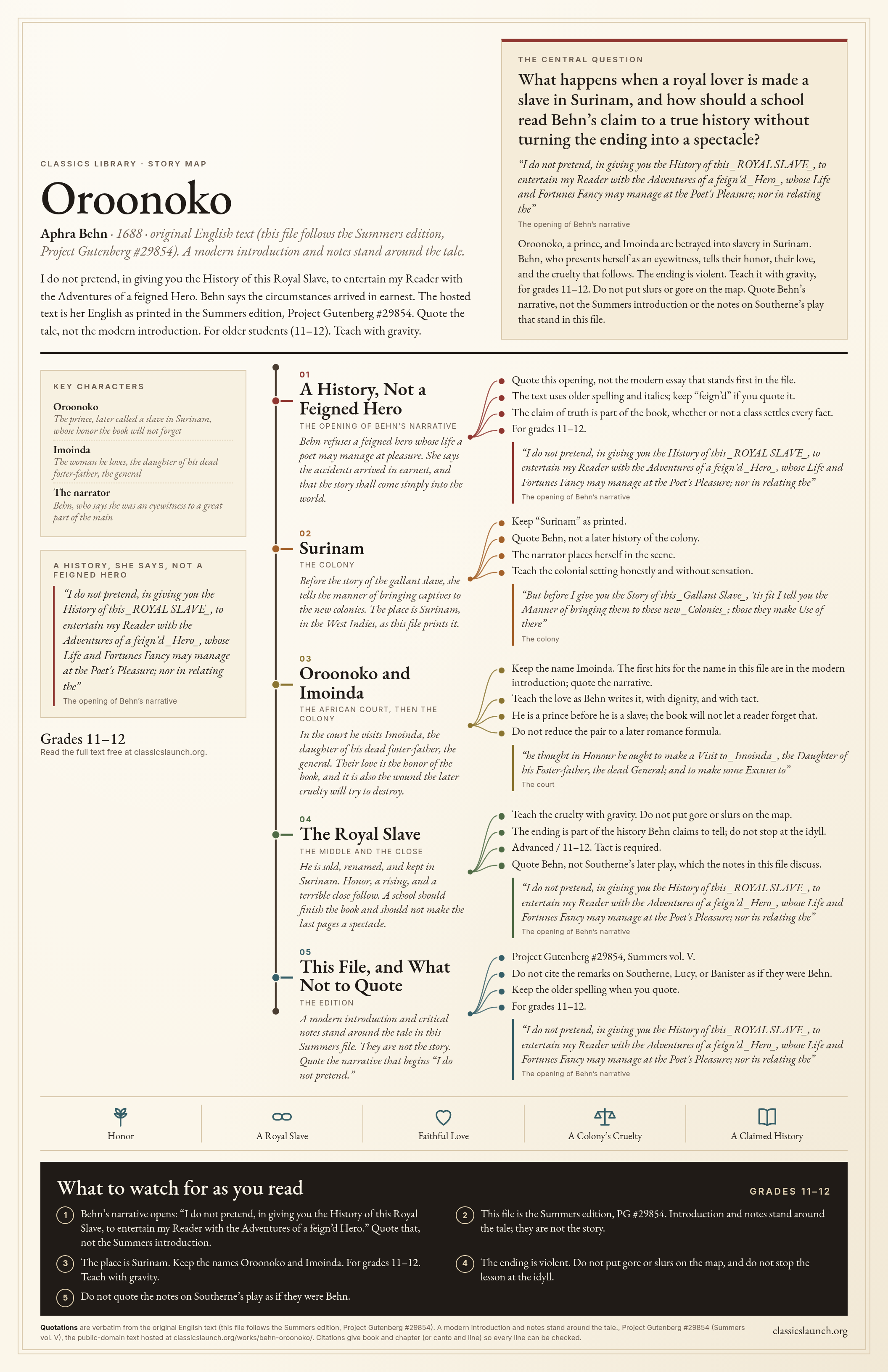
Oroonoko: A Story Map
The PDF is one tabloid page (11 × 17 in). On letter paper, choose “Fit to page.”
I do not pretend, in giving you the History of this Royal Slave, to entertain my Reader with the Adventures of a feigned Hero. Behn says the circumstances arrived in earnest. The hosted text is her English as printed in the Summers edition, Project Gutenberg #29854. Quote the tale, not the modern introduction. For older students (11–12). Teach with gravity.
The central question
What happens when a royal lover is made a slave in Surinam, and how should a school read Behn’s claim to a true history without turning the ending into a spectacle?
“I do not pretend, in giving you the History of this _ROYAL SLAVE_, to entertain my Reader with the Adventures of a feign'd _Hero_, whose Life and Fortunes Fancy may manage at the Poet's Pleasure; nor in relating the”
Oroonoko, a prince, and Imoinda are betrayed into slavery in Surinam. Behn, who presents herself as an eyewitness, tells their honor, their love, and the cruelty that follows. The ending is violent. Teach it with gravity, for grades 11–12. Do not put slurs or gore on the map. Quote Behn’s narrative, not the Summers introduction or the notes on Southerne’s play that stand in this file.
- 01
A History, Not a Feigned Hero
The opening of Behn’s narrative
Behn refuses a feigned hero whose life a poet may manage at pleasure. She says the accidents arrived in earnest, and that the story shall come simply into the world.
- Quote this opening, not the modern essay that stands first in the file.
- The text uses older spelling and italics; keep “feign’d” if you quote it.
- The claim of truth is part of the book, whether or not a class settles every fact.
- For grades 11–12.
“I do not pretend, in giving you the History of this _ROYAL SLAVE_, to entertain my Reader with the Adventures of a feign'd _Hero_, whose Life and Fortunes Fancy may manage at the Poet's Pleasure; nor in relating the”
- 02
Surinam
The colony
Before the story of the gallant slave, she tells the manner of bringing captives to the new colonies. The place is Surinam, in the West Indies, as this file prints it.
- Keep “Surinam” as printed.
- Quote Behn, not a later history of the colony.
- The narrator places herself in the scene.
- Teach the colonial setting honestly and without sensation.
“But before I give you the Story of this _Gallant Slave_, 'tis fit I tell you the Manner of bringing them to these new _Colonies_; those they make Use of there”
- 03
Oroonoko and Imoinda
The African court, then the colony
In the court he visits Imoinda, the daughter of his dead foster-father, the general. Their love is the honor of the book, and it is also the wound the later cruelty will try to destroy.
- Keep the name Imoinda. The first hits for the name in this file are in the modern introduction; quote the narrative.
- Teach the love as Behn writes it, with dignity, and with tact.
- He is a prince before he is a slave; the book will not let a reader forget that.
- Do not reduce the pair to a later romance formula.
“he thought in Honour he ought to make a Visit to _Imoinda_, the Daughter of his Foster-father, the dead General; and to make some Excuses to”
- 04
The Royal Slave
The middle and the close
He is sold, renamed, and kept in Surinam. Honor, a rising, and a terrible close follow. A school should finish the book and should not make the last pages a spectacle.
- Teach the cruelty with gravity. Do not put gore or slurs on the map.
- The ending is part of the history Behn claims to tell; do not stop at the idyll.
- Advanced / 11–12. Tact is required.
- Quote Behn, not Southerne’s later play, which the notes in this file discuss.
“I do not pretend, in giving you the History of this _ROYAL SLAVE_, to entertain my Reader with the Adventures of a feign'd _Hero_, whose Life and Fortunes Fancy may manage at the Poet's Pleasure; nor in relating the”
- 05
This File, and What Not to Quote
The edition
A modern introduction and critical notes stand around the tale in this Summers file. They are not the story. Quote the narrative that begins “I do not pretend.”
- Project Gutenberg #29854, Summers vol. V.
- Do not cite the remarks on Southerne, Lucy, or Banister as if they were Behn.
- Keep the older spelling when you quote.
- For grades 11–12.
“I do not pretend, in giving you the History of this _ROYAL SLAVE_, to entertain my Reader with the Adventures of a feign'd _Hero_, whose Life and Fortunes Fancy may manage at the Poet's Pleasure; nor in relating the”
- Honor
- A Royal Slave
- Faithful Love
- A Colony’s Cruelty
- A Claimed History
What to watch for as you read
Grades 11–12- Behn’s narrative opens: “I do not pretend, in giving you the History of this Royal Slave, to entertain my Reader with the Adventures of a feign’d Hero.” Quote that, not the Summers introduction.
- This file is the Summers edition, PG #29854. Introduction and notes stand around the tale; they are not the story.
- The place is Surinam. Keep the names Oroonoko and Imoinda. For grades 11–12. Teach with gravity.
- The ending is violent. Do not put gore or slurs on the map, and do not stop the lesson at the idyll.
- Do not quote the notes on Southerne’s play as if they were Behn.
Every quotation is word for word from the original English text (this file follows the Summers edition, Project Gutenberg #29854). A modern introduction and notes stand around the tale. hosted in this library and is checked against that text each time the site is built. Citations give book and chapter (or canto and line).