Story maps · Grades 11–12
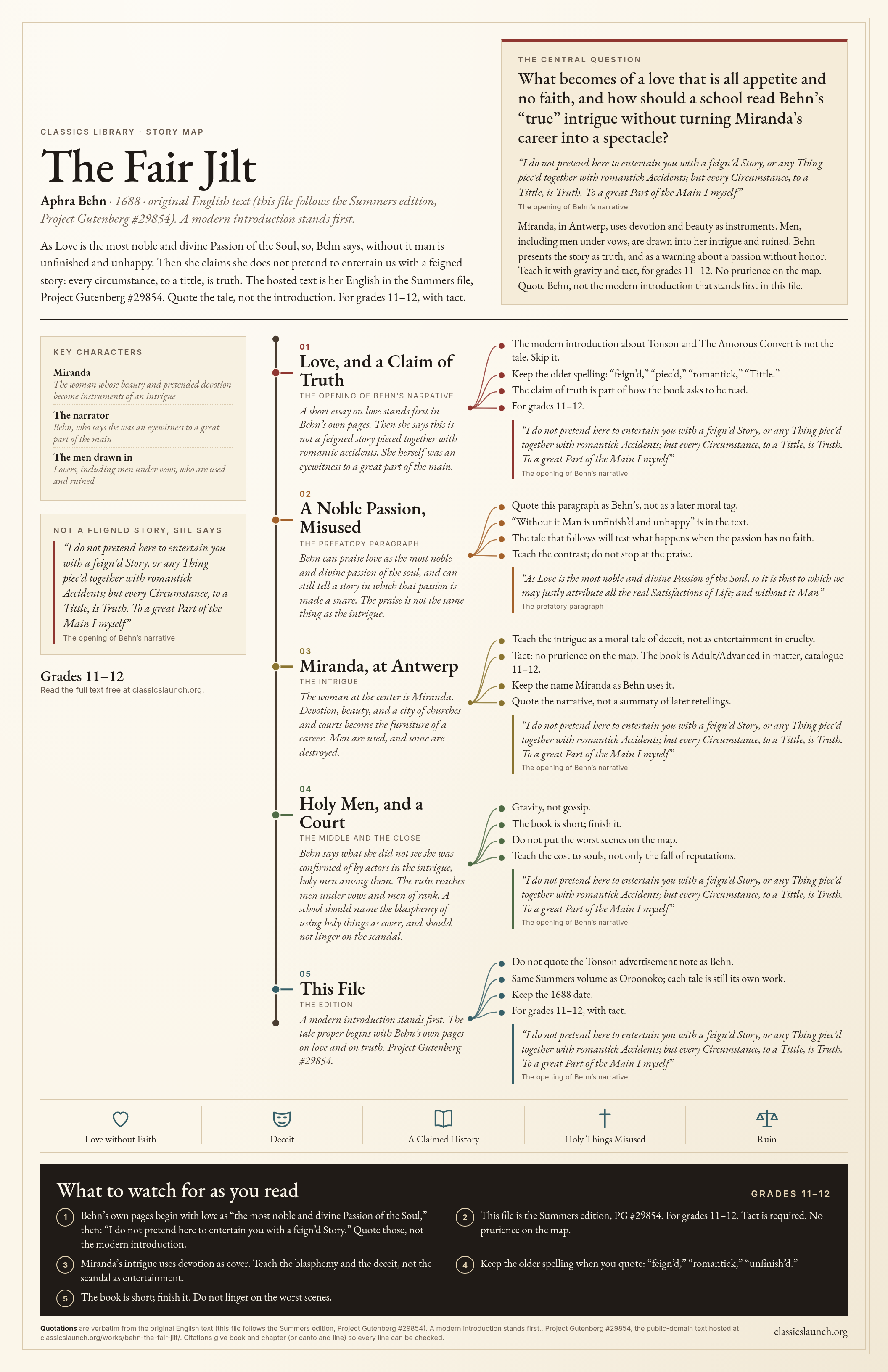
The Fair Jilt: A Story Map
The PDF is one tabloid page (11 × 17 in). On letter paper, choose “Fit to page.”
As Love is the most noble and divine Passion of the Soul, so, Behn says, without it man is unfinished and unhappy. Then she claims she does not pretend to entertain us with a feigned story: every circumstance, to a tittle, is truth. The hosted text is her English in the Summers file, Project Gutenberg #29854. Quote the tale, not the introduction. For grades 11–12, with tact.
The central question
What becomes of a love that is all appetite and no faith, and how should a school read Behn’s “true” intrigue without turning Miranda’s career into a spectacle?
“I do not pretend here to entertain you with a feign'd Story, or any Thing piec'd together with romantick Accidents; but every Circumstance, to a Tittle, is Truth. To a great Part of the Main I myself”
Miranda, in Antwerp, uses devotion and beauty as instruments. Men, including men under vows, are drawn into her intrigue and ruined. Behn presents the story as truth, and as a warning about a passion without honor. Teach it with gravity and tact, for grades 11–12. No prurience on the map. Quote Behn, not the modern introduction that stands first in this file.
- 01
Love, and a Claim of Truth
The opening of Behn’s narrative
A short essay on love stands first in Behn’s own pages. Then she says this is not a feigned story pieced together with romantic accidents. She herself was an eyewitness to a great part of the main.
- The modern introduction about Tonson and The Amorous Convert is not the tale. Skip it.
- Keep the older spelling: “feign’d,” “piec’d,” “romantick,” “Tittle.”
- The claim of truth is part of how the book asks to be read.
- For grades 11–12.
“I do not pretend here to entertain you with a feign'd Story, or any Thing piec'd together with romantick Accidents; but every Circumstance, to a Tittle, is Truth. To a great Part of the Main I myself”
- 02
A Noble Passion, Misused
The prefatory paragraph
Behn can praise love as the most noble and divine passion of the soul, and can still tell a story in which that passion is made a snare. The praise is not the same thing as the intrigue.
- Quote this paragraph as Behn’s, not as a later moral tag.
- “Without it Man is unfinish’d and unhappy” is in the text.
- The tale that follows will test what happens when the passion has no faith.
- Teach the contrast; do not stop at the praise.
“As Love is the most noble and divine Passion of the Soul, so it is that to which we may justly attribute all the real Satisfactions of Life; and without it Man”
- 03
Miranda, at Antwerp
The intrigue
The woman at the center is Miranda. Devotion, beauty, and a city of churches and courts become the furniture of a career. Men are used, and some are destroyed.
- Teach the intrigue as a moral tale of deceit, not as entertainment in cruelty.
- Tact: no prurience on the map. The book is Adult/Advanced in matter, catalogue 11–12.
- Keep the name Miranda as Behn uses it.
- Quote the narrative, not a summary of later retellings.
“I do not pretend here to entertain you with a feign'd Story, or any Thing piec'd together with romantick Accidents; but every Circumstance, to a Tittle, is Truth. To a great Part of the Main I myself”
- 04
Holy Men, and a Court
The middle and the close
Behn says what she did not see she was confirmed of by actors in the intrigue, holy men among them. The ruin reaches men under vows and men of rank. A school should name the blasphemy of using holy things as cover, and should not linger on the scandal.
- Gravity, not gossip.
- The book is short; finish it.
- Do not put the worst scenes on the map.
- Teach the cost to souls, not only the fall of reputations.
“I do not pretend here to entertain you with a feign'd Story, or any Thing piec'd together with romantick Accidents; but every Circumstance, to a Tittle, is Truth. To a great Part of the Main I myself”
- 05
This File
The edition
A modern introduction stands first. The tale proper begins with Behn’s own pages on love and on truth. Project Gutenberg #29854.
- Do not quote the Tonson advertisement note as Behn.
- Same Summers volume as Oroonoko; each tale is still its own work.
- Keep the 1688 date.
- For grades 11–12, with tact.
“I do not pretend here to entertain you with a feign'd Story, or any Thing piec'd together with romantick Accidents; but every Circumstance, to a Tittle, is Truth. To a great Part of the Main I myself”
- Love without Faith
- Deceit
- A Claimed History
- Holy Things Misused
- Ruin
What to watch for as you read
Grades 11–12- Behn’s own pages begin with love as “the most noble and divine Passion of the Soul,” then: “I do not pretend here to entertain you with a feign’d Story.” Quote those, not the modern introduction.
- This file is the Summers edition, PG #29854. For grades 11–12. Tact is required. No prurience on the map.
- Miranda’s intrigue uses devotion as cover. Teach the blasphemy and the deceit, not the scandal as entertainment.
- Keep the older spelling when you quote: “feign’d,” “romantick,” “unfinish’d.”
- The book is short; finish it. Do not linger on the worst scenes.
Every quotation is word for word from the original English text (this file follows the Summers edition, Project Gutenberg #29854). A modern introduction stands first. hosted in this library and is checked against that text each time the site is built. Citations give book and chapter (or canto and line).