Story maps · Grades 3–5
Black Beauty: A Story Map
The PDF is one tabloid page (11 × 17 in). On letter paper, choose “Fit to page.”
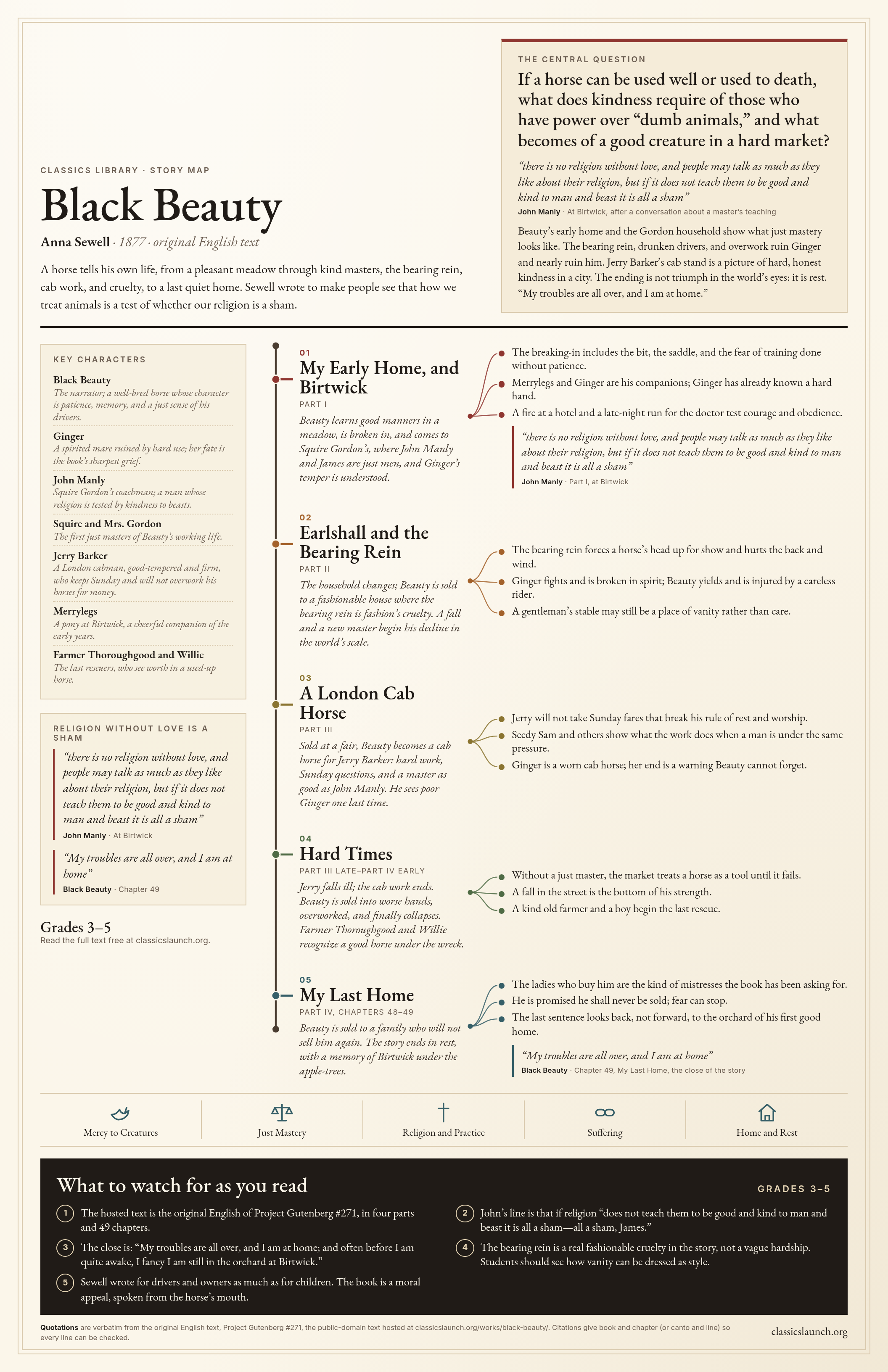
A horse tells his own life, from a pleasant meadow through kind masters, the bearing rein, cab work, and cruelty, to a last quiet home. Sewell wrote to make people see that how we treat animals is a test of whether our religion is a sham.
The central question
If a horse can be used well or used to death, what does kindness require of those who have power over “dumb animals,” and what becomes of a good creature in a hard market?
“there is no religion without love, and people may talk as much as they like about their religion, but if it does not teach them to be good and kind to man and beast it is all a sham”
Beauty’s early home and the Gordon household show what just mastery looks like. The bearing rein, drunken drivers, and overwork ruin Ginger and nearly ruin him. Jerry Barker’s cab stand is a picture of hard, honest kindness in a city. The ending is not triumph in the world’s eyes: it is rest. “My troubles are all over, and I am at home.”
- 01
My Early Home, and Birtwick
Part I
Beauty learns good manners in a meadow, is broken in, and comes to Squire Gordon’s, where John Manly and James are just men, and Ginger’s temper is understood.
- The breaking-in includes the bit, the saddle, and the fear of training done without patience.
- Merrylegs and Ginger are his companions; Ginger has already known a hard hand.
- A fire at a hotel and a late-night run for the doctor test courage and obedience.
“there is no religion without love, and people may talk as much as they like about their religion, but if it does not teach them to be good and kind to man and beast it is all a sham”
- 02
Earlshall and the Bearing Rein
Part II
The household changes; Beauty is sold to a fashionable house where the bearing rein is fashion’s cruelty. A fall and a new master begin his decline in the world’s scale.
- The bearing rein forces a horse’s head up for show and hurts the back and wind.
- Ginger fights and is broken in spirit; Beauty yields and is injured by a careless rider.
- A gentleman’s stable may still be a place of vanity rather than care.
- 03
A London Cab Horse
Part III
Sold at a fair, Beauty becomes a cab horse for Jerry Barker: hard work, Sunday questions, and a master as good as John Manly. He sees poor Ginger one last time.
- Jerry will not take Sunday fares that break his rule of rest and worship.
- Seedy Sam and others show what the work does when a man is under the same pressure.
- Ginger is a worn cab horse; her end is a warning Beauty cannot forget.
- 04
Hard Times
Part III late–Part IV early
Jerry falls ill; the cab work ends. Beauty is sold into worse hands, overworked, and finally collapses. Farmer Thoroughgood and Willie recognize a good horse under the wreck.
- Without a just master, the market treats a horse as a tool until it fails.
- A fall in the street is the bottom of his strength.
- A kind old farmer and a boy begin the last rescue.
- 05
My Last Home
Part IV, Chapters 48–49
Beauty is sold to a family who will not sell him again. The story ends in rest, with a memory of Birtwick under the apple-trees.
- The ladies who buy him are the kind of mistresses the book has been asking for.
- He is promised he shall never be sold; fear can stop.
- The last sentence looks back, not forward, to the orchard of his first good home.
“My troubles are all over, and I am at home”
- Mercy to Creatures
- Just Mastery
- Religion and Practice
- Suffering
- Home and Rest
What to watch for as you read
Grades 3–5- The hosted text is the original English of Project Gutenberg #271, in four parts and 49 chapters.
- John’s line is that if religion “does not teach them to be good and kind to man and beast it is all a sham—all a sham, James.”
- The close is: “My troubles are all over, and I am at home; and often before I am quite awake, I fancy I am still in the orchard at Birtwick.”
- The bearing rein is a real fashionable cruelty in the story, not a vague hardship. Students should see how vanity can be dressed as style.
- Sewell wrote for drivers and owners as much as for children. The book is a moral appeal, spoken from the horse’s mouth.
Every quotation is word for word from the original English text hosted in this library and is checked against that text each time the site is built. Citations give book and chapter (or canto and line).