Story maps · Grades 11–12
Candide: Or Optimism: A Story Map
The PDF is one tabloid page (11 × 17 in). On letter paper, choose “Fit to page.”
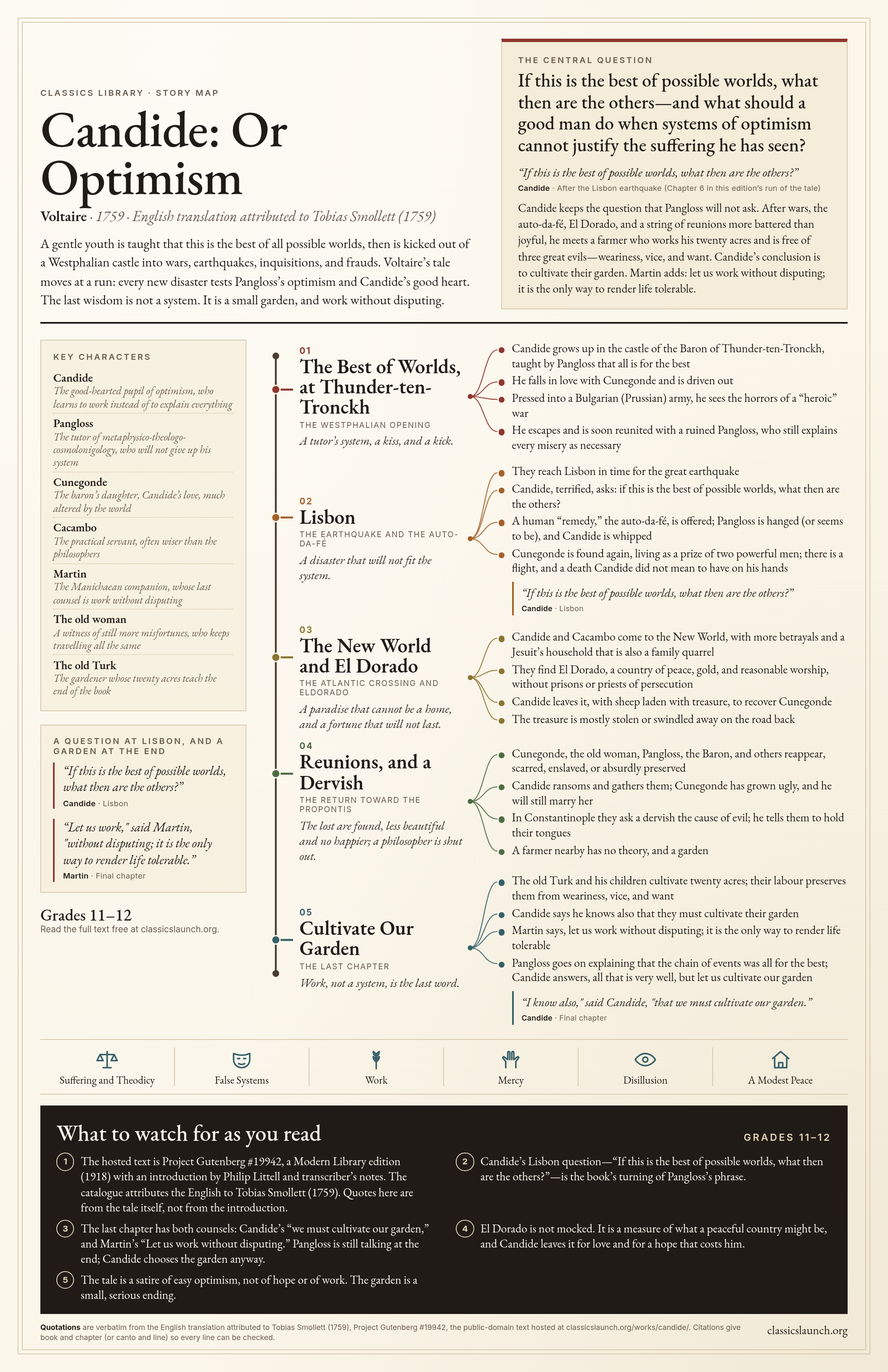
A gentle youth is taught that this is the best of all possible worlds, then is kicked out of a Westphalian castle into wars, earthquakes, inquisitions, and frauds. Voltaire’s tale moves at a run: every new disaster tests Pangloss’s optimism and Candide’s good heart. The last wisdom is not a system. It is a small garden, and work without disputing.
The central question
If this is the best of possible worlds, what then are the others—and what should a good man do when systems of optimism cannot justify the suffering he has seen?
“If this is the best of possible worlds, what then are the others?”
Candide keeps the question that Pangloss will not ask. After wars, the auto-da-fé, El Dorado, and a string of reunions more battered than joyful, he meets a farmer who works his twenty acres and is free of three great evils—weariness, vice, and want. Candide’s conclusion is to cultivate their garden. Martin adds: let us work without disputing; it is the only way to render life tolerable.
- 01
The Best of Worlds, at Thunder-ten-Tronckh
The Westphalian opening
A tutor’s system, a kiss, and a kick.
- Candide grows up in the castle of the Baron of Thunder-ten-Tronckh, taught by Pangloss that all is for the best
- He falls in love with Cunegonde and is driven out
- Pressed into a Bulgarian (Prussian) army, he sees the horrors of a “heroic” war
- He escapes and is soon reunited with a ruined Pangloss, who still explains every misery as necessary
- 02
Lisbon
The earthquake and the auto-da-fé
A disaster that will not fit the system.
- They reach Lisbon in time for the great earthquake
- Candide, terrified, asks: if this is the best of possible worlds, what then are the others?
- A human “remedy,” the auto-da-fé, is offered; Pangloss is hanged (or seems to be), and Candide is whipped
- Cunegonde is found again, living as a prize of two powerful men; there is a flight, and a death Candide did not mean to have on his hands
“If this is the best of possible worlds, what then are the others?”
- 03
The New World and El Dorado
The Atlantic crossing and Eldorado
A paradise that cannot be a home, and a fortune that will not last.
- Candide and Cacambo come to the New World, with more betrayals and a Jesuit’s household that is also a family quarrel
- They find El Dorado, a country of peace, gold, and reasonable worship, without prisons or priests of persecution
- Candide leaves it, with sheep laden with treasure, to recover Cunegonde
- The treasure is mostly stolen or swindled away on the road back
- 04
Reunions, and a Dervish
The return toward the Propontis
The lost are found, less beautiful and no happier; a philosopher is shut out.
- Cunegonde, the old woman, Pangloss, the Baron, and others reappear, scarred, enslaved, or absurdly preserved
- Candide ransoms and gathers them; Cunegonde has grown ugly, and he will still marry her
- In Constantinople they ask a dervish the cause of evil; he tells them to hold their tongues
- A farmer nearby has no theory, and a garden
- 05
Cultivate Our Garden
The last chapter
Work, not a system, is the last word.
- The old Turk and his children cultivate twenty acres; their labour preserves them from weariness, vice, and want
- Candide says he knows also that they must cultivate their garden
- Martin says, let us work without disputing; it is the only way to render life tolerable
- Pangloss goes on explaining that the chain of events was all for the best; Candide answers, all that is very well, but let us cultivate our garden
“I know also," said Candide, "that we must cultivate our garden.”
- Suffering and Theodicy
- False Systems
- Work
- Mercy
- Disillusion
- A Modest Peace
What to watch for as you read
Grades 11–12- The hosted text is Project Gutenberg #19942, a Modern Library edition (1918) with an introduction by Philip Littell and transcriber’s notes. The catalogue attributes the English to Tobias Smollett (1759). Quotes here are from the tale itself, not from the introduction.
- Candide’s Lisbon question—“If this is the best of possible worlds, what then are the others?”—is the book’s turning of Pangloss’s phrase.
- The last chapter has both counsels: Candide’s “we must cultivate our garden,” and Martin’s “Let us work without disputing.” Pangloss is still talking at the end; Candide chooses the garden anyway.
- El Dorado is not mocked. It is a measure of what a peaceful country might be, and Candide leaves it for love and for a hope that costs him.
- The tale is a satire of easy optimism, not of hope or of work. The garden is a small, serious ending.
Every quotation is word for word from the English translation attributed to Tobias Smollett (1759) hosted in this library and is checked against that text each time the site is built. Citations give book and chapter (or canto and line).