Story maps · Grades 11–12
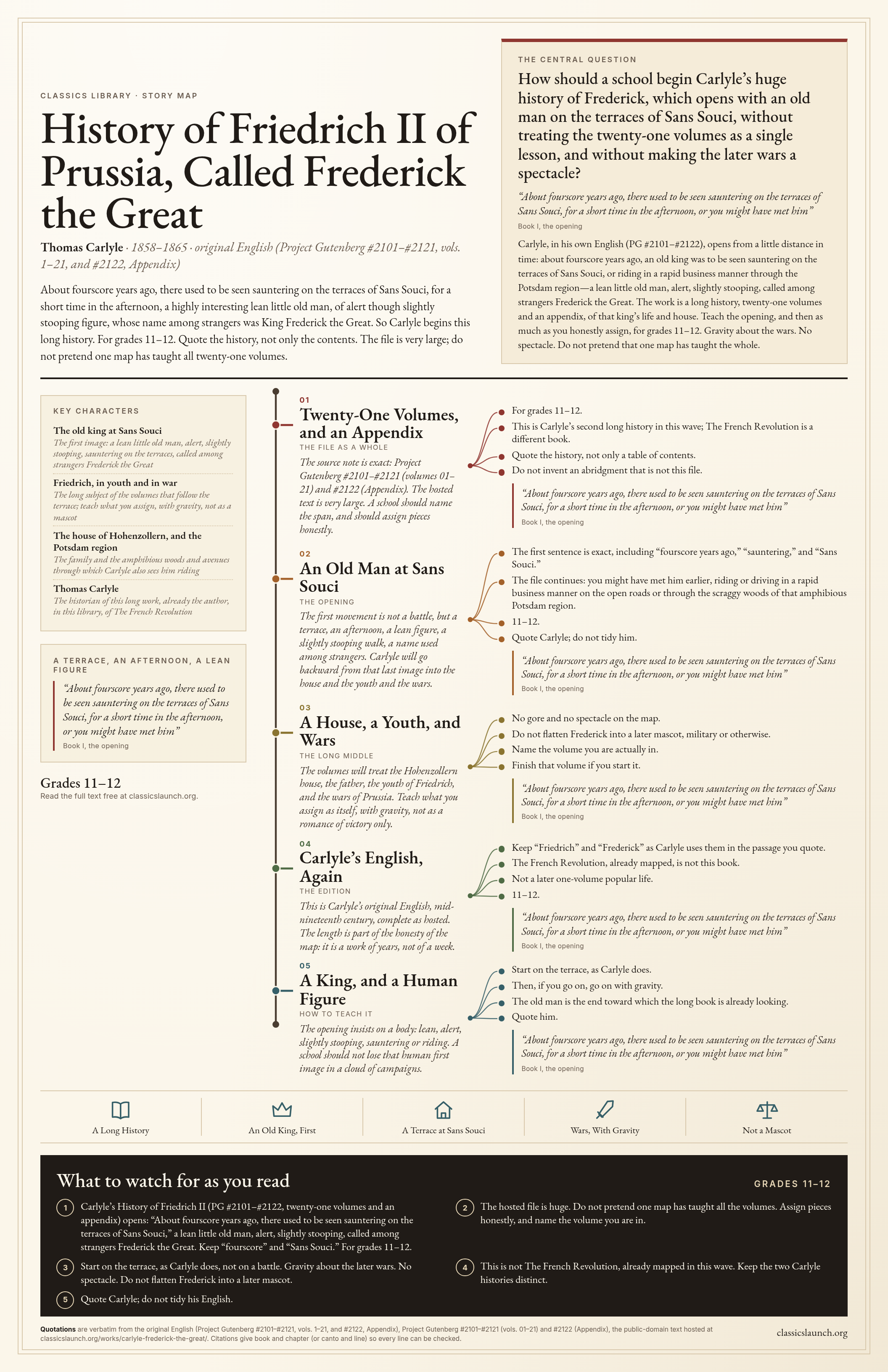
History of Friedrich II of Prussia, Called Frederick the Great: A Story Map
The PDF is one tabloid page (11 × 17 in). On letter paper, choose “Fit to page.”
About fourscore years ago, there used to be seen sauntering on the terraces of Sans Souci, for a short time in the afternoon, a highly interesting lean little old man, of alert though slightly stooping figure, whose name among strangers was King Frederick the Great. So Carlyle begins this long history. For grades 11–12. Quote the history, not only the contents. The file is very large; do not pretend one map has taught all twenty-one volumes.
The central question
How should a school begin Carlyle’s huge history of Frederick, which opens with an old man on the terraces of Sans Souci, without treating the twenty-one volumes as a single lesson, and without making the later wars a spectacle?
“About fourscore years ago, there used to be seen sauntering on the terraces of Sans Souci, for a short time in the afternoon, or you might have met him”
Carlyle, in his own English (PG #2101–#2122), opens from a little distance in time: about fourscore years ago, an old king was to be seen sauntering on the terraces of Sans Souci, or riding in a rapid business manner through the Potsdam region—a lean little old man, alert, slightly stooping, called among strangers Frederick the Great. The work is a long history, twenty-one volumes and an appendix, of that king’s life and house. Teach the opening, and then as much as you honestly assign, for grades 11–12. Gravity about the wars. No spectacle. Do not pretend that one map has taught the whole.
- 01
Twenty-One Volumes, and an Appendix
The file as a whole
The source note is exact: Project Gutenberg #2101–#2121 (volumes 01–21) and #2122 (Appendix). The hosted text is very large. A school should name the span, and should assign pieces honestly.
- For grades 11–12.
- This is Carlyle’s second long history in this wave; The French Revolution is a different book.
- Quote the history, not only a table of contents.
- Do not invent an abridgment that is not this file.
“About fourscore years ago, there used to be seen sauntering on the terraces of Sans Souci, for a short time in the afternoon, or you might have met him”
- 02
An Old Man at Sans Souci
The opening
The first movement is not a battle, but a terrace, an afternoon, a lean figure, a slightly stooping walk, a name used among strangers. Carlyle will go backward from that last image into the house and the youth and the wars.
- The first sentence is exact, including “fourscore years ago,” “sauntering,” and “Sans Souci.”
- The file continues: you might have met him earlier, riding or driving in a rapid business manner on the open roads or through the scraggy woods of that amphibious Potsdam region.
- 11–12.
- Quote Carlyle; do not tidy him.
“About fourscore years ago, there used to be seen sauntering on the terraces of Sans Souci, for a short time in the afternoon, or you might have met him”
- 03
A House, a Youth, and Wars
The long middle
The volumes will treat the Hohenzollern house, the father, the youth of Friedrich, and the wars of Prussia. Teach what you assign as itself, with gravity, not as a romance of victory only.
- No gore and no spectacle on the map.
- Do not flatten Frederick into a later mascot, military or otherwise.
- Name the volume you are actually in.
- Finish that volume if you start it.
“About fourscore years ago, there used to be seen sauntering on the terraces of Sans Souci, for a short time in the afternoon, or you might have met him”
- 04
Carlyle’s English, Again
The edition
This is Carlyle’s original English, mid-nineteenth century, complete as hosted. The length is part of the honesty of the map: it is a work of years, not of a week.
- Keep “Friedrich” and “Frederick” as Carlyle uses them in the passage you quote.
- The French Revolution, already mapped, is not this book.
- Not a later one-volume popular life.
- 11–12.
“About fourscore years ago, there used to be seen sauntering on the terraces of Sans Souci, for a short time in the afternoon, or you might have met him”
- 05
A King, and a Human Figure
How to teach it
The opening insists on a body: lean, alert, slightly stooping, sauntering or riding. A school should not lose that human first image in a cloud of campaigns.
- Start on the terrace, as Carlyle does.
- Then, if you go on, go on with gravity.
- The old man is the end toward which the long book is already looking.
- Quote him.
“About fourscore years ago, there used to be seen sauntering on the terraces of Sans Souci, for a short time in the afternoon, or you might have met him”
- A Long History
- An Old King, First
- A Terrace at Sans Souci
- Wars, With Gravity
- Not a Mascot
What to watch for as you read
Grades 11–12- Carlyle’s History of Friedrich II (PG #2101–#2122, twenty-one volumes and an appendix) opens: “About fourscore years ago, there used to be seen sauntering on the terraces of Sans Souci,” a lean little old man, alert, slightly stooping, called among strangers Frederick the Great. Keep “fourscore” and “Sans Souci.” For grades 11–12.
- The hosted file is huge. Do not pretend one map has taught all the volumes. Assign pieces honestly, and name the volume you are in.
- Start on the terrace, as Carlyle does, not on a battle. Gravity about the later wars. No spectacle. Do not flatten Frederick into a later mascot.
- This is not The French Revolution, already mapped in this wave. Keep the two Carlyle histories distinct.
- Quote Carlyle; do not tidy his English.
Every quotation is word for word from the original English (Project Gutenberg #2101–#2121, vols. 1–21, and #2122, Appendix) hosted in this library and is checked against that text each time the site is built. Citations give book and chapter (or canto and line).