Story maps · Grades 10–12
Chancellorsville and Gettysburg: A Story Map
The PDF is one tabloid page (11 × 17 in). On letter paper, choose “Fit to page.”
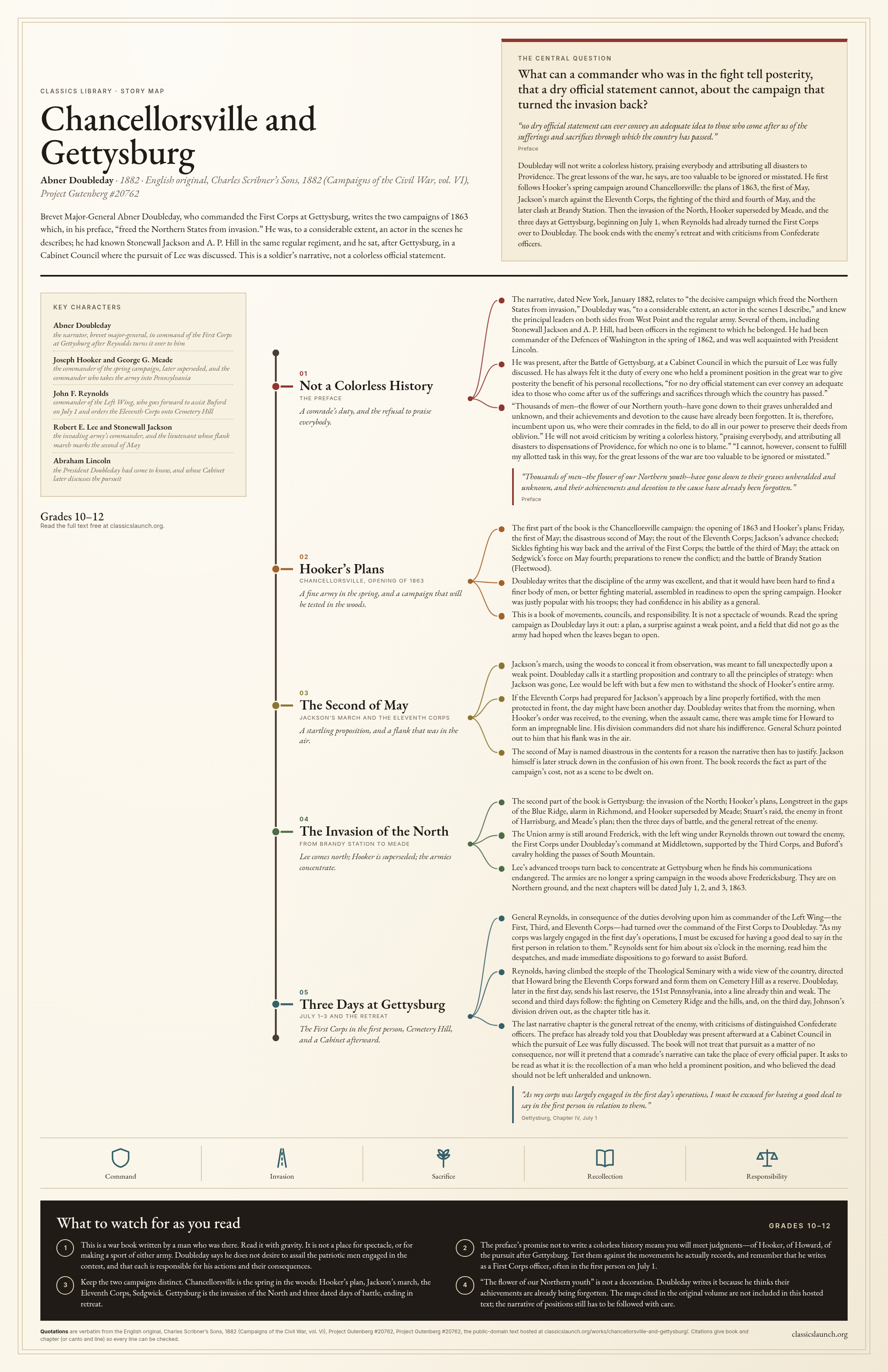
Brevet Major-General Abner Doubleday, who commanded the First Corps at Gettysburg, writes the two campaigns of 1863 which, in his preface, “freed the Northern States from invasion.” He was, to a considerable extent, an actor in the scenes he describes; he had known Stonewall Jackson and A. P. Hill in the same regular regiment, and he sat, after Gettysburg, in a Cabinet Council where the pursuit of Lee was discussed. This is a soldier’s narrative, not a colorless official statement.
The central question
What can a commander who was in the fight tell posterity, that a dry official statement cannot, about the campaign that turned the invasion back?
“no dry official statement can ever convey an adequate idea to those who come after us of the sufferings and sacrifices through which the country has passed.”
Doubleday will not write a colorless history, praising everybody and attributing all disasters to Providence. The great lessons of the war, he says, are too valuable to be ignored or misstated. He first follows Hooker’s spring campaign around Chancellorsville: the plans of 1863, the first of May, Jackson’s march against the Eleventh Corps, the fighting of the third and fourth of May, and the later clash at Brandy Station. Then the invasion of the North, Hooker superseded by Meade, and the three days at Gettysburg, beginning on July 1, when Reynolds had already turned the First Corps over to Doubleday. The book ends with the enemy’s retreat and with criticisms from Confederate officers.
- 01
Not a Colorless History
The preface
A comrade’s duty, and the refusal to praise everybody.
- The narrative, dated New York, January 1882, relates to “the decisive campaign which freed the Northern States from invasion,” Doubleday was, “to a considerable extent, an actor in the scenes I describe,” and knew the principal leaders on both sides from West Point and the regular army. Several of them, including Stonewall Jackson and A. P. Hill, had been officers in the regiment to which he belonged. He had been commander of the Defences of Washington in the spring of 1862, and was well acquainted with President Lincoln.
- He was present, after the Battle of Gettysburg, at a Cabinet Council in which the pursuit of Lee was fully discussed. He has always felt it the duty of every one who held a prominent position in the great war to give posterity the benefit of his personal recollections, “for no dry official statement can ever convey an adequate idea to those who come after us of the sufferings and sacrifices through which the country has passed.”
- “Thousands of men--the flower of our Northern youth--have gone down to their graves unheralded and unknown, and their achievements and devotion to the cause have already been forgotten. It is, therefore, incumbent upon us, who were their comrades in the field, to do all in our power to preserve their deeds from oblivion.” He will not avoid criticism by writing a colorless history, “praising everybody, and attributing all disasters to dispensations of Providence, for which no one is to blame.” “I cannot, however, consent to fulfill my allotted task in this way, for the great lessons of the war are too valuable to be ignored or misstated.”
“Thousands of men--the flower of our Northern youth--have gone down to their graves unheralded and unknown, and their achievements and devotion to the cause have already been forgotten.”
- 02
Hooker’s Plans
Chancellorsville, opening of 1863
A fine army in the spring, and a campaign that will be tested in the woods.
- The first part of the book is the Chancellorsville campaign: the opening of 1863 and Hooker’s plans; Friday, the first of May; the disastrous second of May; the rout of the Eleventh Corps; Jackson’s advance checked; Sickles fighting his way back and the arrival of the First Corps; the battle of the third of May; the attack on Sedgwick’s force on May fourth; preparations to renew the conflict; and the battle of Brandy Station (Fleetwood).
- Doubleday writes that the discipline of the army was excellent, and that it would have been hard to find a finer body of men, or better fighting material, assembled in readiness to open the spring campaign. Hooker was justly popular with his troops; they had confidence in his ability as a general.
- This is a book of movements, councils, and responsibility. It is not a spectacle of wounds. Read the spring campaign as Doubleday lays it out: a plan, a surprise against a weak point, and a field that did not go as the army had hoped when the leaves began to open.
- 03
The Second of May
Jackson’s march and the Eleventh Corps
A startling proposition, and a flank that was in the air.
- Jackson’s march, using the woods to conceal it from observation, was meant to fall unexpectedly upon a weak point. Doubleday calls it a startling proposition and contrary to all the principles of strategy: when Jackson was gone, Lee would be left with but a few men to withstand the shock of Hooker’s entire army.
- If the Eleventh Corps had prepared for Jackson’s approach by a line properly fortified, with the men protected in front, the day might have been another day. Doubleday writes that from the morning, when Hooker’s order was received, to the evening, when the assault came, there was ample time for Howard to form an impregnable line. His division commanders did not share his indifference. General Schurz pointed out to him that his flank was in the air.
- The second of May is named disastrous in the contents for a reason the narrative then has to justify. Jackson himself is later struck down in the confusion of his own front. The book records the fact as part of the campaign’s cost, not as a scene to be dwelt on.
- 04
The Invasion of the North
From Brandy Station to Meade
Lee comes north; Hooker is superseded; the armies concentrate.
- The second part of the book is Gettysburg: the invasion of the North; Hooker’s plans, Longstreet in the gaps of the Blue Ridge, alarm in Richmond, and Hooker superseded by Meade; Stuart’s raid, the enemy in front of Harrisburg, and Meade’s plan; then the three days of battle, and the general retreat of the enemy.
- The Union army is still around Frederick, with the left wing under Reynolds thrown out toward the enemy, the First Corps under Doubleday’s command at Middletown, supported by the Third Corps, and Buford’s cavalry holding the passes of South Mountain.
- Lee’s advanced troops turn back to concentrate at Gettysburg when he finds his communications endangered. The armies are no longer a spring campaign in the woods above Fredericksburg. They are on Northern ground, and the next chapters will be dated July 1, 2, and 3, 1863.
- 05
Three Days at Gettysburg
July 1–3 and the retreat
The First Corps in the first person, Cemetery Hill, and a Cabinet afterward.
- General Reynolds, in consequence of the duties devolving upon him as commander of the Left Wing—the First, Third, and Eleventh Corps—had turned over the command of the First Corps to Doubleday. “As my corps was largely engaged in the first day’s operations, I must be excused for having a good deal to say in the first person in relation to them.” Reynolds sent for him about six o’clock in the morning, read him the despatches, and made immediate dispositions to go forward to assist Buford.
- Reynolds, having climbed the steeple of the Theological Seminary with a wide view of the country, directed that Howard bring the Eleventh Corps forward and form them on Cemetery Hill as a reserve. Doubleday, later in the first day, sends his last reserve, the 151st Pennsylvania, into a line already thin and weak. The second and third days follow: the fighting on Cemetery Ridge and the hills, and, on the third day, Johnson’s division driven out, as the chapter title has it.
- The last narrative chapter is the general retreat of the enemy, with criticisms of distinguished Confederate officers. The preface has already told you that Doubleday was present afterward at a Cabinet Council in which the pursuit of Lee was fully discussed. The book will not treat that pursuit as a matter of no consequence, nor will it pretend that a comrade’s narrative can take the place of every official paper. It asks to be read as what it is: the recollection of a man who held a prominent position, and who believed the dead should not be left unheralded and unknown.
“As my corps was largely engaged in the first day’s operations, I must be excused for having a good deal to say in the first person in relation to them.”
- Command
- Invasion
- Sacrifice
- Recollection
- Responsibility
What to watch for as you read
Grades 10–12- This is a war book written by a man who was there. Read it with gravity. It is not a place for spectacle, or for making a sport of either army. Doubleday says he does not desire to assail the patriotic men engaged in the contest, and that each is responsible for his actions and their consequences.
- The preface’s promise not to write a colorless history means you will meet judgments—of Hooker, of Howard, of the pursuit after Gettysburg. Test them against the movements he actually records, and remember that he writes as a First Corps officer, often in the first person on July 1.
- Keep the two campaigns distinct. Chancellorsville is the spring in the woods: Hooker’s plan, Jackson’s march, the Eleventh Corps, Sedgwick. Gettysburg is the invasion of the North and three dated days of battle, ending in retreat.
- “The flower of our Northern youth” is not a decoration. Doubleday writes it because he thinks their achievements are already being forgotten. The maps cited in the original volume are not included in this hosted text; the narrative of positions still has to be followed with care.
Every quotation is word for word from the English original, Charles Scribner’s Sons, 1882 (Campaigns of the Civil War, vol. VI), Project Gutenberg #20762 hosted in this library and is checked against that text each time the site is built. Citations give book and chapter (or canto and line).