Story maps · Grades 10–12
The Cherry Orchard: A Story Map
The PDF is one tabloid page (11 × 17 in). On letter paper, choose “Fit to page.”
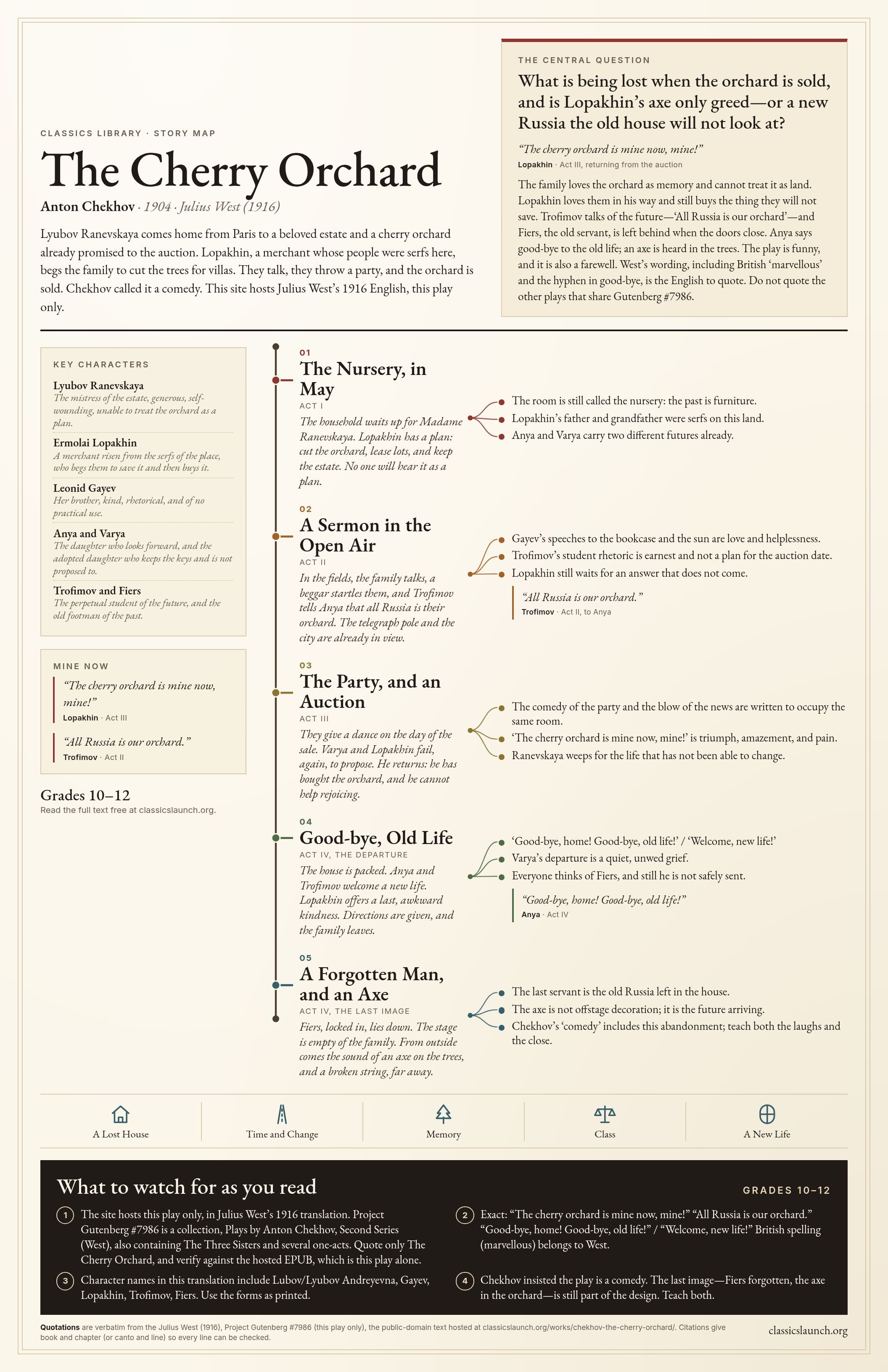
Lyubov Ranevskaya comes home from Paris to a beloved estate and a cherry orchard already promised to the auction. Lopakhin, a merchant whose people were serfs here, begs the family to cut the trees for villas. They talk, they throw a party, and the orchard is sold. Chekhov called it a comedy. This site hosts Julius West’s 1916 English, this play only.
The central question
What is being lost when the orchard is sold, and is Lopakhin’s axe only greed—or a new Russia the old house will not look at?
“The cherry orchard is mine now, mine!”
The family loves the orchard as memory and cannot treat it as land. Lopakhin loves them in his way and still buys the thing they will not save. Trofimov talks of the future—‘All Russia is our orchard’—and Fiers, the old servant, is left behind when the doors close. Anya says good-bye to the old life; an axe is heard in the trees. The play is funny, and it is also a farewell. West’s wording, including British ‘marvellous’ and the hyphen in good-bye, is the English to quote. Do not quote the other plays that share Gutenberg #7986.
- 01
The Nursery, in May
Act I
The household waits up for Madame Ranevskaya. Lopakhin has a plan: cut the orchard, lease lots, and keep the estate. No one will hear it as a plan.
- The room is still called the nursery: the past is furniture.
- Lopakhin’s father and grandfather were serfs on this land.
- Anya and Varya carry two different futures already.
- 02
A Sermon in the Open Air
Act II
In the fields, the family talks, a beggar startles them, and Trofimov tells Anya that all Russia is their orchard. The telegraph pole and the city are already in view.
- Gayev’s speeches to the bookcase and the sun are love and helplessness.
- Trofimov’s student rhetoric is earnest and not a plan for the auction date.
- Lopakhin still waits for an answer that does not come.
“All Russia is our orchard.”
- 03
The Party, and an Auction
Act III
They give a dance on the day of the sale. Varya and Lopakhin fail, again, to propose. He returns: he has bought the orchard, and he cannot help rejoicing.
- The comedy of the party and the blow of the news are written to occupy the same room.
- ‘The cherry orchard is mine now, mine!’ is triumph, amazement, and pain.
- Ranevskaya weeps for the life that has not been able to change.
- 04
Good-bye, Old Life
Act IV, the departure
The house is packed. Anya and Trofimov welcome a new life. Lopakhin offers a last, awkward kindness. Directions are given, and the family leaves.
- ‘Good-bye, home! Good-bye, old life!’ / ‘Welcome, new life!’
- Varya’s departure is a quiet, unwed grief.
- Everyone thinks of Fiers, and still he is not safely sent.
“Good-bye, home! Good-bye, old life!”
- 05
A Forgotten Man, and an Axe
Act IV, the last image
Fiers, locked in, lies down. The stage is empty of the family. From outside comes the sound of an axe on the trees, and a broken string, far away.
- The last servant is the old Russia left in the house.
- The axe is not offstage decoration; it is the future arriving.
- Chekhov’s ‘comedy’ includes this abandonment; teach both the laughs and the close.
- A Lost House
- Time and Change
- Memory
- Class
- A New Life
What to watch for as you read
Grades 10–12- The site hosts this play only, in Julius West’s 1916 translation. Project Gutenberg #7986 is a collection, Plays by Anton Chekhov, Second Series (West), also containing The Three Sisters and several one-acts. Quote only The Cherry Orchard, and verify against the hosted EPUB, which is this play alone.
- Exact: “The cherry orchard is mine now, mine!” “All Russia is our orchard.” “Good-bye, home! Good-bye, old life!” / “Welcome, new life!” British spelling (marvellous) belongs to West.
- Character names in this translation include Lubov/Lyubov Andreyevna, Gayev, Lopakhin, Trofimov, Fiers. Use the forms as printed.
- Chekhov insisted the play is a comedy. The last image—Fiers forgotten, the axe in the orchard—is still part of the design. Teach both.
Every quotation is word for word from the Julius West (1916) hosted in this library and is checked against that text each time the site is built. Citations give book and chapter (or canto and line).