Story maps · Grades 11–12
Childe Harold’s Pilgrimage: A Story Map
The PDF is one tabloid page (11 × 17 in). On letter paper, choose “Fit to page.”
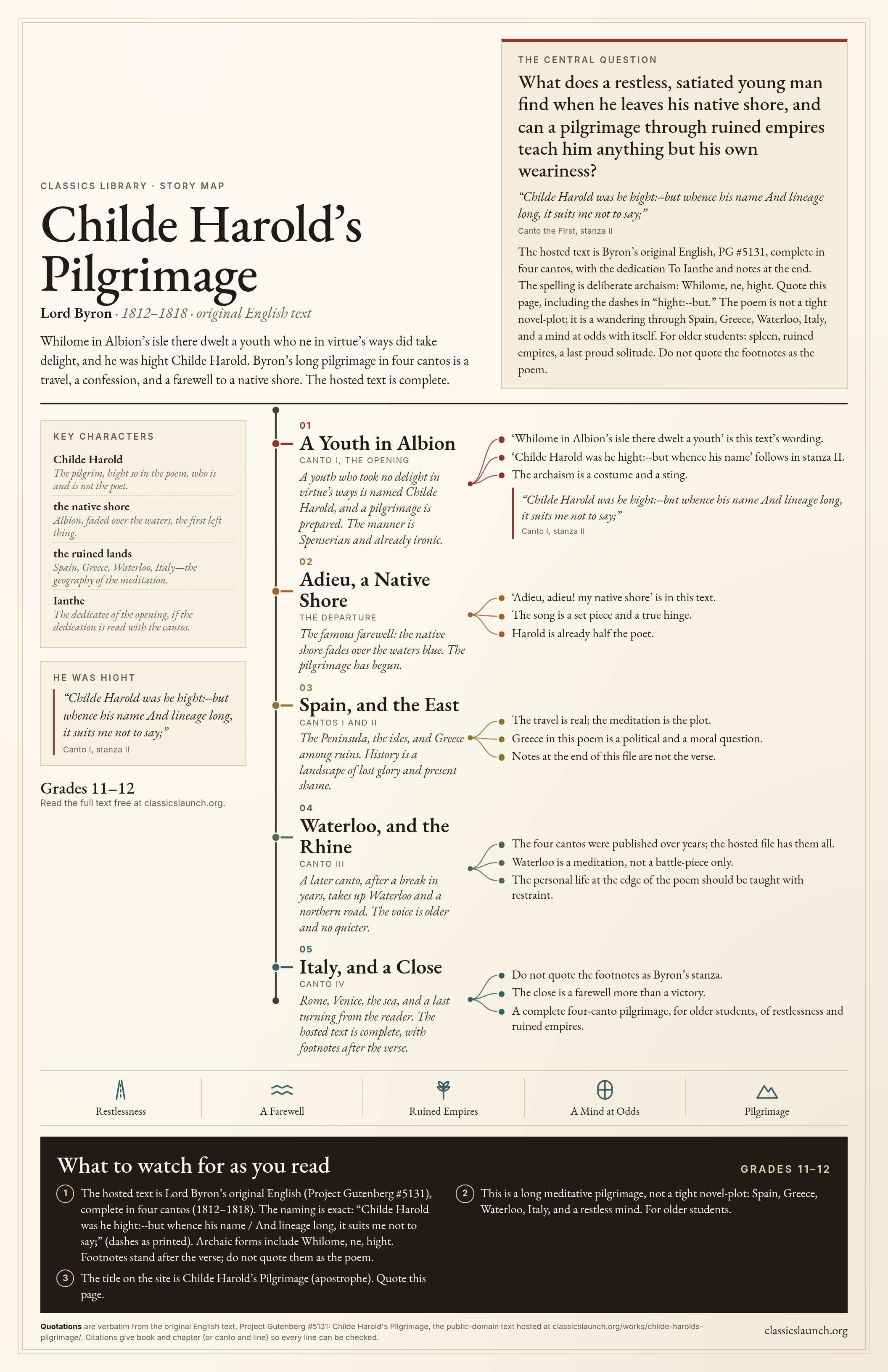
Whilome in Albion’s isle there dwelt a youth who ne in virtue’s ways did take delight, and he was hight Childe Harold. Byron’s long pilgrimage in four cantos is a travel, a confession, and a farewell to a native shore. The hosted text is complete.
The central question
What does a restless, satiated young man find when he leaves his native shore, and can a pilgrimage through ruined empires teach him anything but his own weariness?
“Childe Harold was he hight:--but whence his name And lineage long, it suits me not to say;”
The hosted text is Byron’s original English, PG #5131, complete in four cantos, with the dedication To Ianthe and notes at the end. The spelling is deliberate archaism: Whilome, ne, hight. Quote this page, including the dashes in “hight:--but.” The poem is not a tight novel-plot; it is a wandering through Spain, Greece, Waterloo, Italy, and a mind at odds with itself. For older students: spleen, ruined empires, a last proud solitude. Do not quote the footnotes as the poem.
- 01
A Youth in Albion
Canto I, the opening
A youth who took no delight in virtue’s ways is named Childe Harold, and a pilgrimage is prepared. The manner is Spenserian and already ironic.
- ‘Whilome in Albion’s isle there dwelt a youth’ is this text’s wording.
- ‘Childe Harold was he hight:--but whence his name’ follows in stanza II.
- The archaism is a costume and a sting.
“Childe Harold was he hight:--but whence his name And lineage long, it suits me not to say;”
- 02
Adieu, a Native Shore
The departure
The famous farewell: the native shore fades over the waters blue. The pilgrimage has begun.
- ‘Adieu, adieu! my native shore’ is in this text.
- The song is a set piece and a true hinge.
- Harold is already half the poet.
- 03
Spain, and the East
Cantos I and II
The Peninsula, the isles, and Greece among ruins. History is a landscape of lost glory and present shame.
- The travel is real; the meditation is the plot.
- Greece in this poem is a political and a moral question.
- Notes at the end of this file are not the verse.
- 04
Waterloo, and the Rhine
Canto III
A later canto, after a break in years, takes up Waterloo and a northern road. The voice is older and no quieter.
- The four cantos were published over years; the hosted file has them all.
- Waterloo is a meditation, not a battle-piece only.
- The personal life at the edge of the poem should be taught with restraint.
- 05
Italy, and a Close
Canto IV
Rome, Venice, the sea, and a last turning from the reader. The hosted text is complete, with footnotes after the verse.
- Do not quote the footnotes as Byron’s stanza.
- The close is a farewell more than a victory.
- A complete four-canto pilgrimage, for older students, of restlessness and ruined empires.
- Restlessness
- A Farewell
- Ruined Empires
- A Mind at Odds
- Pilgrimage
What to watch for as you read
Grades 11–12- The hosted text is Lord Byron’s original English (Project Gutenberg #5131), complete in four cantos (1812–1818). The naming is exact: “Childe Harold was he hight:--but whence his name / And lineage long, it suits me not to say;” (dashes as printed). Archaic forms include Whilome, ne, hight. Footnotes stand after the verse; do not quote them as the poem.
- This is a long meditative pilgrimage, not a tight novel-plot: Spain, Greece, Waterloo, Italy, and a restless mind. For older students.
- The title on the site is Childe Harold’s Pilgrimage (apostrophe). Quote this page.
Every quotation is word for word from the original English text hosted in this library and is checked against that text each time the site is built. Citations give book and chapter (or canto and line).