Story maps · Grades 9–12
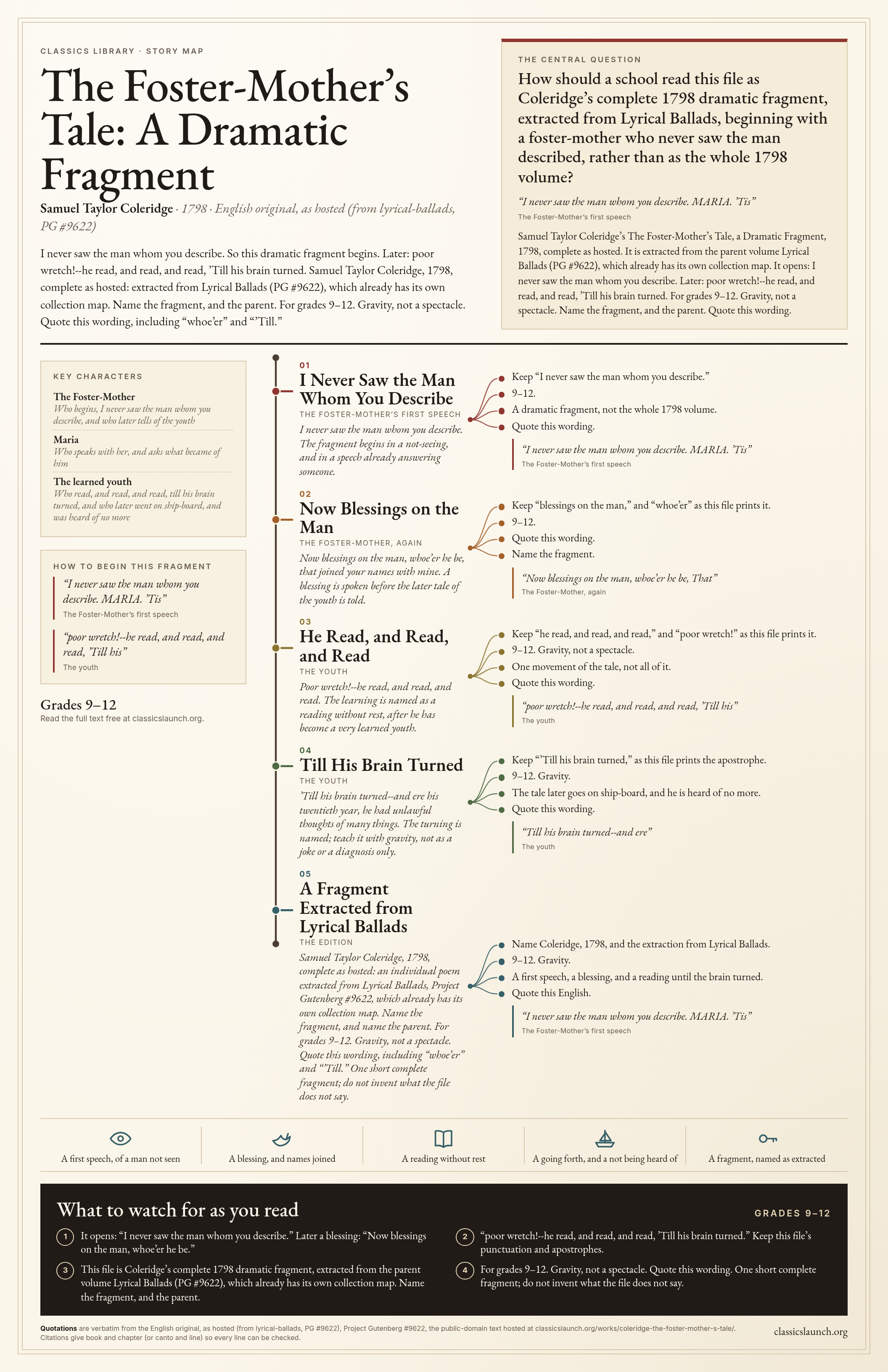
The Foster-Mother’s Tale: A Dramatic Fragment: A Story Map
The PDF is one tabloid page (11 × 17 in). On letter paper, choose “Fit to page.”
I never saw the man whom you describe. So this dramatic fragment begins. Later: poor wretch!--he read, and read, and read, ’Till his brain turned. Samuel Taylor Coleridge, 1798, complete as hosted: extracted from Lyrical Ballads (PG #9622), which already has its own collection map. Name the fragment, and the parent. For grades 9–12. Gravity, not a spectacle. Quote this wording, including “whoe’er” and “’Till.”
The central question
How should a school read this file as Coleridge’s complete 1798 dramatic fragment, extracted from Lyrical Ballads, beginning with a foster-mother who never saw the man described, rather than as the whole 1798 volume?
“I never saw the man whom you describe. MARIA. ’Tis”
Samuel Taylor Coleridge’s The Foster-Mother’s Tale, a Dramatic Fragment, 1798, complete as hosted. It is extracted from the parent volume Lyrical Ballads (PG #9622), which already has its own collection map. It opens: I never saw the man whom you describe. Later: poor wretch!--he read, and read, and read, ’Till his brain turned. For grades 9–12. Gravity, not a spectacle. Name the fragment, and the parent. Quote this wording.
- 01
I Never Saw the Man Whom You Describe
The Foster-Mother’s first speech
I never saw the man whom you describe. The fragment begins in a not-seeing, and in a speech already answering someone.
- Keep “I never saw the man whom you describe.”
- 9–12.
- A dramatic fragment, not the whole 1798 volume.
- Quote this wording.
“I never saw the man whom you describe. MARIA. ’Tis”
- 02
Now Blessings on the Man
The Foster-Mother, again
Now blessings on the man, whoe’er he be, that joined your names with mine. A blessing is spoken before the later tale of the youth is told.
- Keep “blessings on the man,” and “whoe’er” as this file prints it.
- 9–12.
- Quote this wording.
- Name the fragment.
“Now blessings on the man, whoe’er he be, That”
- 03
He Read, and Read, and Read
The youth
Poor wretch!--he read, and read, and read. The learning is named as a reading without rest, after he has become a very learned youth.
- Keep “he read, and read, and read,” and “poor wretch!” as this file prints it.
- 9–12. Gravity, not a spectacle.
- One movement of the tale, not all of it.
- Quote this wording.
“poor wretch!--he read, and read, and read, ’Till his”
- 04
Till His Brain Turned
The youth
’Till his brain turned--and ere his twentieth year, he had unlawful thoughts of many things. The turning is named; teach it with gravity, not as a joke or a diagnosis only.
- Keep “’Till his brain turned,” as this file prints the apostrophe.
- 9–12. Gravity.
- The tale later goes on ship-board, and he is heard of no more.
- Quote this wording.
“Till his brain turned--and ere”
- 05
A Fragment Extracted from Lyrical Ballads
The edition
Samuel Taylor Coleridge, 1798, complete as hosted: an individual poem extracted from Lyrical Ballads, Project Gutenberg #9622, which already has its own collection map. Name the fragment, and name the parent. For grades 9–12. Gravity, not a spectacle. Quote this wording, including “whoe’er” and “’Till.” One short complete fragment; do not invent what the file does not say.
- Name Coleridge, 1798, and the extraction from Lyrical Ballads.
- 9–12. Gravity.
- A first speech, a blessing, and a reading until the brain turned.
- Quote this English.
“I never saw the man whom you describe. MARIA. ’Tis”
- A first speech, of a man not seen
- A blessing, and names joined
- A reading without rest
- A going forth, and a not being heard of
- A fragment, named as extracted
What to watch for as you read
Grades 9–12- It opens: “I never saw the man whom you describe.” Later a blessing: “Now blessings on the man, whoe’er he be.”
- “poor wretch!--he read, and read, and read, ’Till his brain turned.” Keep this file’s punctuation and apostrophes.
- This file is Coleridge’s complete 1798 dramatic fragment, extracted from the parent volume Lyrical Ballads (PG #9622), which already has its own collection map. Name the fragment, and the parent.
- For grades 9–12. Gravity, not a spectacle. Quote this wording. One short complete fragment; do not invent what the file does not say.
Every quotation is word for word from the English original, as hosted (from lyrical-ballads, PG #9622) hosted in this library and is checked against that text each time the site is built. Citations give book and chapter (or canto and line).