Story maps · Grades 10–12
Confessions: A Story Map
The PDF is one tabloid page (11 × 17 in). On letter paper, choose “Fit to page.”
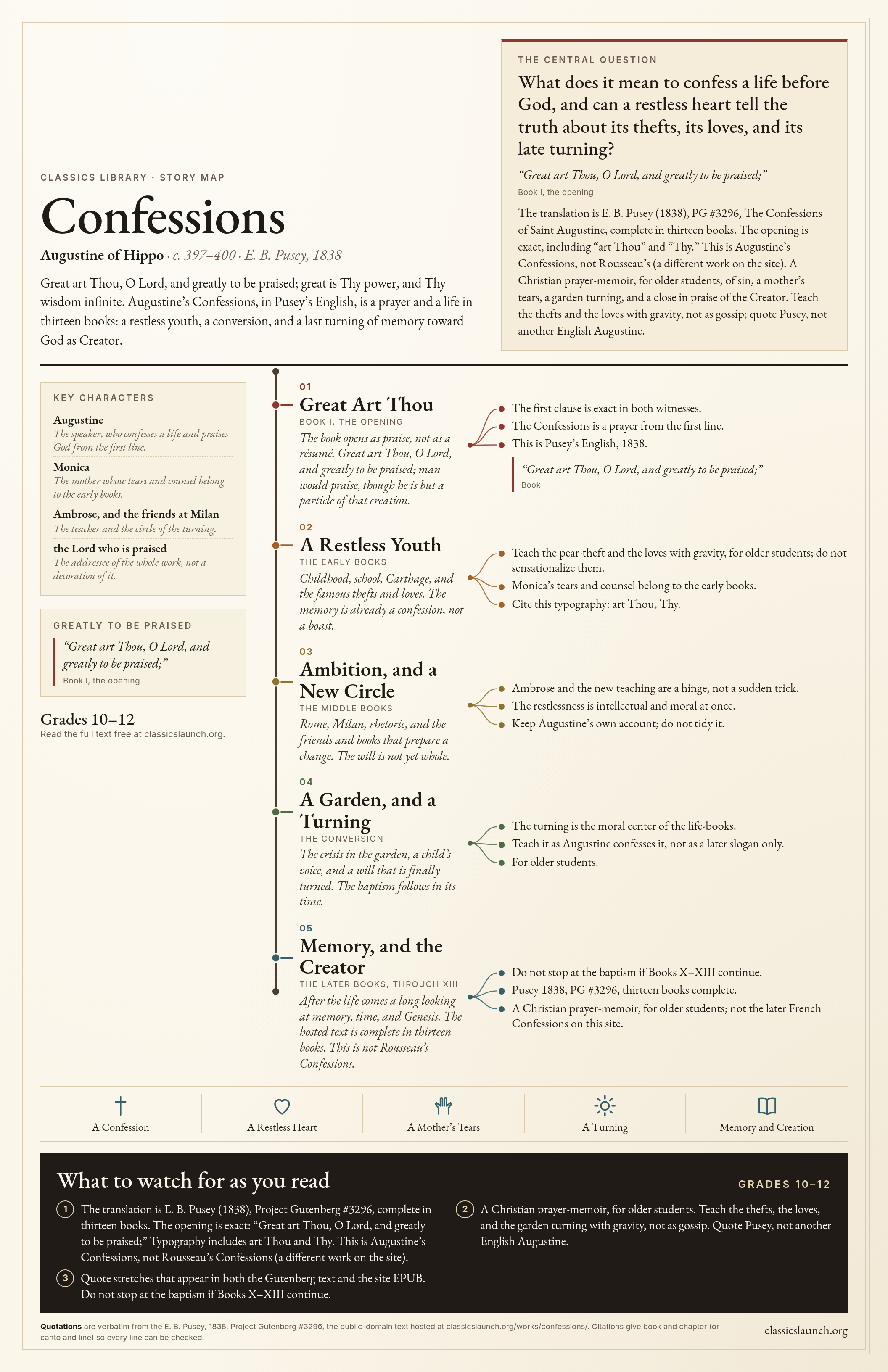
Great art Thou, O Lord, and greatly to be praised; great is Thy power, and Thy wisdom infinite. Augustine’s Confessions, in Pusey’s English, is a prayer and a life in thirteen books: a restless youth, a conversion, and a last turning of memory toward God as Creator.
The central question
What does it mean to confess a life before God, and can a restless heart tell the truth about its thefts, its loves, and its late turning?
“Great art Thou, O Lord, and greatly to be praised;”
The translation is E. B. Pusey (1838), PG #3296, The Confessions of Saint Augustine, complete in thirteen books. The opening is exact, including “art Thou” and “Thy.” This is Augustine’s Confessions, not Rousseau’s (a different work on the site). A Christian prayer-memoir, for older students, of sin, a mother’s tears, a garden turning, and a close in praise of the Creator. Teach the thefts and the loves with gravity, not as gossip; quote Pusey, not another English Augustine.
- 01
Great Art Thou
Book I, the opening
The book opens as praise, not as a résumé. Great art Thou, O Lord, and greatly to be praised; man would praise, though he is but a particle of that creation.
- The first clause is exact in both witnesses.
- The Confessions is a prayer from the first line.
- This is Pusey’s English, 1838.
“Great art Thou, O Lord, and greatly to be praised;”
- 02
A Restless Youth
The early books
Childhood, school, Carthage, and the famous thefts and loves. The memory is already a confession, not a boast.
- Teach the pear-theft and the loves with gravity, for older students; do not sensationalize them.
- Monica’s tears and counsel belong to the early books.
- Cite this typography: art Thou, Thy.
- 03
Ambition, and a New Circle
The middle books
Rome, Milan, rhetoric, and the friends and books that prepare a change. The will is not yet whole.
- Ambrose and the new teaching are a hinge, not a sudden trick.
- The restlessness is intellectual and moral at once.
- Keep Augustine’s own account; do not tidy it.
- 04
A Garden, and a Turning
The conversion
The crisis in the garden, a child’s voice, and a will that is finally turned. The baptism follows in its time.
- The turning is the moral center of the life-books.
- Teach it as Augustine confesses it, not as a later slogan only.
- For older students.
- 05
Memory, and the Creator
The later books, through XIII
After the life comes a long looking at memory, time, and Genesis. The hosted text is complete in thirteen books. This is not Rousseau’s Confessions.
- Do not stop at the baptism if Books X–XIII continue.
- Pusey 1838, PG #3296, thirteen books complete.
- A Christian prayer-memoir, for older students; not the later French Confessions on this site.
- A Confession
- A Restless Heart
- A Mother’s Tears
- A Turning
- Memory and Creation
What to watch for as you read
Grades 10–12- The translation is E. B. Pusey (1838), Project Gutenberg #3296, complete in thirteen books. The opening is exact: “Great art Thou, O Lord, and greatly to be praised;” Typography includes art Thou and Thy. This is Augustine’s Confessions, not Rousseau’s Confessions (a different work on the site).
- A Christian prayer-memoir, for older students. Teach the thefts, the loves, and the garden turning with gravity, not as gossip. Quote Pusey, not another English Augustine.
- Quote stretches that appear in both the Gutenberg text and the site EPUB. Do not stop at the baptism if Books X–XIII continue.
Every quotation is word for word from the E. B. Pusey, 1838 hosted in this library and is checked against that text each time the site is built. Citations give book and chapter (or canto and line).