Story maps · Grades 10–12
Coriolanus: A Story Map
The PDF is one tabloid page (11 × 17 in). On letter paper, choose “Fit to page.”
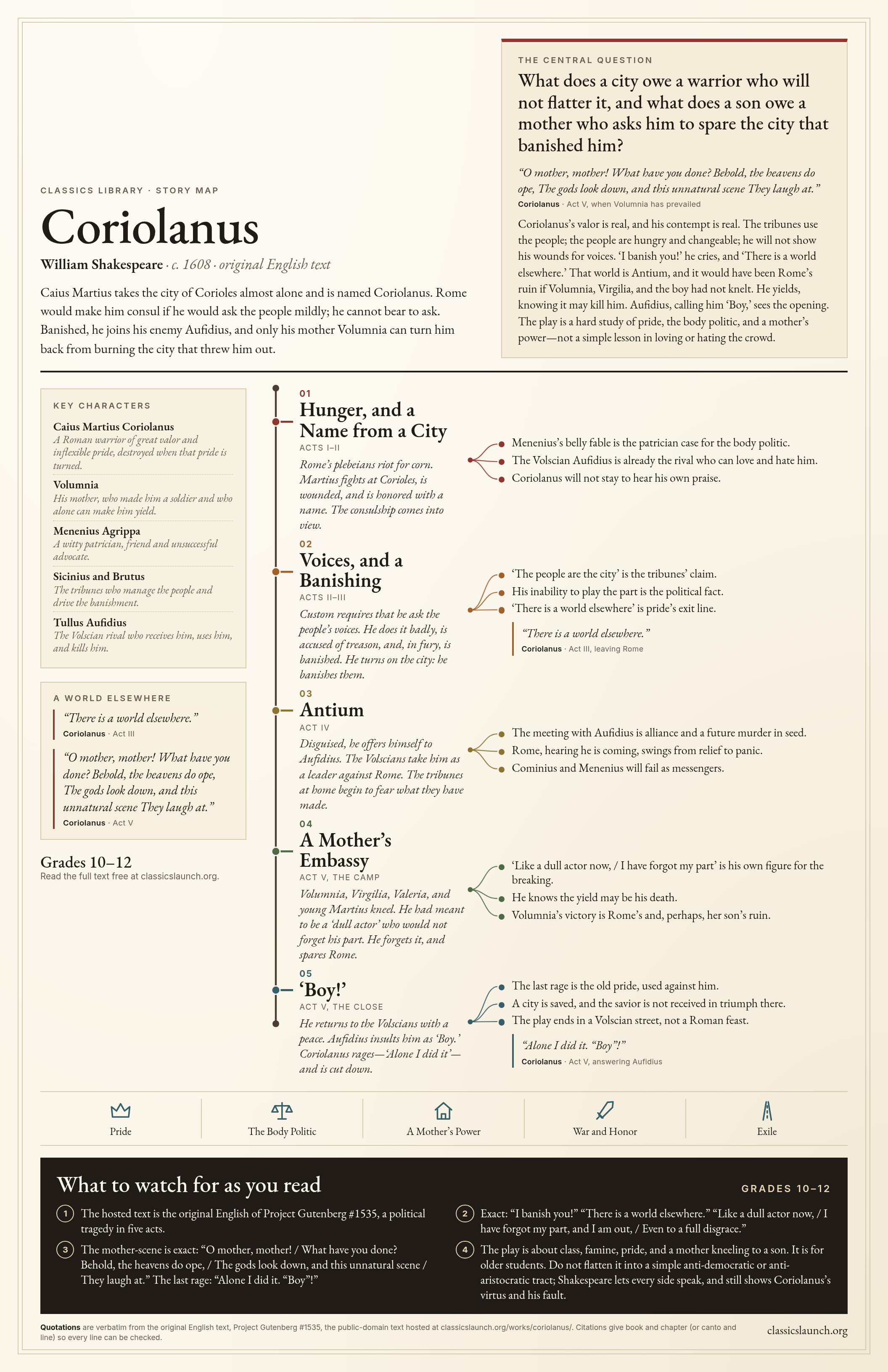
Caius Martius takes the city of Corioles almost alone and is named Coriolanus. Rome would make him consul if he would ask the people mildly; he cannot bear to ask. Banished, he joins his enemy Aufidius, and only his mother Volumnia can turn him back from burning the city that threw him out.
The central question
What does a city owe a warrior who will not flatter it, and what does a son owe a mother who asks him to spare the city that banished him?
“O mother, mother! What have you done? Behold, the heavens do ope, The gods look down, and this unnatural scene They laugh at.”
Coriolanus’s valor is real, and his contempt is real. The tribunes use the people; the people are hungry and changeable; he will not show his wounds for voices. ‘I banish you!’ he cries, and ‘There is a world elsewhere.’ That world is Antium, and it would have been Rome’s ruin if Volumnia, Virgilia, and the boy had not knelt. He yields, knowing it may kill him. Aufidius, calling him ‘Boy,’ sees the opening. The play is a hard study of pride, the body politic, and a mother’s power—not a simple lesson in loving or hating the crowd.
- 01
Hunger, and a Name from a City
Acts I–II
Rome’s plebeians riot for corn. Martius fights at Corioles, is wounded, and is honored with a name. The consulship comes into view.
- Menenius’s belly fable is the patrician case for the body politic.
- The Volscian Aufidius is already the rival who can love and hate him.
- Coriolanus will not stay to hear his own praise.
- 02
Voices, and a Banishing
Acts II–III
Custom requires that he ask the people’s voices. He does it badly, is accused of treason, and, in fury, is banished. He turns on the city: he banishes them.
- ‘The people are the city’ is the tribunes’ claim.
- His inability to play the part is the political fact.
- ‘There is a world elsewhere’ is pride’s exit line.
“There is a world elsewhere.”
- 03
Antium
Act IV
Disguised, he offers himself to Aufidius. The Volscians take him as a leader against Rome. The tribunes at home begin to fear what they have made.
- The meeting with Aufidius is alliance and a future murder in seed.
- Rome, hearing he is coming, swings from relief to panic.
- Cominius and Menenius will fail as messengers.
- 04
A Mother’s Embassy
Act V, the camp
Volumnia, Virgilia, Valeria, and young Martius kneel. He had meant to be a ‘dull actor’ who would not forget his part. He forgets it, and spares Rome.
- ‘Like a dull actor now, / I have forgot my part’ is his own figure for the breaking.
- He knows the yield may be his death.
- Volumnia’s victory is Rome’s and, perhaps, her son’s ruin.
- 05
‘Boy!’
Act V, the close
He returns to the Volscians with a peace. Aufidius insults him as ‘Boy.’ Coriolanus rages—‘Alone I did it’—and is cut down.
- The last rage is the old pride, used against him.
- A city is saved, and the savior is not received in triumph there.
- The play ends in a Volscian street, not a Roman feast.
“Alone I did it. “Boy”!”
- Pride
- The Body Politic
- A Mother’s Power
- War and Honor
- Exile
What to watch for as you read
Grades 10–12- The hosted text is the original English of Project Gutenberg #1535, a political tragedy in five acts.
- Exact: “I banish you!” “There is a world elsewhere.” “Like a dull actor now, / I have forgot my part, and I am out, / Even to a full disgrace.”
- The mother-scene is exact: “O mother, mother! / What have you done? Behold, the heavens do ope, / The gods look down, and this unnatural scene / They laugh at.” The last rage: “Alone I did it. “Boy”!”
- The play is about class, famine, pride, and a mother kneeling to a son. It is for older students. Do not flatten it into a simple anti-democratic or anti-aristocratic tract; Shakespeare lets every side speak, and still shows Coriolanus’s virtus and his fault.
Every quotation is word for word from the original English text hosted in this library and is checked against that text each time the site is built. Citations give book and chapter (or canto and line).