Story maps · Grades 7–12
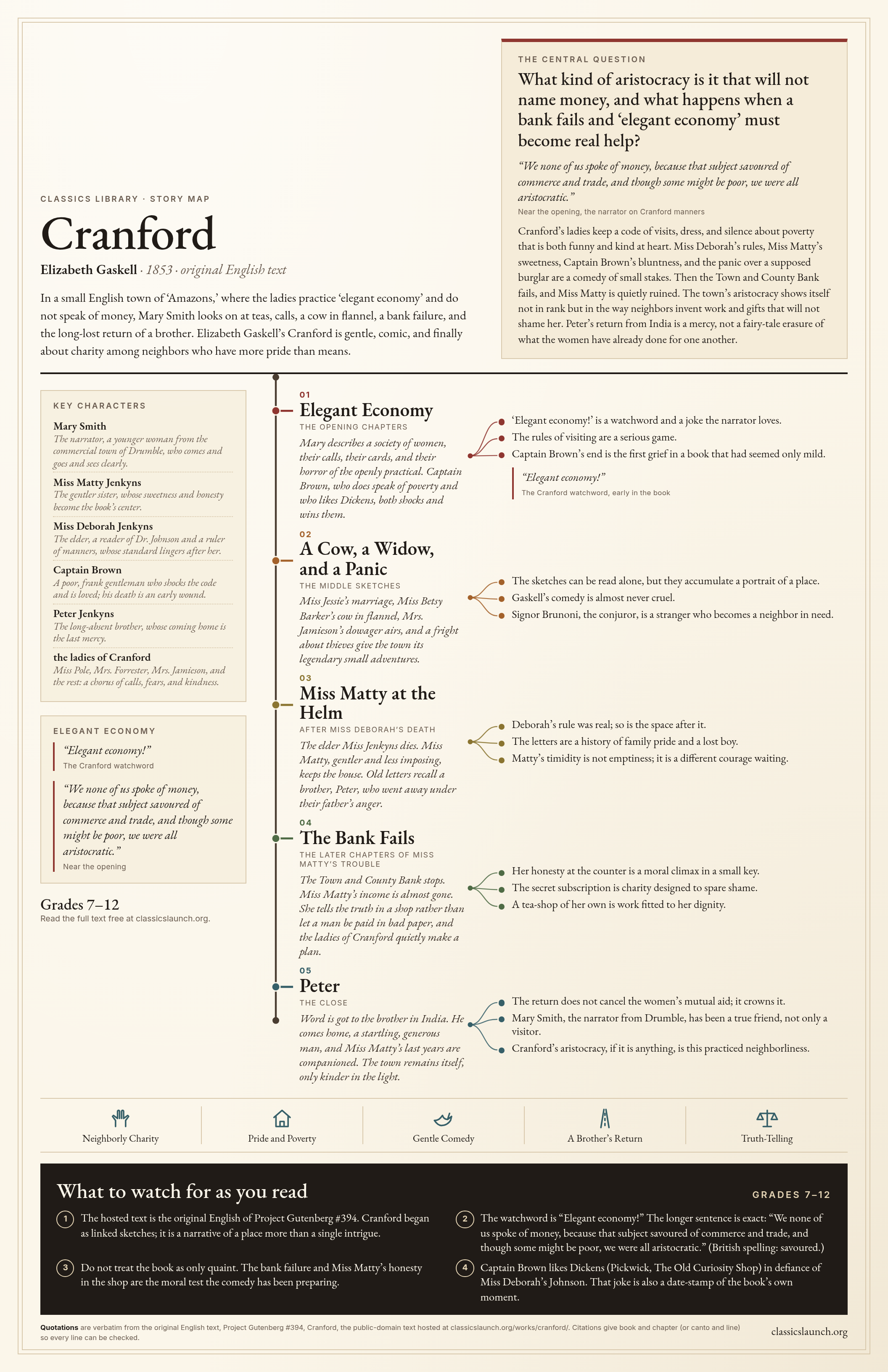
Cranford: A Story Map
The PDF is one tabloid page (11 × 17 in). On letter paper, choose “Fit to page.”
In a small English town of ‘Amazons,’ where the ladies practice ‘elegant economy’ and do not speak of money, Mary Smith looks on at teas, calls, a cow in flannel, a bank failure, and the long-lost return of a brother. Elizabeth Gaskell’s Cranford is gentle, comic, and finally about charity among neighbors who have more pride than means.
The central question
What kind of aristocracy is it that will not name money, and what happens when a bank fails and ‘elegant economy’ must become real help?
“We none of us spoke of money, because that subject savoured of commerce and trade, and though some might be poor, we were all aristocratic.”
Cranford’s ladies keep a code of visits, dress, and silence about poverty that is both funny and kind at heart. Miss Deborah’s rules, Miss Matty’s sweetness, Captain Brown’s bluntness, and the panic over a supposed burglar are a comedy of small stakes. Then the Town and County Bank fails, and Miss Matty is quietly ruined. The town’s aristocracy shows itself not in rank but in the way neighbors invent work and gifts that will not shame her. Peter’s return from India is a mercy, not a fairy-tale erasure of what the women have already done for one another.
- 01
Elegant Economy
The opening chapters
Mary describes a society of women, their calls, their cards, and their horror of the openly practical. Captain Brown, who does speak of poverty and who likes Dickens, both shocks and wins them.
- ‘Elegant economy!’ is a watchword and a joke the narrator loves.
- The rules of visiting are a serious game.
- Captain Brown’s end is the first grief in a book that had seemed only mild.
“Elegant economy!”
- 02
A Cow, a Widow, and a Panic
The middle sketches
Miss Jessie’s marriage, Miss Betsy Barker’s cow in flannel, Mrs. Jamieson’s dowager airs, and a fright about thieves give the town its legendary small adventures.
- The sketches can be read alone, but they accumulate a portrait of a place.
- Gaskell’s comedy is almost never cruel.
- Signor Brunoni, the conjuror, is a stranger who becomes a neighbor in need.
- 03
Miss Matty at the Helm
After Miss Deborah’s death
The elder Miss Jenkyns dies. Miss Matty, gentler and less imposing, keeps the house. Old letters recall a brother, Peter, who went away under their father’s anger.
- Deborah’s rule was real; so is the space after it.
- The letters are a history of family pride and a lost boy.
- Matty’s timidity is not emptiness; it is a different courage waiting.
- 04
The Bank Fails
The later chapters of Miss Matty’s trouble
The Town and County Bank stops. Miss Matty’s income is almost gone. She tells the truth in a shop rather than let a man be paid in bad paper, and the ladies of Cranford quietly make a plan.
- Her honesty at the counter is a moral climax in a small key.
- The secret subscription is charity designed to spare shame.
- A tea-shop of her own is work fitted to her dignity.
- 05
Peter
The close
Word is got to the brother in India. He comes home, a startling, generous man, and Miss Matty’s last years are companioned. The town remains itself, only kinder in the light.
- The return does not cancel the women’s mutual aid; it crowns it.
- Mary Smith, the narrator from Drumble, has been a true friend, not only a visitor.
- Cranford’s aristocracy, if it is anything, is this practiced neighborliness.
- Neighborly Charity
- Pride and Poverty
- Gentle Comedy
- A Brother’s Return
- Truth-Telling
What to watch for as you read
Grades 7–12- The hosted text is the original English of Project Gutenberg #394. Cranford began as linked sketches; it is a narrative of a place more than a single intrigue.
- The watchword is “Elegant economy!” The longer sentence is exact: “We none of us spoke of money, because that subject savoured of commerce and trade, and though some might be poor, we were all aristocratic.” (British spelling: savoured.)
- Do not treat the book as only quaint. The bank failure and Miss Matty’s honesty in the shop are the moral test the comedy has been preparing.
- Captain Brown likes Dickens (Pickwick, The Old Curiosity Shop) in defiance of Miss Deborah’s Johnson. That joke is also a date-stamp of the book’s own moment.
Every quotation is word for word from the original English text hosted in this library and is checked against that text each time the site is built. Citations give book and chapter (or canto and line).