Story maps · Grades 11–12
Daisy Miller: A Story Map
The PDF is one tabloid page (11 × 17 in). On letter paper, choose “Fit to page.”
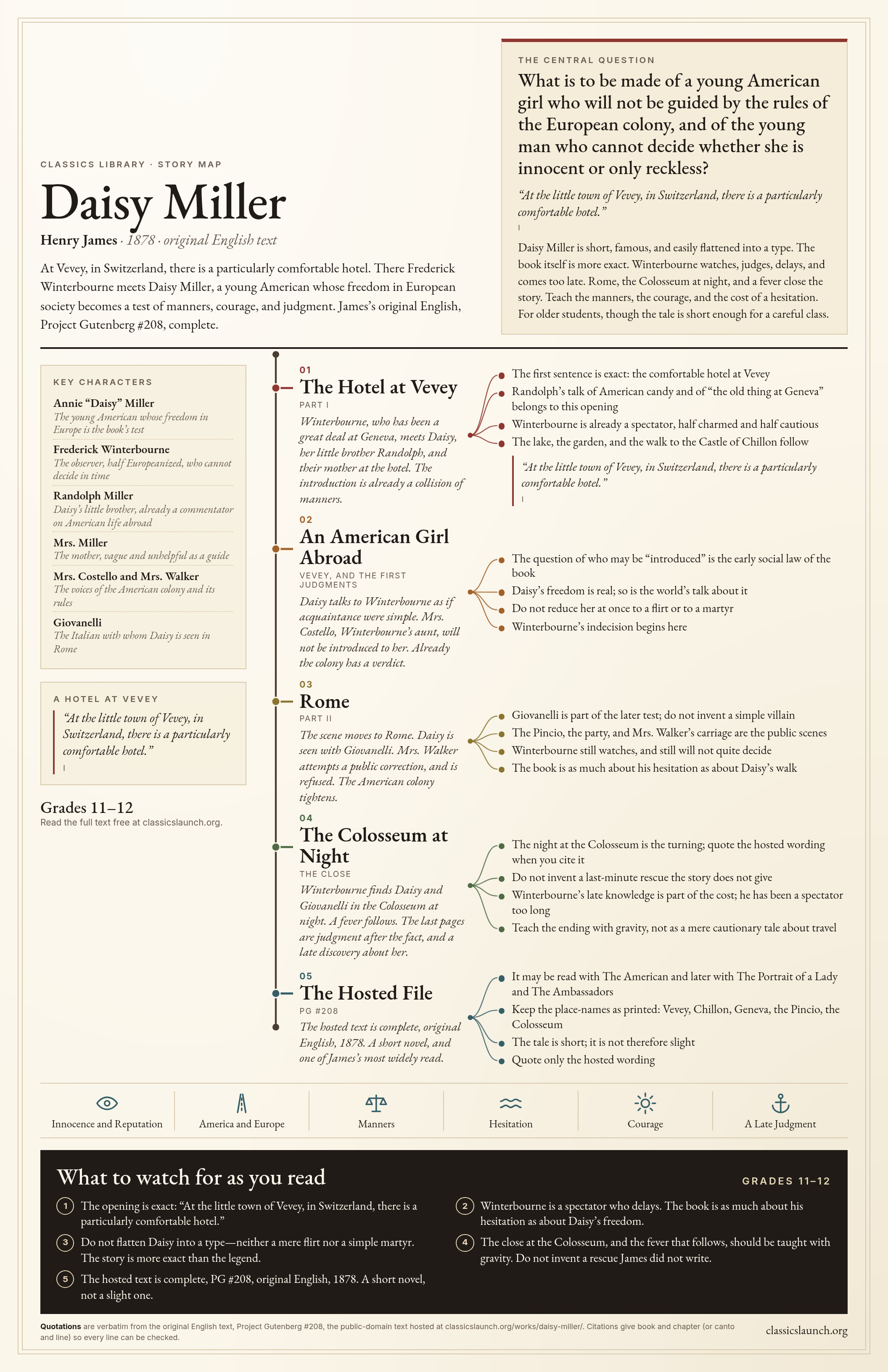
At Vevey, in Switzerland, there is a particularly comfortable hotel. There Frederick Winterbourne meets Daisy Miller, a young American whose freedom in European society becomes a test of manners, courage, and judgment. James’s original English, Project Gutenberg #208, complete.
The central question
What is to be made of a young American girl who will not be guided by the rules of the European colony, and of the young man who cannot decide whether she is innocent or only reckless?
“At the little town of Vevey, in Switzerland, there is a particularly comfortable hotel.”
Daisy Miller is short, famous, and easily flattened into a type. The book itself is more exact. Winterbourne watches, judges, delays, and comes too late. Rome, the Colosseum at night, and a fever close the story. Teach the manners, the courage, and the cost of a hesitation. For older students, though the tale is short enough for a careful class.
- 01
The Hotel at Vevey
Part I
Winterbourne, who has been a great deal at Geneva, meets Daisy, her little brother Randolph, and their mother at the hotel. The introduction is already a collision of manners.
- The first sentence is exact: the comfortable hotel at Vevey
- Randolph’s talk of American candy and of “the old thing at Geneva” belongs to this opening
- Winterbourne is already a spectator, half charmed and half cautious
- The lake, the garden, and the walk to the Castle of Chillon follow
“At the little town of Vevey, in Switzerland, there is a particularly comfortable hotel.”
- 02
An American Girl Abroad
Vevey, and the first judgments
Daisy talks to Winterbourne as if acquaintance were simple. Mrs. Costello, Winterbourne’s aunt, will not be introduced to her. Already the colony has a verdict.
- The question of who may be “introduced” is the early social law of the book
- Daisy’s freedom is real; so is the world’s talk about it
- Do not reduce her at once to a flirt or to a martyr
- Winterbourne’s indecision begins here
- 03
Rome
Part II
The scene moves to Rome. Daisy is seen with Giovanelli. Mrs. Walker attempts a public correction, and is refused. The American colony tightens.
- Giovanelli is part of the later test; do not invent a simple villain
- The Pincio, the party, and Mrs. Walker’s carriage are the public scenes
- Winterbourne still watches, and still will not quite decide
- The book is as much about his hesitation as about Daisy’s walk
- 04
The Colosseum at Night
The close
Winterbourne finds Daisy and Giovanelli in the Colosseum at night. A fever follows. The last pages are judgment after the fact, and a late discovery about her.
- The night at the Colosseum is the turning; quote the hosted wording when you cite it
- Do not invent a last-minute rescue the story does not give
- Winterbourne’s late knowledge is part of the cost; he has been a spectator too long
- Teach the ending with gravity, not as a mere cautionary tale about travel
- 05
The Hosted File
PG #208
The hosted text is complete, original English, 1878. A short novel, and one of James’s most widely read.
- It may be read with The American and later with The Portrait of a Lady and The Ambassadors
- Keep the place-names as printed: Vevey, Chillon, Geneva, the Pincio, the Colosseum
- The tale is short; it is not therefore slight
- Quote only the hosted wording
- Innocence and Reputation
- America and Europe
- Manners
- Hesitation
- Courage
- A Late Judgment
What to watch for as you read
Grades 11–12- The opening is exact: “At the little town of Vevey, in Switzerland, there is a particularly comfortable hotel.”
- Winterbourne is a spectator who delays. The book is as much about his hesitation as about Daisy’s freedom.
- Do not flatten Daisy into a type—neither a mere flirt nor a simple martyr. The story is more exact than the legend.
- The close at the Colosseum, and the fever that follows, should be taught with gravity. Do not invent a rescue James did not write.
- The hosted text is complete, PG #208, original English, 1878. A short novel, not a slight one.
Every quotation is word for word from the original English text hosted in this library and is checked against that text each time the site is built. Citations give book and chapter (or canto and line).