Story maps · Grades 10–12
Queen Margot (Marguerite de Valois): A Story Map
The PDF is one tabloid page (11 × 17 in). On letter paper, choose “Fit to page.”
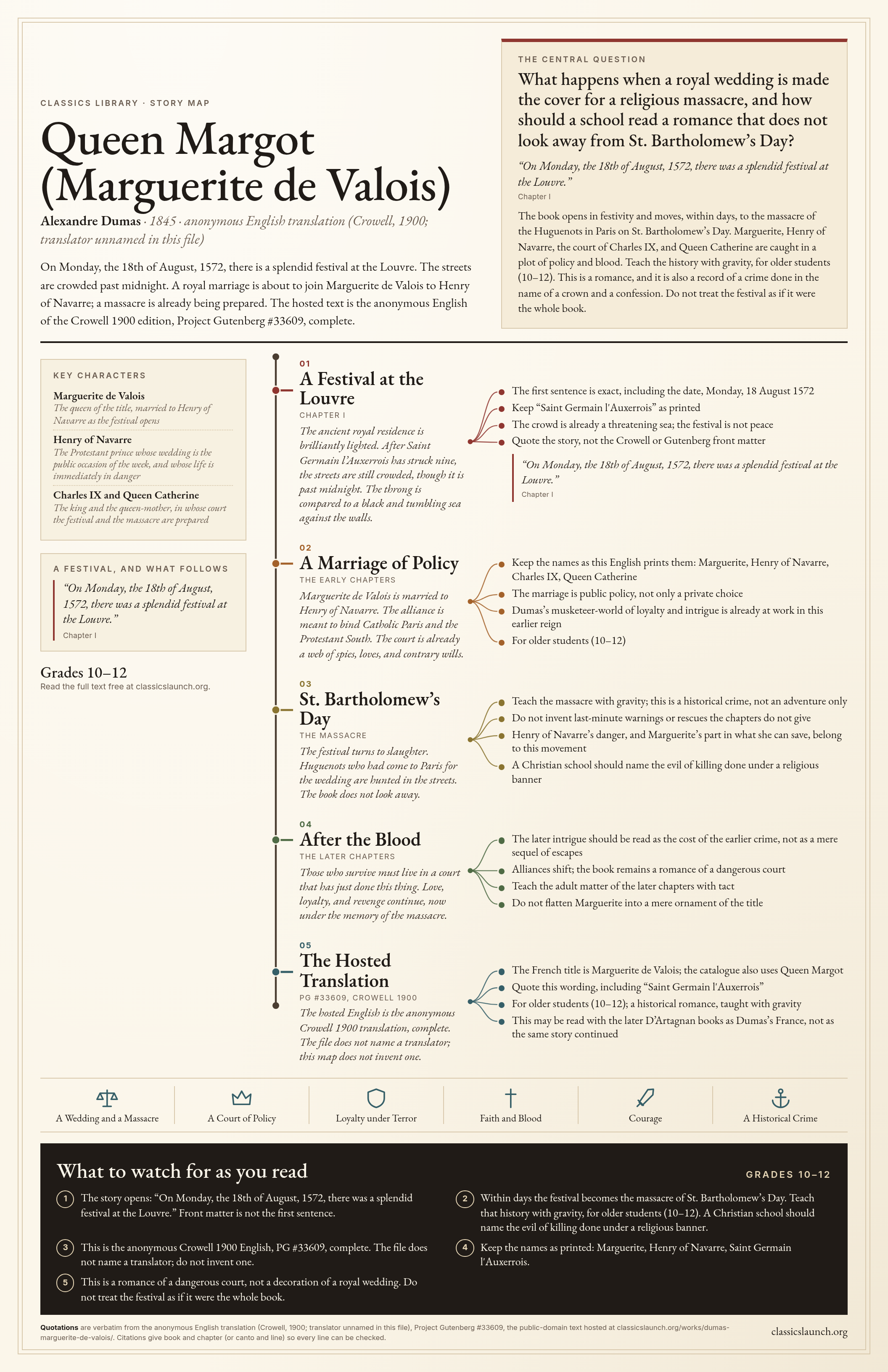
On Monday, the 18th of August, 1572, there is a splendid festival at the Louvre. The streets are crowded past midnight. A royal marriage is about to join Marguerite de Valois to Henry of Navarre; a massacre is already being prepared. The hosted text is the anonymous English of the Crowell 1900 edition, Project Gutenberg #33609, complete.
The central question
What happens when a royal wedding is made the cover for a religious massacre, and how should a school read a romance that does not look away from St. Bartholomew’s Day?
“On Monday, the 18th of August, 1572, there was a splendid festival at the Louvre.”
The book opens in festivity and moves, within days, to the massacre of the Huguenots in Paris on St. Bartholomew’s Day. Marguerite, Henry of Navarre, the court of Charles IX, and Queen Catherine are caught in a plot of policy and blood. Teach the history with gravity, for older students (10–12). This is a romance, and it is also a record of a crime done in the name of a crown and a confession. Do not treat the festival as if it were the whole book.
- 01
A Festival at the Louvre
Chapter I
The ancient royal residence is brilliantly lighted. After Saint Germain l’Auxerrois has struck nine, the streets are still crowded, though it is past midnight. The throng is compared to a black and tumbling sea against the walls.
- The first sentence is exact, including the date, Monday, 18 August 1572
- Keep “Saint Germain l'Auxerrois” as printed
- The crowd is already a threatening sea; the festival is not peace
- Quote the story, not the Crowell or Gutenberg front matter
“On Monday, the 18th of August, 1572, there was a splendid festival at the Louvre.”
- 02
A Marriage of Policy
The early chapters
Marguerite de Valois is married to Henry of Navarre. The alliance is meant to bind Catholic Paris and the Protestant South. The court is already a web of spies, loves, and contrary wills.
- Keep the names as this English prints them: Marguerite, Henry of Navarre, Charles IX, Queen Catherine
- The marriage is public policy, not only a private choice
- Dumas’s musketeer-world of loyalty and intrigue is already at work in this earlier reign
- For older students (10–12)
- 03
St. Bartholomew’s Day
The massacre
The festival turns to slaughter. Huguenots who had come to Paris for the wedding are hunted in the streets. The book does not look away.
- Teach the massacre with gravity; this is a historical crime, not an adventure only
- Do not invent last-minute warnings or rescues the chapters do not give
- Henry of Navarre’s danger, and Marguerite’s part in what she can save, belong to this movement
- A Christian school should name the evil of killing done under a religious banner
- 04
After the Blood
The later chapters
Those who survive must live in a court that has just done this thing. Love, loyalty, and revenge continue, now under the memory of the massacre.
- The later intrigue should be read as the cost of the earlier crime, not as a mere sequel of escapes
- Alliances shift; the book remains a romance of a dangerous court
- Teach the adult matter of the later chapters with tact
- Do not flatten Marguerite into a mere ornament of the title
- 05
The Hosted Translation
PG #33609, Crowell 1900
The hosted English is the anonymous Crowell 1900 translation, complete. The file does not name a translator; this map does not invent one.
- The French title is Marguerite de Valois; the catalogue also uses Queen Margot
- Quote this wording, including “Saint Germain l'Auxerrois”
- For older students (10–12); a historical romance, taught with gravity
- This may be read with the later D’Artagnan books as Dumas’s France, not as the same story continued
- A Wedding and a Massacre
- A Court of Policy
- Loyalty under Terror
- Faith and Blood
- Courage
- A Historical Crime
What to watch for as you read
Grades 10–12- The story opens: “On Monday, the 18th of August, 1572, there was a splendid festival at the Louvre.” Front matter is not the first sentence.
- Within days the festival becomes the massacre of St. Bartholomew’s Day. Teach that history with gravity, for older students (10–12). A Christian school should name the evil of killing done under a religious banner.
- This is the anonymous Crowell 1900 English, PG #33609, complete. The file does not name a translator; do not invent one.
- Keep the names as printed: Marguerite, Henry of Navarre, Saint Germain l'Auxerrois.
- This is a romance of a dangerous court, not a decoration of a royal wedding. Do not treat the festival as if it were the whole book.
Every quotation is word for word from the anonymous English translation (Crowell, 1900; translator unnamed in this file) hosted in this library and is checked against that text each time the site is built. Citations give book and chapter (or canto and line).