Story maps · Grades 7–12
The Black Tulip: A Story Map
The PDF is one tabloid page (11 × 17 in). On letter paper, choose “Fit to page.”
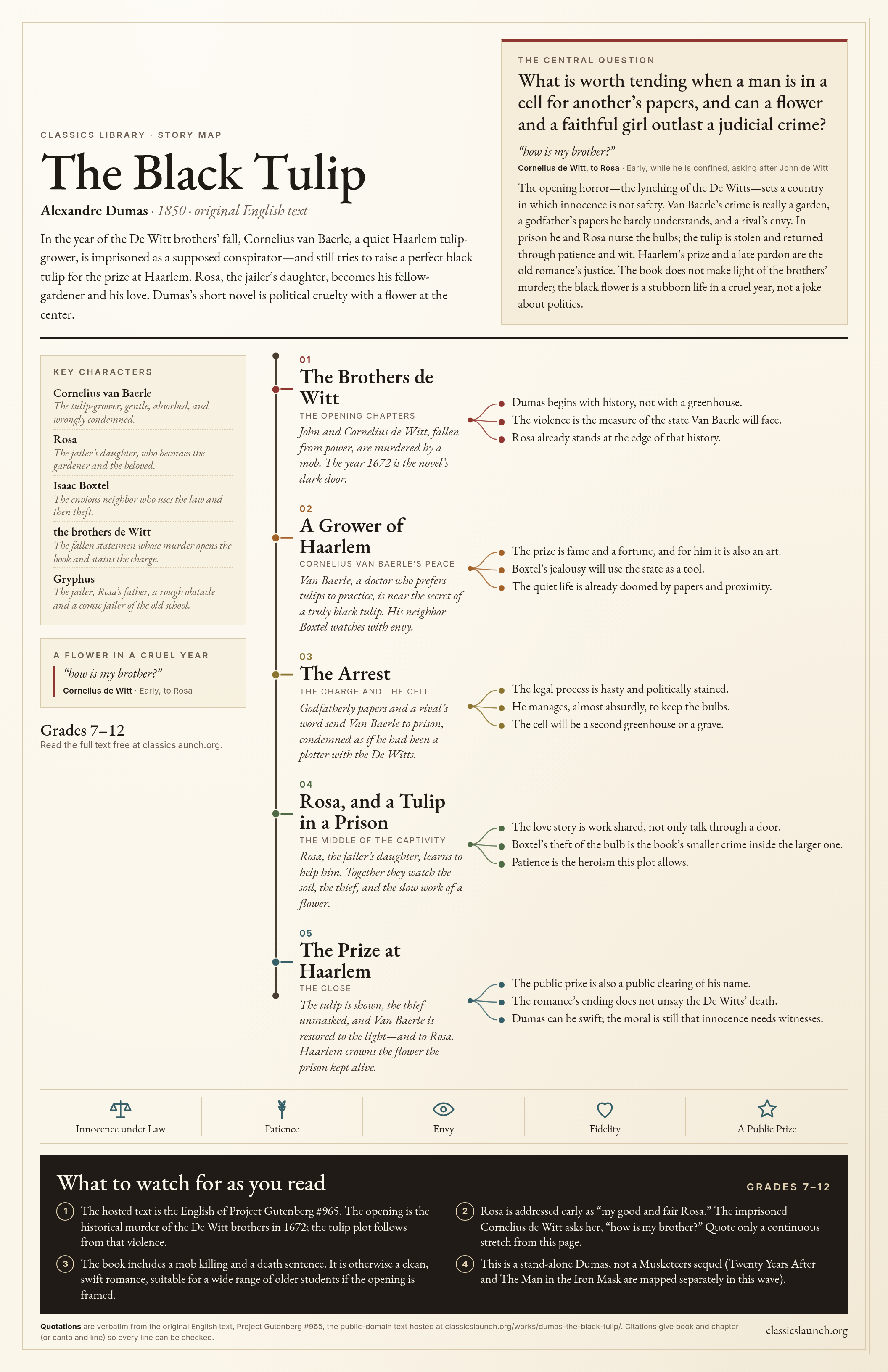
In the year of the De Witt brothers’ fall, Cornelius van Baerle, a quiet Haarlem tulip-grower, is imprisoned as a supposed conspirator—and still tries to raise a perfect black tulip for the prize at Haarlem. Rosa, the jailer’s daughter, becomes his fellow-gardener and his love. Dumas’s short novel is political cruelty with a flower at the center.
The central question
What is worth tending when a man is in a cell for another’s papers, and can a flower and a faithful girl outlast a judicial crime?
“how is my brother?”
The opening horror—the lynching of the De Witts—sets a country in which innocence is not safety. Van Baerle’s crime is really a garden, a godfather’s papers he barely understands, and a rival’s envy. In prison he and Rosa nurse the bulbs; the tulip is stolen and returned through patience and wit. Haarlem’s prize and a late pardon are the old romance’s justice. The book does not make light of the brothers’ murder; the black flower is a stubborn life in a cruel year, not a joke about politics.
- 01
The Brothers de Witt
The opening chapters
John and Cornelius de Witt, fallen from power, are murdered by a mob. The year 1672 is the novel’s dark door.
- Dumas begins with history, not with a greenhouse.
- The violence is the measure of the state Van Baerle will face.
- Rosa already stands at the edge of that history.
- 02
A Grower of Haarlem
Cornelius van Baerle’s peace
Van Baerle, a doctor who prefers tulips to practice, is near the secret of a truly black tulip. His neighbor Boxtel watches with envy.
- The prize is fame and a fortune, and for him it is also an art.
- Boxtel’s jealousy will use the state as a tool.
- The quiet life is already doomed by papers and proximity.
- 03
The Arrest
The charge and the cell
Godfatherly papers and a rival’s word send Van Baerle to prison, condemned as if he had been a plotter with the De Witts.
- The legal process is hasty and politically stained.
- He manages, almost absurdly, to keep the bulbs.
- The cell will be a second greenhouse or a grave.
- 04
Rosa, and a Tulip in a Prison
The middle of the captivity
Rosa, the jailer’s daughter, learns to help him. Together they watch the soil, the thief, and the slow work of a flower.
- The love story is work shared, not only talk through a door.
- Boxtel’s theft of the bulb is the book’s smaller crime inside the larger one.
- Patience is the heroism this plot allows.
- 05
The Prize at Haarlem
The close
The tulip is shown, the thief unmasked, and Van Baerle is restored to the light—and to Rosa. Haarlem crowns the flower the prison kept alive.
- The public prize is also a public clearing of his name.
- The romance’s ending does not unsay the De Witts’ death.
- Dumas can be swift; the moral is still that innocence needs witnesses.
- Innocence under Law
- Patience
- Envy
- Fidelity
- A Public Prize
What to watch for as you read
Grades 7–12- The hosted text is the English of Project Gutenberg #965. The opening is the historical murder of the De Witt brothers in 1672; the tulip plot follows from that violence.
- Rosa is addressed early as “my good and fair Rosa.” The imprisoned Cornelius de Witt asks her, “how is my brother?” Quote only a continuous stretch from this page.
- The book includes a mob killing and a death sentence. It is otherwise a clean, swift romance, suitable for a wide range of older students if the opening is framed.
- This is a stand-alone Dumas, not a Musketeers sequel (Twenty Years After and The Man in the Iron Mask are mapped separately in this wave).
Every quotation is word for word from the original English text hosted in this library and is checked against that text each time the site is built. Citations give book and chapter (or canto and line).