Story maps · Grades 9–12
The Vicomte de Bragelonne: A Story Map
The PDF is one tabloid page (11 × 17 in). On letter paper, choose “Fit to page.”
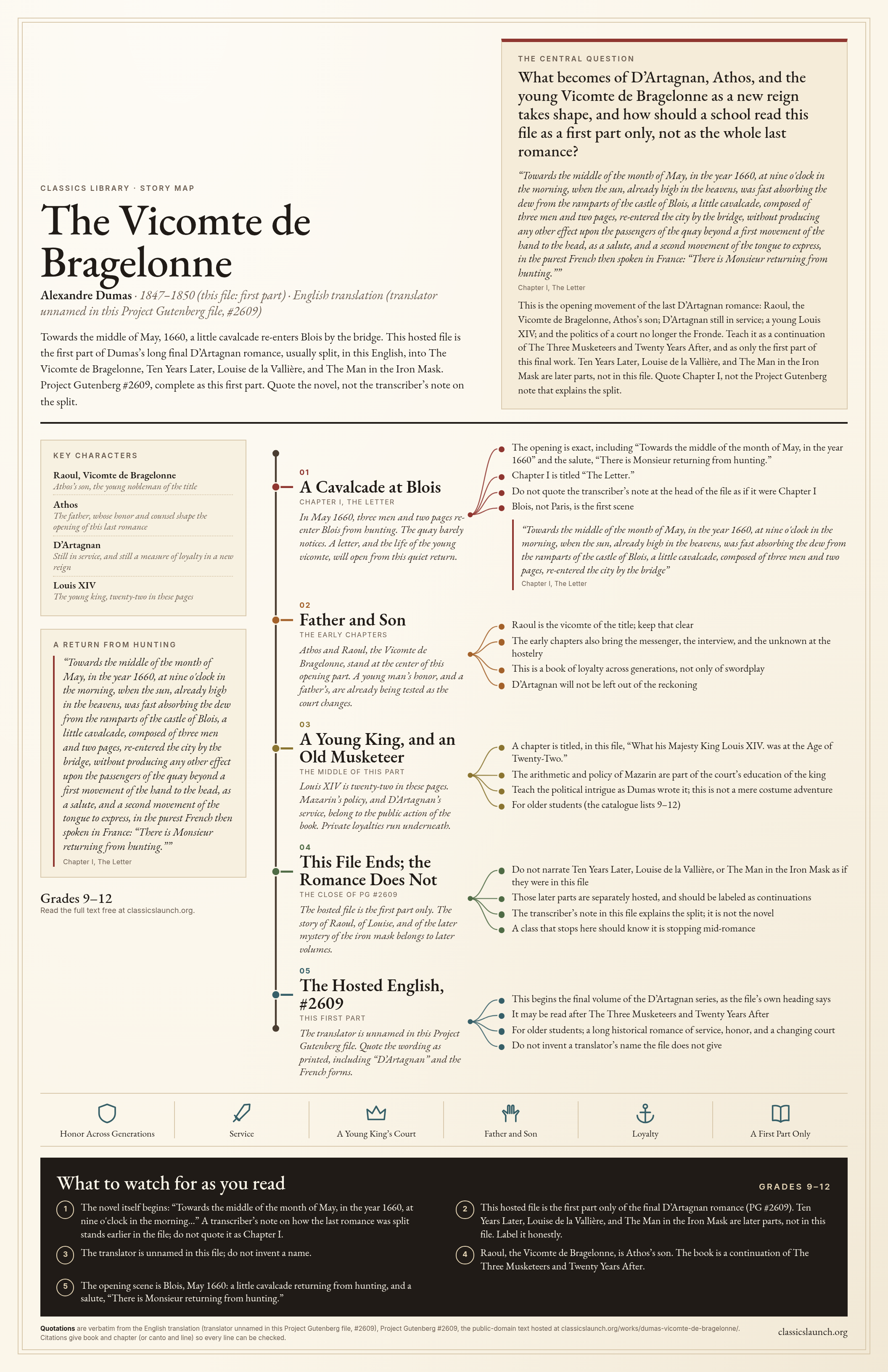
Towards the middle of May, 1660, a little cavalcade re-enters Blois by the bridge. This hosted file is the first part of Dumas’s long final D’Artagnan romance, usually split, in this English, into The Vicomte de Bragelonne, Ten Years Later, Louise de la Vallière, and The Man in the Iron Mask. Project Gutenberg #2609, complete as this first part. Quote the novel, not the transcriber’s note on the split.
The central question
What becomes of D’Artagnan, Athos, and the young Vicomte de Bragelonne as a new reign takes shape, and how should a school read this file as a first part only, not as the whole last romance?
“Towards the middle of the month of May, in the year 1660, at nine o'clock in the morning, when the sun, already high in the heavens, was fast absorbing the dew from the ramparts of the castle of Blois, a little cavalcade, composed of three men and two pages, re-entered the city by the bridge, without producing any other effect upon the passengers of the quay beyond a first movement of the hand to the head, as a salute, and a second movement of the tongue to express, in the purest French then spoken in France: “There is Monsieur returning from hunting.””
This is the opening movement of the last D’Artagnan romance: Raoul, the Vicomte de Bragelonne, Athos’s son; D’Artagnan still in service; a young Louis XIV; and the politics of a court no longer the Fronde. Teach it as a continuation of The Three Musketeers and Twenty Years After, and as only the first part of this final work. Ten Years Later, Louise de la Vallière, and The Man in the Iron Mask are later parts, not in this file. Quote Chapter I, not the Project Gutenberg note that explains the split.
- 01
A Cavalcade at Blois
Chapter I, The Letter
In May 1660, three men and two pages re-enter Blois from hunting. The quay barely notices. A letter, and the life of the young vicomte, will open from this quiet return.
- The opening is exact, including “Towards the middle of the month of May, in the year 1660” and the salute, “There is Monsieur returning from hunting.”
- Chapter I is titled “The Letter.”
- Do not quote the transcriber’s note at the head of the file as if it were Chapter I
- Blois, not Paris, is the first scene
“Towards the middle of the month of May, in the year 1660, at nine o'clock in the morning, when the sun, already high in the heavens, was fast absorbing the dew from the ramparts of the castle of Blois, a little cavalcade, composed of three men and two pages, re-entered the city by the bridge”
- 02
Father and Son
The early chapters
Athos and Raoul, the Vicomte de Bragelonne, stand at the center of this opening part. A young man’s honor, and a father’s, are already being tested as the court changes.
- Raoul is the vicomte of the title; keep that clear
- The early chapters also bring the messenger, the interview, and the unknown at the hostelry
- This is a book of loyalty across generations, not only of swordplay
- D’Artagnan will not be left out of the reckoning
- 03
A Young King, and an Old Musketeer
The middle of this part
Louis XIV is twenty-two in these pages. Mazarin’s policy, and D’Artagnan’s service, belong to the public action of the book. Private loyalties run underneath.
- A chapter is titled, in this file, “What his Majesty King Louis XIV. was at the Age of Twenty-Two.”
- The arithmetic and policy of Mazarin are part of the court’s education of the king
- Teach the political intrigue as Dumas wrote it; this is not a mere costume adventure
- For older students (the catalogue lists 9–12)
- 04
This File Ends; the Romance Does Not
The close of PG #2609
The hosted file is the first part only. The story of Raoul, of Louise, and of the later mystery of the iron mask belongs to later volumes.
- Do not narrate Ten Years Later, Louise de la Vallière, or The Man in the Iron Mask as if they were in this file
- Those later parts are separately hosted, and should be labeled as continuations
- The transcriber’s note in this file explains the split; it is not the novel
- A class that stops here should know it is stopping mid-romance
- 05
The Hosted English, #2609
This first part
The translator is unnamed in this Project Gutenberg file. Quote the wording as printed, including “D’Artagnan” and the French forms.
- This begins the final volume of the D’Artagnan series, as the file’s own heading says
- It may be read after The Three Musketeers and Twenty Years After
- For older students; a long historical romance of service, honor, and a changing court
- Do not invent a translator’s name the file does not give
- Honor Across Generations
- Service
- A Young King’s Court
- Father and Son
- Loyalty
- A First Part Only
What to watch for as you read
Grades 9–12- The novel itself begins: “Towards the middle of the month of May, in the year 1660, at nine o'clock in the morning…” A transcriber’s note on how the last romance was split stands earlier in the file; do not quote it as Chapter I.
- This hosted file is the first part only of the final D’Artagnan romance (PG #2609). Ten Years Later, Louise de la Vallière, and The Man in the Iron Mask are later parts, not in this file. Label it honestly.
- The translator is unnamed in this file; do not invent a name.
- Raoul, the Vicomte de Bragelonne, is Athos’s son. The book is a continuation of The Three Musketeers and Twenty Years After.
- The opening scene is Blois, May 1660: a little cavalcade returning from hunting, and a salute, “There is Monsieur returning from hunting.”
Every quotation is word for word from the English translation (translator unnamed in this Project Gutenberg file, #2609) hosted in this library and is checked against that text each time the site is built. Citations give book and chapter (or canto and line).