Story maps · Grades 9–12
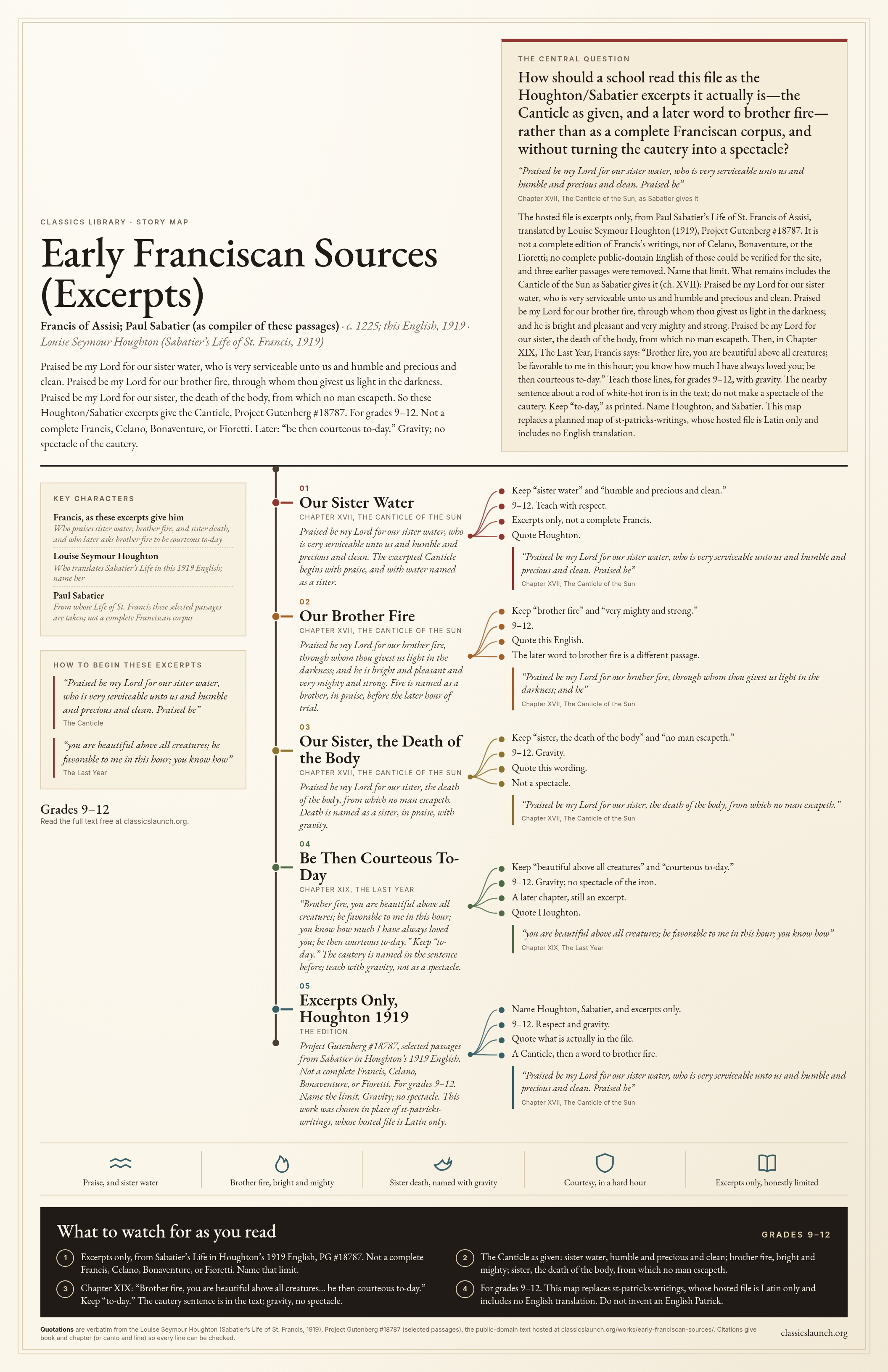
Early Franciscan Sources (Excerpts): A Story Map
The PDF is one tabloid page (11 × 17 in). On letter paper, choose “Fit to page.”
Praised be my Lord for our sister water, who is very serviceable unto us and humble and precious and clean. Praised be my Lord for our brother fire, through whom thou givest us light in the darkness. Praised be my Lord for our sister, the death of the body, from which no man escapeth. So these Houghton/Sabatier excerpts give the Canticle, Project Gutenberg #18787. For grades 9–12. Not a complete Francis, Celano, Bonaventure, or Fioretti. Later: “be then courteous to-day.” Gravity; no spectacle of the cautery.
The central question
How should a school read this file as the Houghton/Sabatier excerpts it actually is—the Canticle as given, and a later word to brother fire—rather than as a complete Franciscan corpus, and without turning the cautery into a spectacle?
“Praised be my Lord for our sister water, who is very serviceable unto us and humble and precious and clean. Praised be”
The hosted file is excerpts only, from Paul Sabatier’s Life of St. Francis of Assisi, translated by Louise Seymour Houghton (1919), Project Gutenberg #18787. It is not a complete edition of Francis’s writings, nor of Celano, Bonaventure, or the Fioretti; no complete public-domain English of those could be verified for the site, and three earlier passages were removed. Name that limit. What remains includes the Canticle of the Sun as Sabatier gives it (ch. XVII): Praised be my Lord for our sister water, who is very serviceable unto us and humble and precious and clean. Praised be my Lord for our brother fire, through whom thou givest us light in the darkness; and he is bright and pleasant and very mighty and strong. Praised be my Lord for our sister, the death of the body, from which no man escapeth. Then, in Chapter XIX, The Last Year, Francis says: “Brother fire, you are beautiful above all creatures; be favorable to me in this hour; you know how much I have always loved you; be then courteous to-day.” Teach those lines, for grades 9–12, with gravity. The nearby sentence about a rod of white-hot iron is in the text; do not make a spectacle of the cautery. Keep “to-day,” as printed. Name Houghton, and Sabatier. This map replaces a planned map of st-patricks-writings, whose hosted file is Latin only and includes no English translation.
- 01
Our Sister Water
Chapter XVII, The Canticle of the Sun
Praised be my Lord for our sister water, who is very serviceable unto us and humble and precious and clean. The excerpted Canticle begins with praise, and with water named as a sister.
- Keep “sister water” and “humble and precious and clean.”
- 9–12. Teach with respect.
- Excerpts only, not a complete Francis.
- Quote Houghton.
“Praised be my Lord for our sister water, who is very serviceable unto us and humble and precious and clean. Praised be”
- 02
Our Brother Fire
Chapter XVII, The Canticle of the Sun
Praised be my Lord for our brother fire, through whom thou givest us light in the darkness; and he is bright and pleasant and very mighty and strong. Fire is named as a brother, in praise, before the later hour of trial.
- Keep “brother fire” and “very mighty and strong.”
- 9–12.
- Quote this English.
- The later word to brother fire is a different passage.
“Praised be my Lord for our brother fire, through whom thou givest us light in the darkness; and he”
- 03
Our Sister, the Death of the Body
Chapter XVII, The Canticle of the Sun
Praised be my Lord for our sister, the death of the body, from which no man escapeth. Death is named as a sister, in praise, with gravity.
- Keep “sister, the death of the body” and “no man escapeth.”
- 9–12. Gravity.
- Quote this wording.
- Not a spectacle.
“Praised be my Lord for our sister, the death of the body, from which no man escapeth.”
- 04
Be Then Courteous To-Day
Chapter XIX, The Last Year
“Brother fire, you are beautiful above all creatures; be favorable to me in this hour; you know how much I have always loved you; be then courteous to-day.” Keep “to-day.” The cautery is named in the sentence before; teach with gravity, not as a spectacle.
- Keep “beautiful above all creatures” and “courteous to-day.”
- 9–12. Gravity; no spectacle of the iron.
- A later chapter, still an excerpt.
- Quote Houghton.
“you are beautiful above all creatures; be favorable to me in this hour; you know how”
- 05
Excerpts Only, Houghton 1919
The edition
Project Gutenberg #18787, selected passages from Sabatier in Houghton’s 1919 English. Not a complete Francis, Celano, Bonaventure, or Fioretti. For grades 9–12. Name the limit. Gravity; no spectacle. This work was chosen in place of st-patricks-writings, whose hosted file is Latin only.
- Name Houghton, Sabatier, and excerpts only.
- 9–12. Respect and gravity.
- Quote what is actually in the file.
- A Canticle, then a word to brother fire.
“Praised be my Lord for our sister water, who is very serviceable unto us and humble and precious and clean. Praised be”
- Praise, and sister water
- Brother fire, bright and mighty
- Sister death, named with gravity
- Courtesy, in a hard hour
- Excerpts only, honestly limited
What to watch for as you read
Grades 9–12- Excerpts only, from Sabatier’s Life in Houghton’s 1919 English, PG #18787. Not a complete Francis, Celano, Bonaventure, or Fioretti. Name that limit.
- The Canticle as given: sister water, humble and precious and clean; brother fire, bright and mighty; sister, the death of the body, from which no man escapeth.
- Chapter XIX: “Brother fire, you are beautiful above all creatures… be then courteous to-day.” Keep “to-day.” The cautery sentence is in the text; gravity, no spectacle.
- For grades 9–12. This map replaces st-patricks-writings, whose hosted file is Latin only and includes no English translation. Do not invent an English Patrick.
Every quotation is word for word from the Louise Seymour Houghton (Sabatier’s Life of St. Francis, 1919) hosted in this library and is checked against that text each time the site is built. Citations give book and chapter (or canto and line).