Story maps · Grades 9–12
The Early Kings of Norway: A Story Map
The PDF is one tabloid page (11 × 17 in). On letter paper, choose “Fit to page.”
Till about the Year of Grace 860 there were no kings in Norway, nothing but numerous jarls,—essentially kinglets, each presiding over a kind of republican or parliamentary little territory. So Carlyle begins, with Harald Haarfagr. For grades 9–12. Quote the history, not only a later list of kings. This is a short Carlyle, not the huge Frederick already in this wave.
The central question
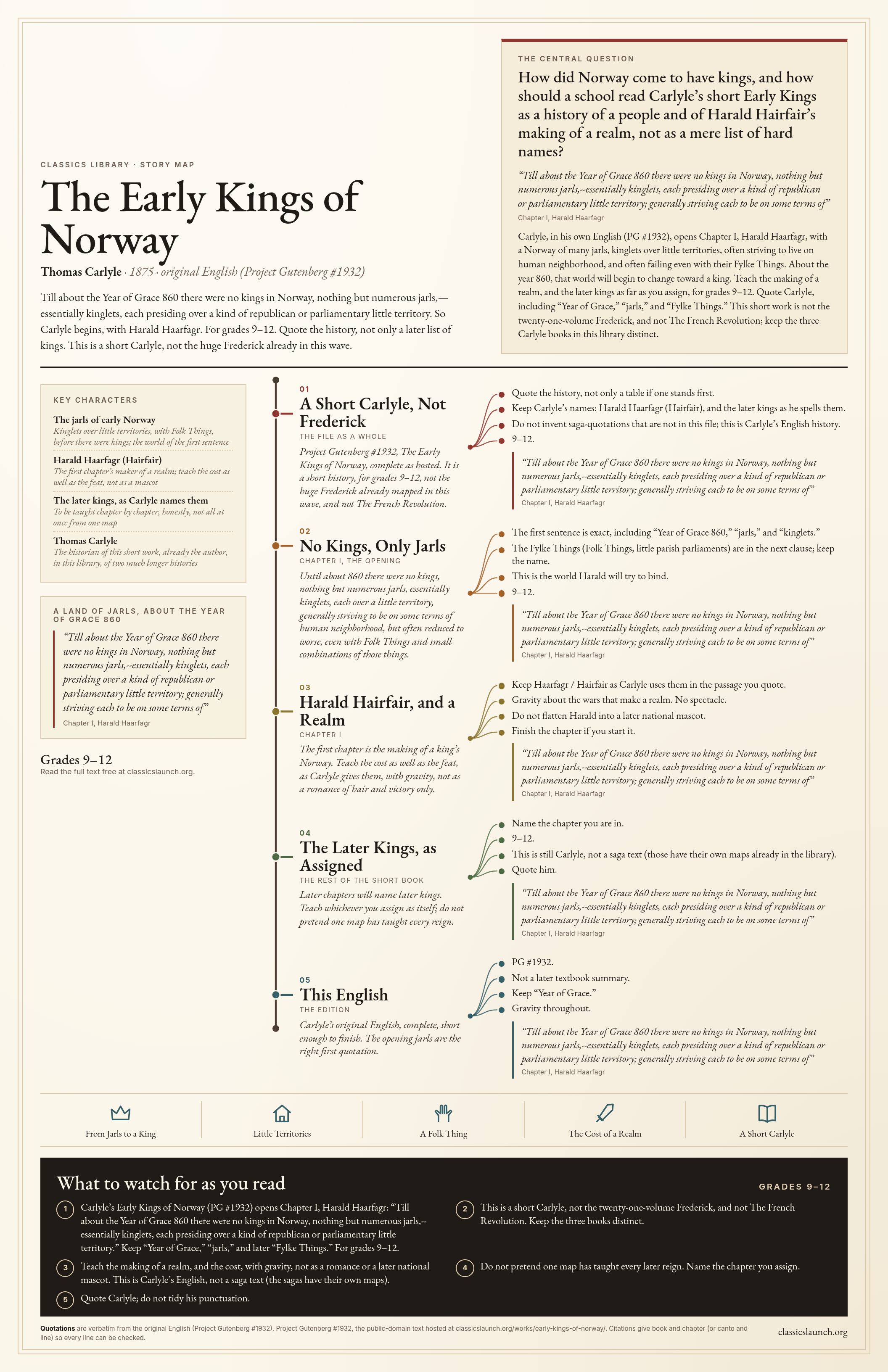
How did Norway come to have kings, and how should a school read Carlyle’s short Early Kings as a history of a people and of Harald Hairfair’s making of a realm, not as a mere list of hard names?
“Till about the Year of Grace 860 there were no kings in Norway, nothing but numerous jarls,--essentially kinglets, each presiding over a kind of republican or parliamentary little territory; generally striving each to be on some terms of”
Carlyle, in his own English (PG #1932), opens Chapter I, Harald Haarfagr, with a Norway of many jarls, kinglets over little territories, often striving to live on human neighborhood, and often failing even with their Fylke Things. About the year 860, that world will begin to change toward a king. Teach the making of a realm, and the later kings as far as you assign, for grades 9–12. Quote Carlyle, including “Year of Grace,” “jarls,” and “Fylke Things.” This short work is not the twenty-one-volume Frederick, and not The French Revolution; keep the three Carlyle books in this library distinct.
- 01
A Short Carlyle, Not Frederick
The file as a whole
Project Gutenberg #1932, The Early Kings of Norway, complete as hosted. It is a short history, for grades 9–12, not the huge Frederick already mapped in this wave, and not The French Revolution.
- Quote the history, not only a table if one stands first.
- Keep Carlyle’s names: Harald Haarfagr (Hairfair), and the later kings as he spells them.
- Do not invent saga-quotations that are not in this file; this is Carlyle’s English history.
- 9–12.
“Till about the Year of Grace 860 there were no kings in Norway, nothing but numerous jarls,--essentially kinglets, each presiding over a kind of republican or parliamentary little territory; generally striving each to be on some terms of”
- 02
No Kings, Only Jarls
Chapter I, the opening
Until about 860 there were no kings, nothing but numerous jarls, essentially kinglets, each over a little territory, generally striving to be on some terms of human neighborhood, but often reduced to worse, even with Folk Things and small combinations of those things.
- The first sentence is exact, including “Year of Grace 860,” “jarls,” and “kinglets.”
- The Fylke Things (Folk Things, little parish parliaments) are in the next clause; keep the name.
- This is the world Harald will try to bind.
- 9–12.
“Till about the Year of Grace 860 there were no kings in Norway, nothing but numerous jarls,--essentially kinglets, each presiding over a kind of republican or parliamentary little territory; generally striving each to be on some terms of”
- 03
Harald Hairfair, and a Realm
Chapter I
The first chapter is the making of a king’s Norway. Teach the cost as well as the feat, as Carlyle gives them, with gravity, not as a romance of hair and victory only.
- Keep Haarfagr / Hairfair as Carlyle uses them in the passage you quote.
- Gravity about the wars that make a realm. No spectacle.
- Do not flatten Harald into a later national mascot.
- Finish the chapter if you start it.
“Till about the Year of Grace 860 there were no kings in Norway, nothing but numerous jarls,--essentially kinglets, each presiding over a kind of republican or parliamentary little territory; generally striving each to be on some terms of”
- 04
The Later Kings, as Assigned
The rest of the short book
Later chapters will name later kings. Teach whichever you assign as itself; do not pretend one map has taught every reign.
- Name the chapter you are in.
- 9–12.
- This is still Carlyle, not a saga text (those have their own maps already in the library).
- Quote him.
“Till about the Year of Grace 860 there were no kings in Norway, nothing but numerous jarls,--essentially kinglets, each presiding over a kind of republican or parliamentary little territory; generally striving each to be on some terms of”
- 05
This English
The edition
Carlyle’s original English, complete, short enough to finish. The opening jarls are the right first quotation.
- PG #1932.
- Not a later textbook summary.
- Keep “Year of Grace.”
- Gravity throughout.
“Till about the Year of Grace 860 there were no kings in Norway, nothing but numerous jarls,--essentially kinglets, each presiding over a kind of republican or parliamentary little territory; generally striving each to be on some terms of”
- From Jarls to a King
- Little Territories
- A Folk Thing
- The Cost of a Realm
- A Short Carlyle
What to watch for as you read
Grades 9–12- Carlyle’s Early Kings of Norway (PG #1932) opens Chapter I, Harald Haarfagr: “Till about the Year of Grace 860 there were no kings in Norway, nothing but numerous jarls,--essentially kinglets, each presiding over a kind of republican or parliamentary little territory.” Keep “Year of Grace,” “jarls,” and later “Fylke Things.” For grades 9–12.
- This is a short Carlyle, not the twenty-one-volume Frederick, and not The French Revolution. Keep the three books distinct.
- Teach the making of a realm, and the cost, with gravity, not as a romance or a later national mascot. This is Carlyle’s English, not a saga text (the sagas have their own maps).
- Do not pretend one map has taught every later reign. Name the chapter you assign.
- Quote Carlyle; do not tidy his punctuation.
Every quotation is word for word from the original English (Project Gutenberg #1932) hosted in this library and is checked against that text each time the site is built. Citations give book and chapter (or canto and line).