Story maps · Grades Adult/Advanced
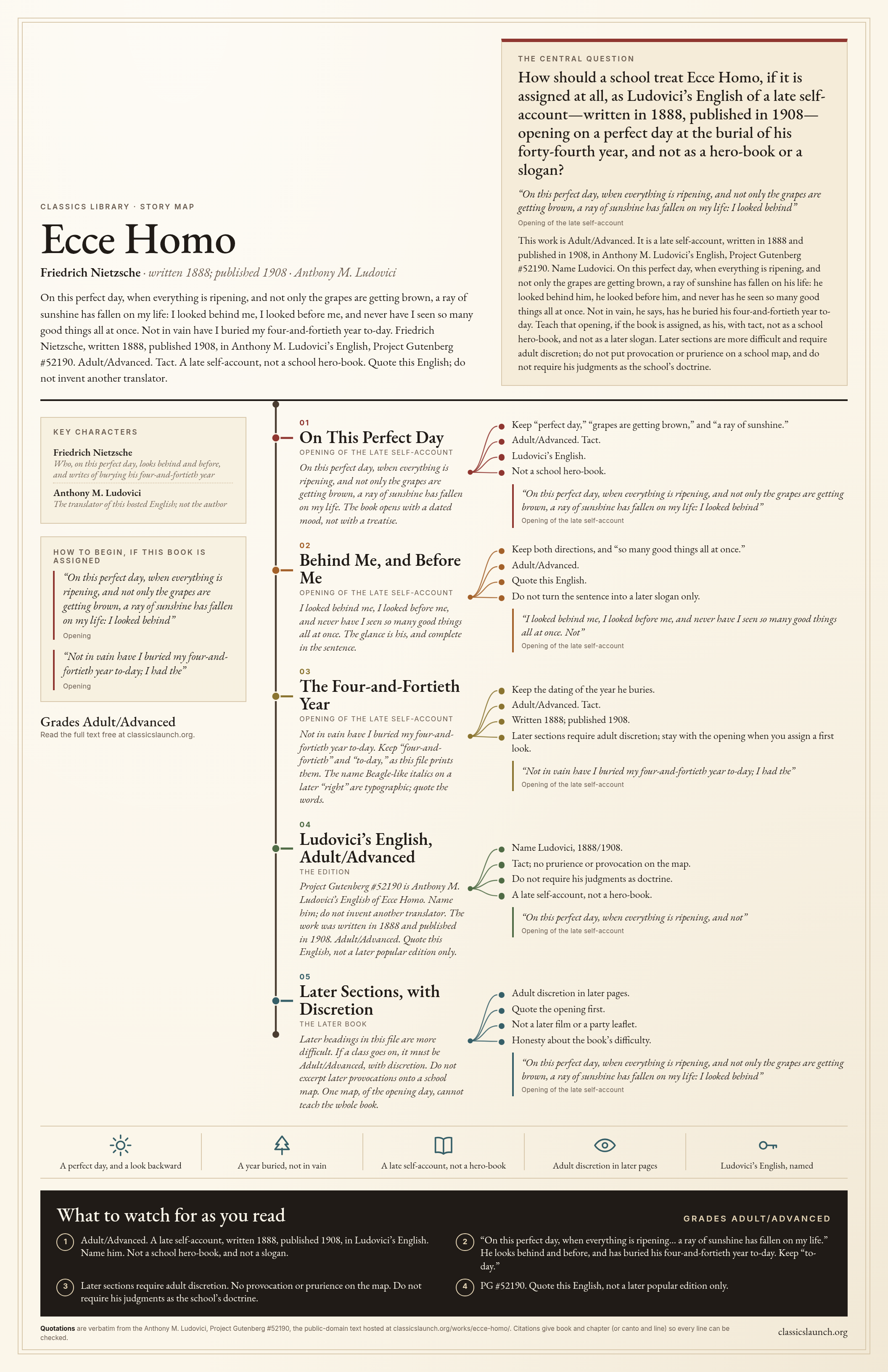
Ecce Homo: A Story Map
The PDF is one tabloid page (11 × 17 in). On letter paper, choose “Fit to page.”
On this perfect day, when everything is ripening, and not only the grapes are getting brown, a ray of sunshine has fallen on my life: I looked behind me, I looked before me, and never have I seen so many good things all at once. Not in vain have I buried my four-and-fortieth year to-day. Friedrich Nietzsche, written 1888, published 1908, in Anthony M. Ludovici’s English, Project Gutenberg #52190. Adult/Advanced. Tact. A late self-account, not a school hero-book. Quote this English; do not invent another translator.
The central question
How should a school treat Ecce Homo, if it is assigned at all, as Ludovici’s English of a late self-account—written in 1888, published in 1908—opening on a perfect day at the burial of his forty-fourth year, and not as a hero-book or a slogan?
“On this perfect day, when everything is ripening, and not only the grapes are getting brown, a ray of sunshine has fallen on my life: I looked behind”
This work is Adult/Advanced. It is a late self-account, written in 1888 and published in 1908, in Anthony M. Ludovici’s English, Project Gutenberg #52190. Name Ludovici. On this perfect day, when everything is ripening, and not only the grapes are getting brown, a ray of sunshine has fallen on his life: he looked behind him, he looked before him, and never has he seen so many good things all at once. Not in vain, he says, has he buried his four-and-fortieth year to-day. Teach that opening, if the book is assigned, as his, with tact, not as a school hero-book, and not as a later slogan. Later sections are more difficult and require adult discretion; do not put provocation or prurience on a school map, and do not require his judgments as the school’s doctrine.
- 01
On This Perfect Day
Opening of the late self-account
On this perfect day, when everything is ripening, and not only the grapes are getting brown, a ray of sunshine has fallen on my life. The book opens with a dated mood, not with a treatise.
- Keep “perfect day,” “grapes are getting brown,” and “a ray of sunshine.”
- Adult/Advanced. Tact.
- Ludovici’s English.
- Not a school hero-book.
“On this perfect day, when everything is ripening, and not only the grapes are getting brown, a ray of sunshine has fallen on my life: I looked behind”
- 02
Behind Me, and Before Me
Opening of the late self-account
I looked behind me, I looked before me, and never have I seen so many good things all at once. The glance is his, and complete in the sentence.
- Keep both directions, and “so many good things all at once.”
- Adult/Advanced.
- Quote this English.
- Do not turn the sentence into a later slogan only.
“I looked behind me, I looked before me, and never have I seen so many good things all at once. Not”
- 03
The Four-and-Fortieth Year
Opening of the late self-account
Not in vain have I buried my four-and-fortieth year to-day. Keep “four-and-fortieth” and “to-day,” as this file prints them. The name Beagle-like italics on a later “right” are typographic; quote the words.
- Keep the dating of the year he buries.
- Adult/Advanced. Tact.
- Written 1888; published 1908.
- Later sections require adult discretion; stay with the opening when you assign a first look.
“Not in vain have I buried my four-and-fortieth year to-day; I had the”
- 04
Ludovici’s English, Adult/Advanced
The edition
Project Gutenberg #52190 is Anthony M. Ludovici’s English of Ecce Homo. Name him; do not invent another translator. The work was written in 1888 and published in 1908. Adult/Advanced. Quote this English, not a later popular edition only.
- Name Ludovici, 1888/1908.
- Tact; no prurience or provocation on the map.
- Do not require his judgments as doctrine.
- A late self-account, not a hero-book.
“On this perfect day, when everything is ripening, and not”
- 05
Later Sections, with Discretion
The later book
Later headings in this file are more difficult. If a class goes on, it must be Adult/Advanced, with discretion. Do not excerpt later provocations onto a school map. One map, of the opening day, cannot teach the whole book.
- Adult discretion in later pages.
- Quote the opening first.
- Not a later film or a party leaflet.
- Honesty about the book’s difficulty.
“On this perfect day, when everything is ripening, and not only the grapes are getting brown, a ray of sunshine has fallen on my life: I looked behind”
- A perfect day, and a look backward
- A year buried, not in vain
- A late self-account, not a hero-book
- Adult discretion in later pages
- Ludovici’s English, named
What to watch for as you read
Grades Adult/Advanced- Adult/Advanced. A late self-account, written 1888, published 1908, in Ludovici’s English. Name him. Not a school hero-book, and not a slogan.
- “On this perfect day, when everything is ripening… a ray of sunshine has fallen on my life.” He looks behind and before, and has buried his four-and-fortieth year to-day. Keep “to-day.”
- Later sections require adult discretion. No provocation or prurience on the map. Do not require his judgments as the school’s doctrine.
- PG #52190. Quote this English, not a later popular edition only.
Every quotation is word for word from the Anthony M. Ludovici hosted in this library and is checked against that text each time the site is built. Citations give book and chapter (or canto and line).