Story maps · Grades 11–12
Effi Briest: A Story Map
The PDF is one tabloid page (11 × 17 in). On letter paper, choose “Fit to page.”
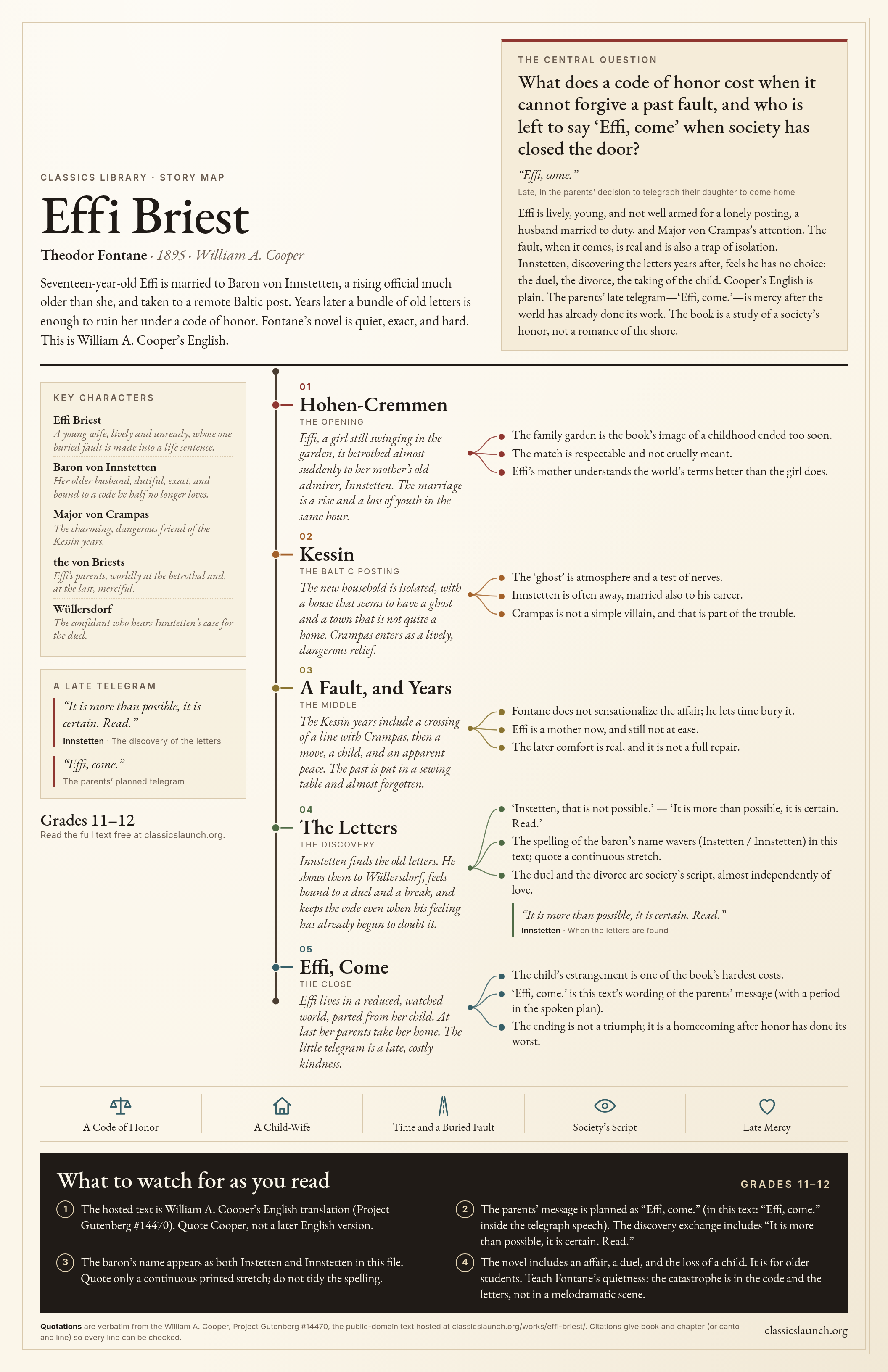
Seventeen-year-old Effi is married to Baron von Innstetten, a rising official much older than she, and taken to a remote Baltic post. Years later a bundle of old letters is enough to ruin her under a code of honor. Fontane’s novel is quiet, exact, and hard. This is William A. Cooper’s English.
The central question
What does a code of honor cost when it cannot forgive a past fault, and who is left to say ‘Effi, come’ when society has closed the door?
“Effi, come.”
Effi is lively, young, and not well armed for a lonely posting, a husband married to duty, and Major von Crampas’s attention. The fault, when it comes, is real and is also a trap of isolation. Innstetten, discovering the letters years after, feels he has no choice: the duel, the divorce, the taking of the child. Cooper’s English is plain. The parents’ late telegram—‘Effi, come.’—is mercy after the world has already done its work. The book is a study of a society’s honor, not a romance of the shore.
- 01
Hohen-Cremmen
The opening
Effi, a girl still swinging in the garden, is betrothed almost suddenly to her mother’s old admirer, Innstetten. The marriage is a rise and a loss of youth in the same hour.
- The family garden is the book’s image of a childhood ended too soon.
- The match is respectable and not cruelly meant.
- Effi’s mother understands the world’s terms better than the girl does.
- 02
Kessin
The Baltic posting
The new household is isolated, with a house that seems to have a ghost and a town that is not quite a home. Crampas enters as a lively, dangerous relief.
- The ‘ghost’ is atmosphere and a test of nerves.
- Innstetten is often away, married also to his career.
- Crampas is not a simple villain, and that is part of the trouble.
- 03
A Fault, and Years
The middle
The Kessin years include a crossing of a line with Crampas, then a move, a child, and an apparent peace. The past is put in a sewing table and almost forgotten.
- Fontane does not sensationalize the affair; he lets time bury it.
- Effi is a mother now, and still not at ease.
- The later comfort is real, and it is not a full repair.
- 04
The Letters
The discovery
Innstetten finds the old letters. He shows them to Wüllersdorf, feels bound to a duel and a break, and keeps the code even when his feeling has already begun to doubt it.
- ‘Instetten, that is not possible.’ — ‘It is more than possible, it is certain. Read.’
- The spelling of the baron’s name wavers (Instetten / Innstetten) in this text; quote a continuous stretch.
- The duel and the divorce are society’s script, almost independently of love.
“It is more than possible, it is certain. Read.”
- 05
Effi, Come
The close
Effi lives in a reduced, watched world, parted from her child. At last her parents take her home. The little telegram is a late, costly kindness.
- The child’s estrangement is one of the book’s hardest costs.
- ‘Effi, come.’ is this text’s wording of the parents’ message (with a period in the spoken plan).
- The ending is not a triumph; it is a homecoming after honor has done its worst.
- A Code of Honor
- A Child-Wife
- Time and a Buried Fault
- Society’s Script
- Late Mercy
What to watch for as you read
Grades 11–12- The hosted text is William A. Cooper’s English translation (Project Gutenberg #14470). Quote Cooper, not a later English version.
- The parents’ message is planned as “Effi, come.” (in this text: “Effi, come.” inside the telegraph speech). The discovery exchange includes “It is more than possible, it is certain. Read.”
- The baron’s name appears as both Instetten and Innstetten in this file. Quote only a continuous printed stretch; do not tidy the spelling.
- The novel includes an affair, a duel, and the loss of a child. It is for older students. Teach Fontane’s quietness: the catastrophe is in the code and the letters, not in a melodramatic scene.
Every quotation is word for word from the William A. Cooper hosted in this library and is checked against that text each time the site is built. Citations give book and chapter (or canto and line).