Story maps · Grades 11–12
The Praise of Folly: A Story Map
The PDF is one tabloid page (11 × 17 in). On letter paper, choose “Fit to page.”
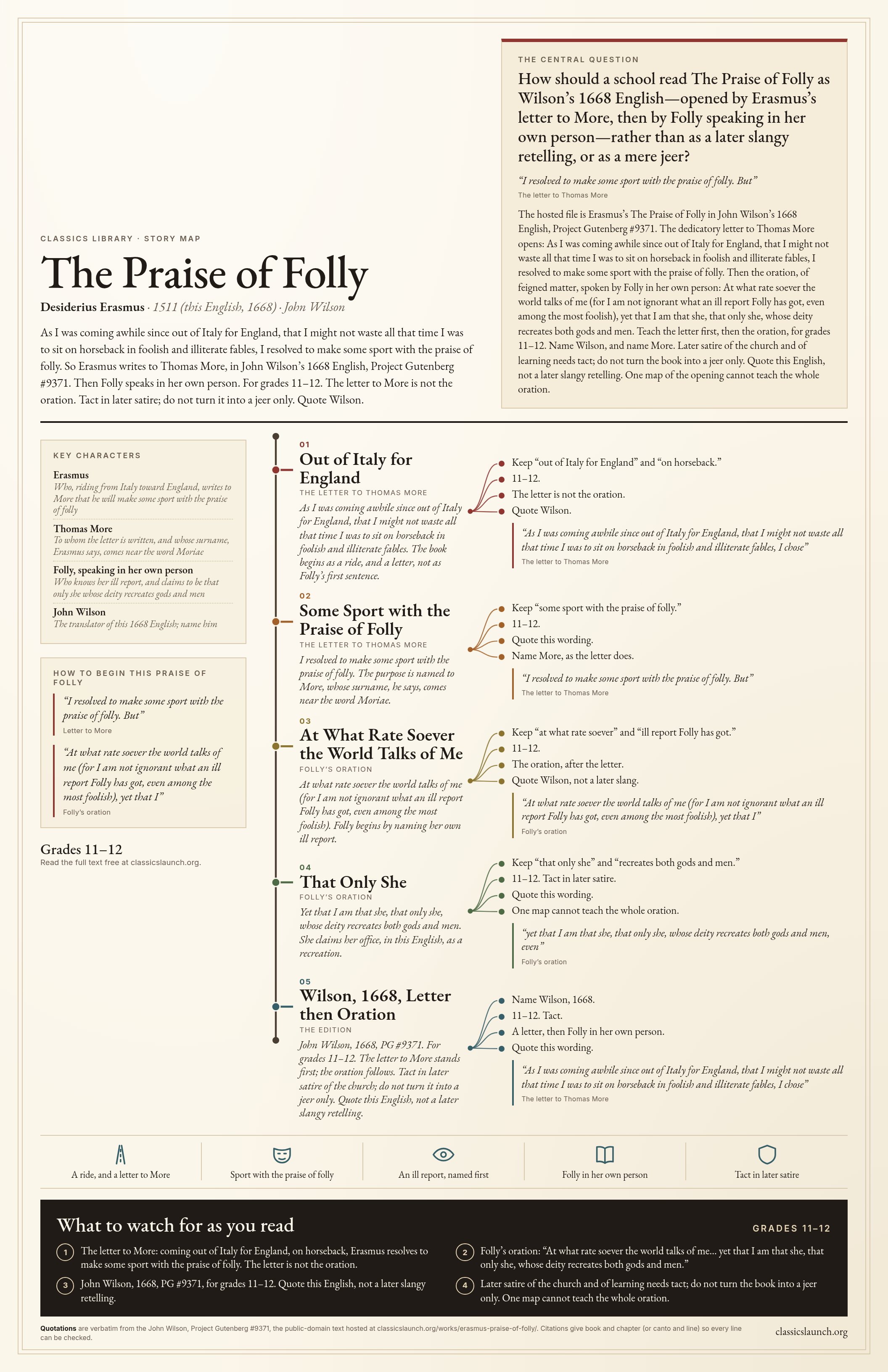
As I was coming awhile since out of Italy for England, that I might not waste all that time I was to sit on horseback in foolish and illiterate fables, I resolved to make some sport with the praise of folly. So Erasmus writes to Thomas More, in John Wilson’s 1668 English, Project Gutenberg #9371. Then Folly speaks in her own person. For grades 11–12. The letter to More is not the oration. Tact in later satire; do not turn it into a jeer only. Quote Wilson.
The central question
How should a school read The Praise of Folly as Wilson’s 1668 English—opened by Erasmus’s letter to More, then by Folly speaking in her own person—rather than as a later slangy retelling, or as a mere jeer?
“I resolved to make some sport with the praise of folly. But”
The hosted file is Erasmus’s The Praise of Folly in John Wilson’s 1668 English, Project Gutenberg #9371. The dedicatory letter to Thomas More opens: As I was coming awhile since out of Italy for England, that I might not waste all that time I was to sit on horseback in foolish and illiterate fables, I resolved to make some sport with the praise of folly. Then the oration, of feigned matter, spoken by Folly in her own person: At what rate soever the world talks of me (for I am not ignorant what an ill report Folly has got, even among the most foolish), yet that I am that she, that only she, whose deity recreates both gods and men. Teach the letter first, then the oration, for grades 11–12. Name Wilson, and name More. Later satire of the church and of learning needs tact; do not turn the book into a jeer only. Quote this English, not a later slangy retelling. One map of the opening cannot teach the whole oration.
- 01
Out of Italy for England
The letter to Thomas More
As I was coming awhile since out of Italy for England, that I might not waste all that time I was to sit on horseback in foolish and illiterate fables. The book begins as a ride, and a letter, not as Folly’s first sentence.
- Keep “out of Italy for England” and “on horseback.”
- 11–12.
- The letter is not the oration.
- Quote Wilson.
“As I was coming awhile since out of Italy for England, that I might not waste all that time I was to sit on horseback in foolish and illiterate fables, I chose”
- 02
Some Sport with the Praise of Folly
The letter to Thomas More
I resolved to make some sport with the praise of folly. The purpose is named to More, whose surname, he says, comes near the word Moriae.
- Keep “some sport with the praise of folly.”
- 11–12.
- Quote this wording.
- Name More, as the letter does.
“I resolved to make some sport with the praise of folly. But”
- 03
At What Rate Soever the World Talks of Me
Folly’s oration
At what rate soever the world talks of me (for I am not ignorant what an ill report Folly has got, even among the most foolish). Folly begins by naming her own ill report.
- Keep “at what rate soever” and “ill report Folly has got.”
- 11–12.
- The oration, after the letter.
- Quote Wilson, not a later slang.
“At what rate soever the world talks of me (for I am not ignorant what an ill report Folly has got, even among the most foolish), yet that I”
- 04
That Only She
Folly’s oration
Yet that I am that she, that only she, whose deity recreates both gods and men. She claims her office, in this English, as a recreation.
- Keep “that only she” and “recreates both gods and men.”
- 11–12. Tact in later satire.
- Quote this wording.
- One map cannot teach the whole oration.
“yet that I am that she, that only she, whose deity recreates both gods and men, even”
- 05
Wilson, 1668, Letter then Oration
The edition
John Wilson, 1668, PG #9371. For grades 11–12. The letter to More stands first; the oration follows. Tact in later satire of the church; do not turn it into a jeer only. Quote this English, not a later slangy retelling.
- Name Wilson, 1668.
- 11–12. Tact.
- A letter, then Folly in her own person.
- Quote this wording.
“As I was coming awhile since out of Italy for England, that I might not waste all that time I was to sit on horseback in foolish and illiterate fables, I chose”
- A ride, and a letter to More
- Sport with the praise of folly
- An ill report, named first
- Folly in her own person
- Tact in later satire
What to watch for as you read
Grades 11–12- The letter to More: coming out of Italy for England, on horseback, Erasmus resolves to make some sport with the praise of folly. The letter is not the oration.
- Folly’s oration: “At what rate soever the world talks of me… yet that I am that she, that only she, whose deity recreates both gods and men.”
- John Wilson, 1668, PG #9371, for grades 11–12. Quote this English, not a later slangy retelling.
- Later satire of the church and of learning needs tact; do not turn the book into a jeer only. One map cannot teach the whole oration.
Every quotation is word for word from the John Wilson hosted in this library and is checked against that text each time the site is built. Citations give book and chapter (or canto and line).